
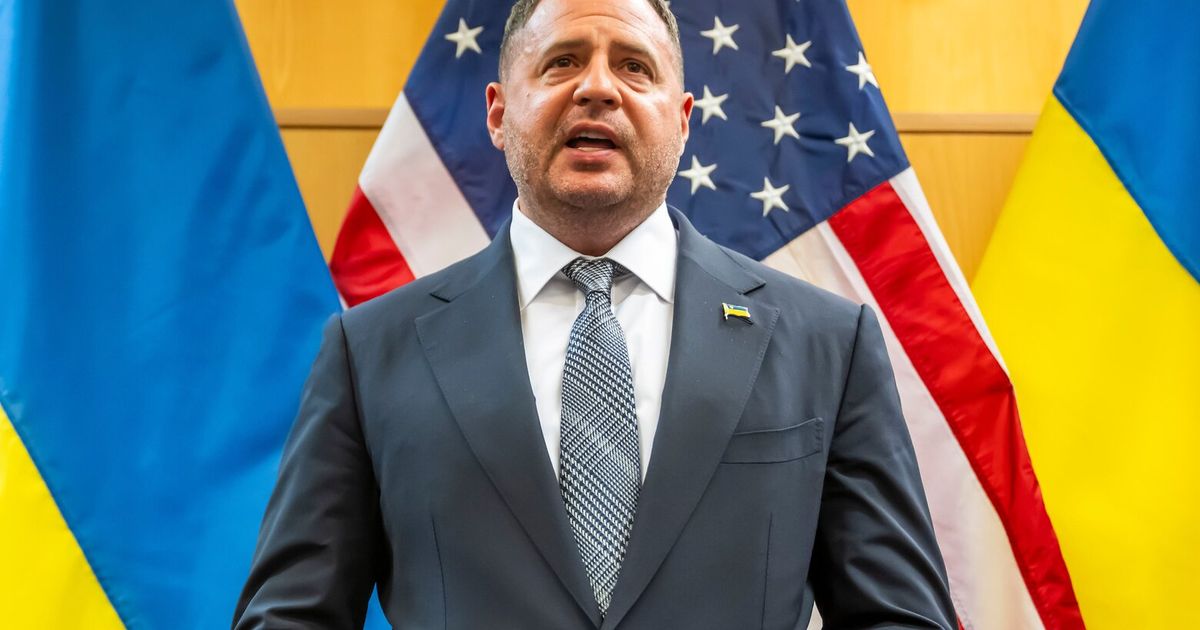
KYIV, Ukraine — President Volodymyr Zelenskyy’s powerful chief of staff, Andriy Yermak, resigned Friday in the highest-level political realignment in Ukraine since Russia’s all-out invasion nearly four years ago.
The departure of Yermak, who had headed Ukraine’s negotiating team in peace talks with the Trump administration, put in doubt the future of the latest round of diplomatic efforts by the United States, Ukraine and European nations to end the war.
It also cost Zelenskyy a longtime close ally who had been a behind-the-scenes operator, a political enforcer and, as Ukraine’s fortunes in the war slumped, a lightning rod for criticism over much of what had gone wrong, including allegations of theft from state companies.
Yermak stepped down amid a spiraling, $100 million embezzlement scandal that has already led to the dismissal of two Cabinet ministers and even threatened to topple Zelenskyy’s entire Cabinet.
“I am grateful to Andriy for always representing Ukraine’s position in the negotiation track exactly as it should be represented,” Zelenskyy said in a video address announcing the resignation. He said he had accepted the resignation to “avoid rumors and speculation” about his chief of staff.
Yermak, 54, is the highest-level official to lose his job in the fallout from the 15-month investigation called Operation Midas, revealed by Ukraine’s top anti-corruption agencies, which said the effort had produced 1,000 hours of wiretaps.
Yermak has not been officially named in the investigation. But Friday, investigators searched his home in Kyiv.
A little over a week ago, the scandal had quickly receded when the Trump administration abruptly put forward a Russia-friendly plan to end the war. Ukraine scrambled to soften provisions that Zelenskyy called grave challenges to his country, in talks led by Yermak.
But just as negotiations are set to resume with a return visit to Kyiv by the U.S. Army secretary, Daniel P. Driscoll, the corruption case has returned to the headlines, ensnaring the very man Zelenskyy had entrusted with protecting Ukraine’s interests.
The dual roles of negotiator and potential criminal suspect had led to calls in parliament and among anti-corruption activists for Yermak’s firing.
Daria Kalenyuk, executive director of the Anticorruption Action Center, a Ukrainian nongovernmental group, said she worried that had Yermak remained involved in the talks, his key motivation would not have been “ensuring a good strategy for Ukrainian people” but instead “how to use negotiations in order to preserve himself.”
Members of the political opposition in Ukraine had accused Zelenskyy and his top aides of using negotiations to divert attention from the domestic scandal and of undermining the talks by including people tainted by the investigation in the delegation. They also pointed out potential conflicts of interest in negotiations over a clause that would have offered amnesty for crimes committed during the war.
Yermak’s departure comes at a delicate moment in the talks, with the United States pushing for a quick resolution but Ukraine and Russia still seemingly far apart. President Vladimir Putin of Russia has insisted that Ukraine cede territory as a condition for any settlement. In an interview with The Atlantic published Thursday, Yermak said that Zelenskyy would not sign any document that involved giving up Ukrainian territory.
Ukrainska Pravda, a leading Ukrainian news outlet, has reported that Driscoll, the American negotiator, raised the corruption case with Zelenskyy at a meeting last week and that Zelensky warned that the talks might collapse if his negotiators were sidelined by the case. Zelenskyy’s office did not respond to questions from The New York Times about the reported exchange.
Zelenskyy, in announcing Yermak’s departure, said his longtime aide had become a “distraction” to the war effort. But the Ukrainian president did not directly address the corruption case, which has alarmed nations that have donated billions of dollars for Ukraine’s defense.
“Russia very much wants Ukraine to make mistakes,” Zelenskyy said. “But there will be no mistakes on our part. Our work continues.”
A second Ukrainian negotiator, Rustem Umerov, the head of the National Security and Defense Council, has been questioned in the corruption investigation but has not been dismissed from the negotiating team.
Investigators released evidence suggesting that Umerov had lobbied for a contractor selling armored vests for soldiers even though the vests had failed quality checks. Umerov denied any wrongdoing.
Investigators in the corruption case say that a group of insiders demanded kickbacks of up to 15% on contracts awarded by the country’s state-owned nuclear-power giant, including for shelters built to protect power plants from Russian missiles and drones.
Some of Zelenskyy’s closest allies have been linked to the scandal, including a former deputy prime minister, a former business partner of Zelenskyy and the former energy minister. Zelenskyy has tried to distance himself, saying anyone engaged in government corruption should be punished.
Earlier this month, an opposition member of parliament, Yaroslav Zheleznyak, who said he helped feed information to anti-corruption investigators, said that Yermak was part of the investigation and called for his ouster.
After the investigation was unveiled, Yermak disappeared from public view for nearly five days, a rare absence for a power broker who had seemed ever-present. He later reemerged when Zelenskyy appointed him to lead Ukraine’s delegation for peace talks in Geneva with U.S. officials.
Opposition politicians had said that Yermak, whose intimidating manner and tendency to micromanage have rubbed many people the wrong way, should be forced out. They had also demanded a vote of no confidence in parliament. Some members of Zelenskyy’s political party, Servant of the People, indicated that they would vote to join the opposition in a no-confidence vote.
The firing came as members of Zelenskyy’s party had broken ranks and signaled that they would not vote in favor of a new budget next week unless Zelenskyy fired Yermak, according to a member of the party who about the internal party rift on the condition of anonymity.
This is the most serious political crisis to face Zelenskyy, once a darling of the West for standing up to President Vladimir Putin of Russia after the invasion in February 2022. At a time when many Western officials expected Ukrainian resistance to collapse in a matter of days, Zelenskyy refused plans by his security services to evacuate him from the capital, instead holing up in a spartan government bunker below the presidential office complex in Kyiv, the capital.
His face ended up on refrigerator magnets, symbols of defiance sold in tourist shops. He was given lengthy standing ovations in front of Congress and the parliaments of Europe, Britain and Canada.
Most of the time, Yermak was there. They had known each other for almost a decade by the time Zelenskyy took office and both worked in film and television — Zelenskyy, the comic actor, and Yermak, the media lawyer and occasional film producer.
At first, the new president named Yermak as a presidential aide who focused on foreign policy issues, playing a central and behind-the-scenes role negotiating over Donald Trump’s request in 2019 that Zelenskyy investigate the business dealings in Ukraine of the son of former President Joe Biden, Hunter Biden. When they became public, these talks led to Trump’s first impeachment in the House.
Zelenskyy relied on him more and more, and in February 2020, Yermak became chief of staff and a towering figure in Ukraine, always by Zelenskyy’s side. He was available when Zelenskyy woke in the morning and late at night, when Zelenskyy gave his daily video address.
In any photograph of Zelenskyy in any world capital, Yermak was the much taller, beefier man in military garb standing nearby or bending down to whisper in the president’s ear. In the political sphere in Kyiv, Yermak became a feared hatchet man known for removing any government official who spoke out of turn or became too popular, a potential rival to him or to Zelenskyy.
Even in 2021, a year before Russia’s full-scale invasion, The Kyiv Post, an English-language newspaper in the Ukrainian capital, described Yermak as having “a somewhat sinister reputation in the media as a power-greedy and Machiavellian politician.”
He took the arrows for Zelenskyy, absorbing criticism over what was happening in the war or in Washington. Some said that he was the power behind the throne, a kind of puppeteer pulling Zelenskyy’s strings. Others, including Zelenskyy himself, said he was executing Zelenskyy’s wishes.
“I respect him for his results; he does what I tell him,” Zelenskyy said in response to a question about Yermak’s powerful role from a Bloomberg reporter in July 2024. Attacks against his chief of staff, Zelenskyy added, were actually against the president.
In the West, mounting questions about corruption were largely overshadowed by the war, until July of this year. As it became clear that the anti-corruption agencies were zeroing in on Zelenskyy’s circle of allies, he and his party pushed through a law stripping the agencies of their independence, and a prominent investigator for one agency was arrested. Facing furious mass protests, the first of his presidency, Zelenskyy quickly backtracked, and the law was rescinded.
But even before then, Yermak had grown deeply unpopular in Ukraine. A poll in March by the Razumkov Center, a Ukrainian think tank, showed 60% of the respondents trusted Zelenskyy. Only 17.5% trusted Yermak.
Yet Zelenskyy long trusted him with everything, even to continually press the United States for more military help — and even after Washington insiders made it clear that Yermak rubbed them the wrong way.
One senior official in the Biden administration described Yermak as a shock absorber for Zelenskyy, the man willing to be the object of everyone’s ire, protecting the president.
After the disastrous Oval Office meeting between Zelenskyy and Trump in February, senior Trump administration officials said they passed private messages to their Ukrainian counterparts that Zelenskyy should fire Yermak because he was abrasive and, in part, because he needed an English translator.
But Zelenskyy kept him on. The Trump administration did not push harder.