
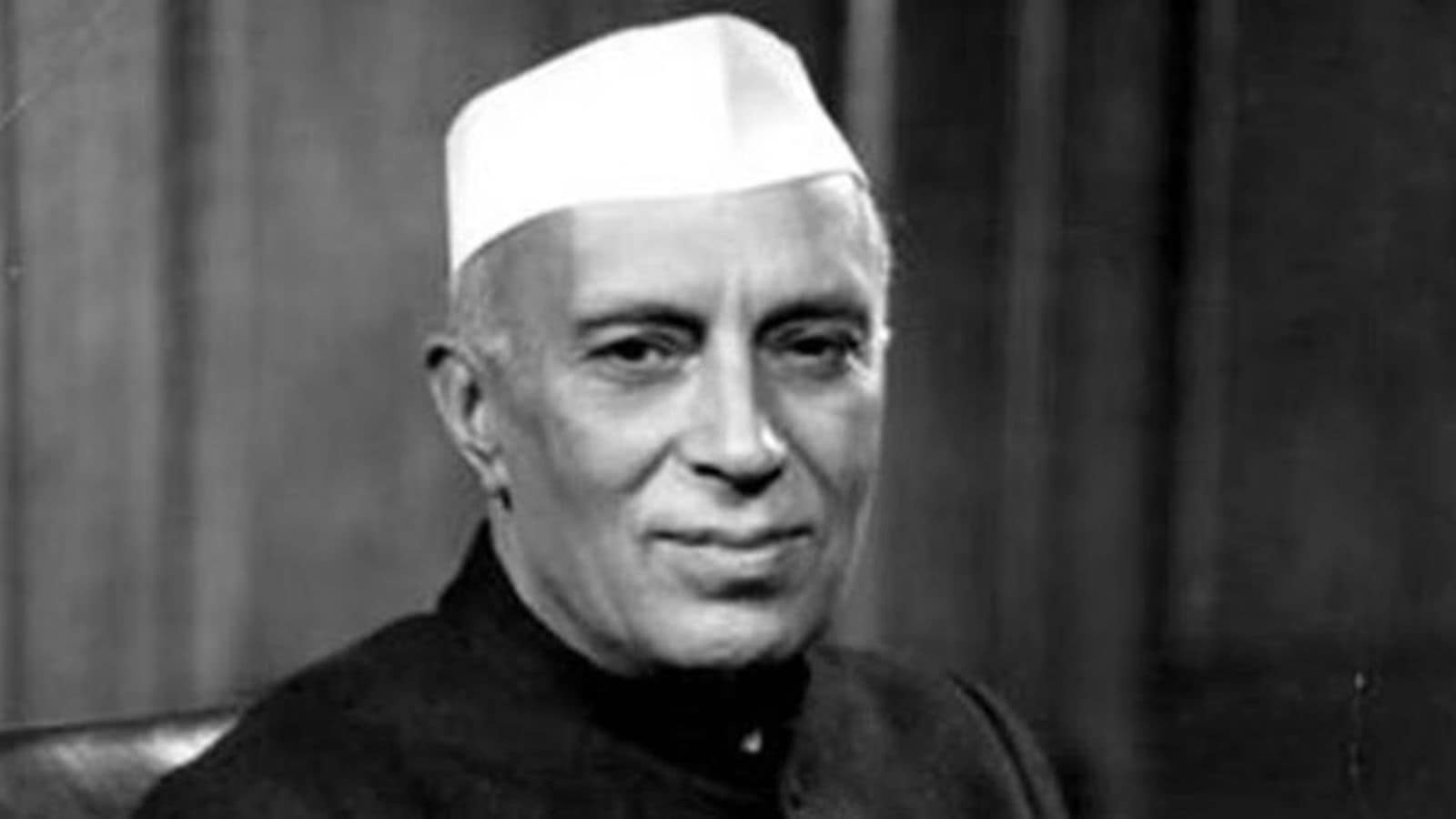
As Parliament prepares to hold a 10-hour discussion on Vande Mataram to mark 150 years of the song on Monday, the BJP on Sunday said the discussion would yet again “expose” former Prime Minister Jawaharlal Nehru.
“When there will be a debate on Vande Mataram in Parliament tomorrow, I feel that the reality of Nehru ji will be revealed to everyone; he will again be exposed,” BJP MP Sambit Patra told reporters on Sunday.
Last month, Prime Minister Narendra Modi, who will open the discussion in the Lok Sabha on Monday, targeted the Congress for “omitting” some stanzas of the song, claiming it “divided the country on religious lines”. The Opposition hit back, accusing Modi of “insulting” the Congress stalwarts who were present at the 1937 CWC meeting where the resolution was adopted.
As allegations and counters fly thick and fast, here is a look at Nehru’s reasons for not wanting Vande Mataram as the national anthem. His letters and speeches are available on The Nehru Archive.
‘Difficult to follow’
In a Cabinet note on May 21, 1948, Nehru spelled out his reasons for choosing Jana Gana Mana over Vande Mataram as the national anthem.
“A National Anthem is, of course, a form of words, but it is even more so a tune or a musical score. It is played by orchestras and bands frequently and only very seldom sung. The music of the National Anthem is, therefore, the most important factor. It is to be full of life as well as dignity and it should be capable of being effectively played by orchestras, big and small, and by military bands and pipes. It is to be played not only in India but abroad and should be such as is generally appreciated in both these places. Jana Gana Mana appears to satisfy these tests … Vande Mataram for all its beauty and history is not an easy tune for orchestral or band rendering. It is rather plaintive and mournful and repetitive. It is particularly difficult for foreigners to appreciate it as a piece of music. It has not got those peculiar distinctive features which Jana Gana Mana has. It represents very truthfully the period of our struggle in longing and not so much the fulfilment thereof in the future.”
Nehru added that the language of Vande Mataram was “very difficult for an average person”, while Jana Gana Mana “is simpler though it is capable of improvement and some changes are necessary in the present context”.
“… Bearing all these considerations in mind, I suggest that we might provisionally accept Jana Gana Mana as the National Anthem which should be played on all suitable occasions,” the former PM said.
Letter to B C Roy
Arguing in favour of Jana Gana Mana as the national anthem, Nehru wrote to Congress leader B C Roy, who became the first CM of West Bengal, on June 15, 1948, saying, “There is no question of some Muslims objecting to Vande Mataram. That has not influenced many people here, but many of us, and I feel strongly about it, think that in the present context Vande Mataram is completely unsuited as a national anthem. It is and it will continue to be a national song which is intimately connected with our struggle for freedom, and which will be revered accordingly. But a national anthem is something different from a song which represents the struggle and the longing which Vande Mataram so powerfully represents. A national anthem should be something of victory and fulfilment, not of past struggle.”
“I should like to repeat that it is the tune of the anthem not so much the words. So far as I can see the Vande Mataram does not fulfil this essential qualification although I believe some people are of opinion that it does. From the point of view of the foreign countries it is undoubtedly a flop. Whether Jana Gana Mana is adopted or not I doubt very much if Vande Mataram could be adopted. As for the words Vande Mataram contains language which most people do not understand. Certainly, I do not understand it,” he wrote.
Letter to Syama Prasad Mookerjee
About a week later, on June 21, 1948, Nehru responded to Syama Prasad Mookerjee’s letter on the issue. Mookerjee later went on to form the Bharatiya Jana Sangh, the precursor to the BJP.
“Personally I do not think Vande Mataram is at all feasible as a national anthem chiefly because of its tune which does not suit orchestral or band rendering… Jana Gana Mana, on the other hand, has already been greatly appreciated in foreign countries as well as in India and the music of it has a great appeal to people who hear it in India or abroad. Vande Mataram is of course intimately connected with our entire national struggle and we are all emotionally attached to it and will continue to be so attached. It will in any event remain as a famous national song but I personally think that a song which represents poignant longing for freedom is not necessarily a song which fits in with the achievement of freedom. Jana Gana Mana has an element of triumph and fulfilment about it,” he wrote.
Constituent Assembly debate
In a reply to V C Kesava Rao’s question on whether the government had instructed provincial administrations to consider Jana Gana Mana as the national anthem, Nehru again responded by outlining why Tagore’s song was more suited for band renditions and said B C Roy had informed that “he and his government preferred Vande Mataram”.
“It is unfortunate that some kind of argument has arisen as between Vande Mataram and Jana Gana Mana. Vande Mataram is obviously and indisputably the premier national song of India, with a great historical tradition, and intimately connected with our struggle for freedom. That position it is bound to retain, and no other song can displace it. It represents the passion and poignancy of that struggle, but perhaps not so much the culmination of it. In regard to the national anthem tune, it was felt that the tune was more important than the words, and that this tune should be such as to represent the Indian musical genius as well as to some extent the western, so that it might equally be adaptable to orchestral and band music, and for being played abroad. The real significance of the national anthem is perhaps more abroad than in the home country. Past experience has shown us that Jana Gana Mana tune has been greatly appreciated and admired abroad. It is very distinctive and there is a certain life and movement in it. It was thought by some people that the Vande Mataram tune with all its very great attraction and historical background was not easily suitable for being played by orchestras in foreign countries, and there was not enough movement in it. It seemed therefore that while Vande Mataram should continue to be the national song par excellence in India, the national anthem tune should be that of Jana Gana Mana, the wording of Jana Gana Mana to be suitably altered to fit in with the existing circumstances.
“This question has to be considered by the Constituent Assembly, and it is open to that Assembly to decide as it chooses. It may decide on a completely new song or tune if such is available,” he said on August 25, 1948.