
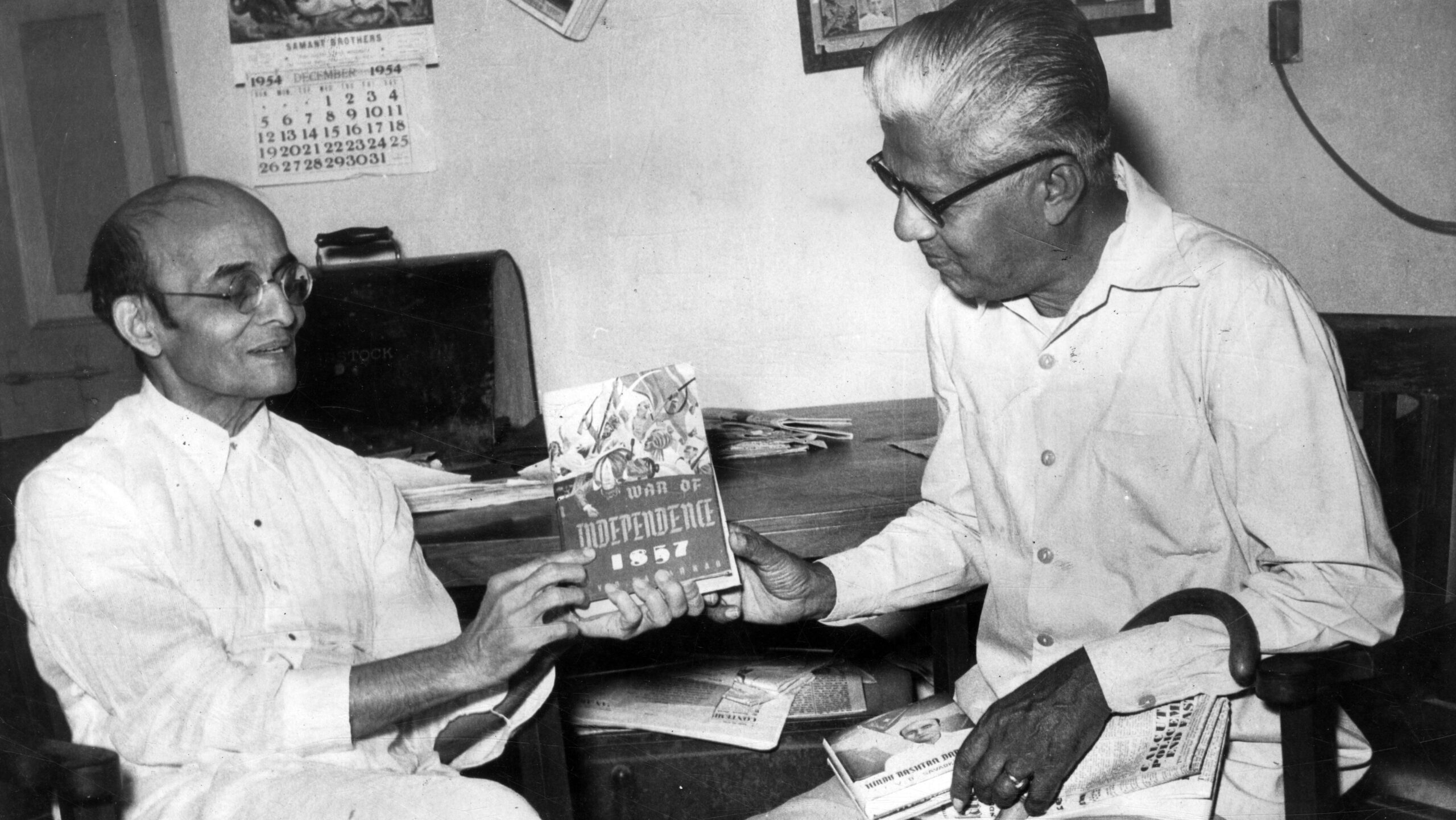
V D Savarkar will be in focus on Friday as Union Home Minister Amit Shah and RSS sarsanghchalak Mohan Bhagwat attend an event in Shri Vijaya Puram (formerly Port Blair) in the Andaman and Nicobar Islands to attend an event to mark 116 years of the Hindutva ideologue’s poem Sagara Pran Talmalala (My soul is in torment).
The poem about Savarkar’s longing for India from distant shores was composed in 1909, with the opening line urging the ocean to carry him back to the “motherland” as his “soul was in torment”.
Shah’s visit comes days after a debate in Parliament to mark 150 years of Bankim Chandra Chattopadhyay’s Vande Mataram, with the BJP accusing the Congress of having done injustice to the national song by truncating it in 1937.
Savarkar composed Sagara Pran Talmalala in Marathi in his younger days as a revolutionary in England, before his incarceration in the Andaman Cellular Jail, and much before he became a Hindutva ideologue and got distanced from the freedom struggle.
The poem has been sung by Lata Mangeshkar and also has a history of celebration by the BJP. In the mid-1980s, Atal Bihari Vajpayee delivered a famous speech on Savarkar in Pune in which he recited the first line in Marathi, drawing applause from the audience. The part of the speech in which Vajpayee describes Savarkar in glowing terms is also available on the BJP’s YouTube channel.
Composing the poem
Savarkar composed the poem at a time when he was a key figure at Syamaji Krishna Varma’s India House in London, a space that he used to bring young Indians into the freedom struggle through his fiery speeches. He found an unlikely disciple who got completely transformed under his influence. This was Madan Lal Dhingra, the son of a rich government civil surgeon in Punjab, who let go of his happy-go-lucky ways to take to the path of armed freedom struggle under the influence of Savarkar’s speeches at India House.
Writing on the activities at India House in her biography of Ghadar Party leader Har Dayal, historian Emily C Brown described the turn of events. Savarkar concealed arms and ammunition in the luggage of Chaturbhuj Amin, an India House cook, to be delivered to his older brother Ganesh in India for armed struggle against the British. But Ganesh Savarkar was taken into custody before the consignment reached him and was tried and sentenced to Cellular Jail for six years.
Savarkar, Brown wrote, “became wild and swore vengeance on the British”. However, the executioner of it was Dhingra, fully converted to the revolutionary cause, who on July 1, 1909, pumped five bullets into the face of William Curzon Wyllie, the political aide-de-camp for the secretary of state for India, killing him on the spot.
A swift trial was concluded in an hour and Dhingra was hanged to death on August 17. Saying nothing in his defence in court, Dhingra just asked for his prepared statement to be read out. It wasn’t, but the statement found its way to the pages of the Daily News and American and Irish newspapers due to one David Garnett, a man in England’s literary circles who knew Savarkar well.
Brown hinted that the statement — in which Dhingra said he wished to be born again and die for the motherland in a similar manner, and ended with “Vande Mataram” — was suspected to have been penned by Savarkar. “It was generally assumed that Dhingra had not been the author, but no one has been willing to say that Savarkar was,” she wrote.
Savarkar’s biographer Dhananjay Keer wrote that soon after Wyllie’s assassination, newspapers blamed Savarkar, restrictions were imposed on Indian students, India House was shut down, and sleuths began to follow Savarkar. He had to quit two lodgings in one night and was ousted from one of them at midnight.
A tired Savarkar finally reached Brighton, a seaside English town, Keer said. With his friend Niranjan Pal, the son of freedom fighter Bipin Chandra Pal, beside him at the beach, Savarkar is believed to have composed the poem — later described by Independence activist and social reformer Kaka Kalelkar “as an inscription on the Marathi language” — days before Dhingra’s execution.
Savarkar is important for the BJP both as an ideologue and as the strongest entry point of the Hindutva ideology into the freedom struggle. However, this has also made Savarkar a controversial figure in the eyes of the Congress and the Left. They have repeatedly flagged his clemency appeals from the Cellular Jail, where he was sentenced for 50 years, and said that once he was released, he stayed away from the freedom struggle and turned only into a Hindutva ideologue. This, the BJP alleges, is the Opposition’s way of trying to dent its nationalism plank.