
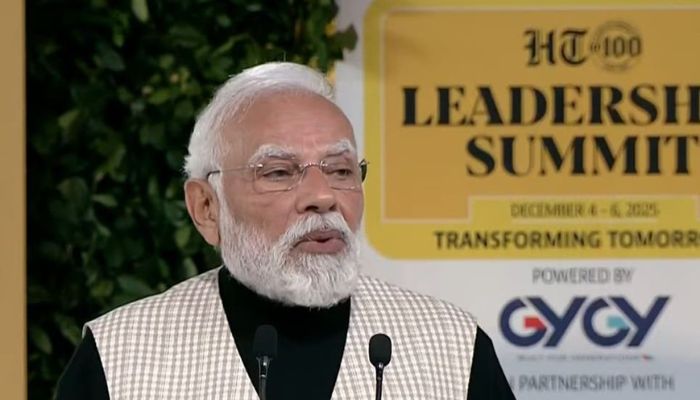
Prime Minister Narendra Modi has taken a strong stand against what he called the “colonial mindset” that continues to shape perceptions about India’s growth story. Speaking at the Hindustan Times Leadership Summit on Saturday, 6th December, he urged citizens to free the country from mental slavery within the next ten years and challenged the derogatory use of the term “Hindu rate of growth” that critics once used to describe India’s slow economic progress.
PM Modi said that India today is full of confidence at a time when the world is facing uncertainties. He pointed out that while many global economies are struggling, India has emerged as a “growth engine” during a global slowdown.
Speaking at the Hindustan Times Leadership Summit 2025. #HTLS2025@htTweets
https://t.co/D5ACi2xSwt— Narendra Modi (@narendramodi) December 6, 2025
The prime minister specifically questioned why, when India struggled to grow at just 2–3 per cent many decades ago, some economists and experts labelled it the “Hindu rate of growth.” But now, when India’s economy is recording some of the highest growth rates in the world, no one is willing to refer to this success as a “Hindu rate of growth” in a positive sense. PM Modi said this mindset arises from a long-running attempt to portray India’s ancient civilisation as unproductive and inherently poor.
PM Modi emphasised that India today is seen as a high-growth, low-inflation economy. He cited a growth rate of 8.2 per cent in the second quarter of this financial year as proof that India is becoming a major driver of global economic recovery. “We are at a turning point,” he said, adding that despite wars, financial crises, and global disruptions in recent years, India is moving forward with clarity and determination.
Lawyer and the former member of the Rajya Sabha, Mahesh Jethmalani, supported PM Modi’s remarks. Sharing a long post on X, Jethamalani said, “PM Modi is absolutely right to call out the decades-old slur of the so-called ‘Hindu rate of growth’ for what it always was: a colonial-socialist sneer meant to belittle Indian civilisational confidence and shift blame from disastrous policy to a supposed cultural deficiency. It was an insult wrapped in economics, a narrative designed to convince Indians that stagnation was our destiny.”
PM Modi is absolutely right to call out the decades-old slur of the so-called “Hindu rate of growth” for what it always was: a colonial-socialist sneer meant to belittle Indian civilisational confidence and shift blame from disastrous policy to a supposed cultural deficiency. It… https://t.co/53rvlARJ93
— Mahesh Jethmalani (@JethmalaniM) December 7, 2025
Today’s India – growing faster than the G7, driving global momentum, unleashing entrepreneurship and reform – has demolished that lie through performance, not polemics, he added.
What is the ‘Hindu Rate of Growth’?
The phrase “Hindu rate of growth” was coined in 1978 by the late economist Raj Krishna. He used it to describe the period of slow economic expansion in India between the 1950s and 1980s. During these decades, the Indian economy grew at an average rate of just 3.5 per cent per year. Since population growth was high, per-capita income increased by only around 1.3 per cent annually. Raj Krishna argued that when economic progress remains persistently low over decades, it reflects structural problems in policy and governance.
However, even though the term included the word “Hindu,” it had nothing to do with religion, culture, or faith. The real reason for slow growth during that period was India’s economic model, heavy state control, socialism-influenced planning, licensing restrictions, and import substitution policies that limited competition and innovation. India remained isolated from global markets and struggled to create jobs and wealth.
Things changed dramatically after the 1991 reforms, when India opened its economy to the world through liberalisation, privatisation, and globalisation. Growth improved sharply, foreign investment increased, and India began moving toward a more market-driven system. This shift clearly proved that the earlier stagnation was due to economic policy choices, not to India’s civilisation or religion.
Raj Krishna, the so-called economist who popularised the phrase, taught at the Delhi School of Economics. He was also a member of the Finance Commission and contributed to planning chapters during India’s Sixth Five-Year Plan. His academic writing often focused on India’s economic structure using a Marxist lens. He believed that the character of the state and the way power is distributed among social classes play a major role in shaping the economy.
His writings show that he admired Marxist ideology and considered it the best analytical framework for India. He argued that India’s socialist system had failed because it did not understand how the state behaves in different societies.
Raghuram Rajan was also supporting the colonial idea
In 2023, former RBI Governor Raghuram Rajan had publicly revived the colonial-era term. Speaking to the news agency PTI, he predicted that India was heading towards the “Hindu rate of growth,” citing slower GDP estimates released by the National Statistical Office, GDP had fallen to 4.4% in the October–December quarter from 6.3% in July–September, and from 13.2% earlier.
Rajan had also said the country would take many years to recover from the pandemic slowdown, but India managed to bounce back within a year, proving his prediction wrong. For five consecutive years, Rajan has warned that India is heading toward economic crisis, yet each time, the economy has outperformed his projections.
Why linking culture to economic growth is wrong
When India grew slowly, the blame was put on Hindu civilisation. Today, India is growing rapidly, around 7 per cent annually, yet no one credits Hindu culture for this success. This double standard reveals the bias behind the original term. Religion cannot be the basis of economic performance, because growth depends on governance, innovation, infrastructure, trade, technology, and political stability, not on whether people belong to a particular culture.
If India’s slow growth was once labelled “Hindu,” then by the same logic, today’s high growth should also be seen as “Hindu.” But critics readily separate Hinduism from India’s achievements while associating it with shortcomings. This shows how the original phrase was used to undermine a civilisation rather than to analyse economic performance.
India has now become the fastest-growing major economy in the world. Yet very few international experts speak proudly of this success, even though the same experts had no problem dragging Hinduism into the narrative earlier. This reflects the lingering influence of colonial-era attitudes that portrayed India as incapable of modern progress.
India’s growth outshines major G20 Economies
India’s current economic performance stands in sharp contrast with many developed nations. In recent quarters, G20 countries have experienced slowdowns, contractions, or very low growth. But India continues to remain strong, supported by domestic demand, digital progress, manufacturing expansion, and infrastructure growth.
Recent global data shows:
- India recorded the highest year-on-year growth among G20 economies at 7.3 per cent.
- China and Indonesia followed with 5.2 per cent and 5.1 per cent growth.
- Germany remained at the bottom with nearly 0.2 per cent growth.
- Countries like Canada, Germany, and Italy even recorded a contraction in GDP during recent quarters.
- The United Kingdom and Brazil saw a significant decline in growth momentum.
This comparison highlights one thing clearly: India has moved far beyond the days of slow growth. It is playing a key role in global expansion and is widely acknowledged as a powerful economic force. Yet, this growth is never given a cultural label, unlike the earlier phase of sluggish progress.

A reflection of Hinduphobia and Colonial thinking
The phrase “Hindu rate of growth” has deeper implications beyond economics. It represents an academic and cultural prejudice that has existed for decades. Over time, this term found legitimacy in textbooks, universities, international institutions, and the media. By attaching poor economic performance to Hinduism, it reinforced the idea that Indian civilisation was incapable of development.
Ironically, while people are always careful not to link religious identity with terrorism or violence, rightly saying “terror has no religion”, they had no hesitation in linking Hinduism with poverty. The expression became a way to mock and belittle a peaceful civilisation and its believers. It ignored the diversity of India and failed to recognise the contributions of Hindus to science, philosophy, culture, innovation, entrepreneurship, and now, modern economic success.
This reveals a disturbing trend: Hindus are seen as an easy target because they do not respond with aggression. Criticising Hindu culture has become fashionable in some intellectual circles, where it is celebrated as progressive thought. In reality, it is a continuation of colonial-style prejudice that tried to detach India’s spiritual foundation from its aspirations for prosperity.
The fact that only Hinduism is burdened with a “rate of growth” shows the contempt some scholars held for the identity of the majority. That is why Prime Minister Modi called for a complete rejection of such colonial frameworks. He said India must rise with self-confidence rooted in its civilisation, not through borrowed ideas that demean its identity.
The hypocrisy of religious labels on growth
To understand how unfair the term is, just consider a simple comparison. Afghanistan recorded a GDP growth rate of about 2.3 per cent in 2023. Pakistan grew by nearly 3.2 per cent in 2024. Should anyone call this the “Muslim rate of growth”? No, because it would be communal, insensitive, and illogical. Religion does not decide economic outcomes; governance does.
So why was Hinduism singled out? Why was India’s slow growth identified with the faith of its people? The answer lies in colonial-era attitudes and a political environment where criticising Hindu civilisation was seen as intellectual sophistication.
Today, India leads the world in growth. If phrases must exist, then logically, the years of slow progress should be known as the “Nehru rate of growth,” because Nehru was the first PM of India; he remained incumbent till 1964. Most of the economic policies were decided/approved by Nehru.
Therefore the expression ‘Nehru Rate of Growth’ looks more apt for the economic growth during his regime and the years that followed.
Time to end the insult
India has entered a new era. From a struggling nation fighting for basic growth, it has risen to become a global economic powerhouse. The narrative that once tried to portray Hindu civilisation as backwards has been broken by India’s own achievements, led by innovation, infrastructure, and self-confidence.
The label “Hindu rate of growth” was never an economic concept; it was a cultural insult. It was rooted in ignorance, bias, and a desire to separate India’s future from its civilisation. As the prime minister urged, the next ten years must be spent freeing our thinking from this colonial baggage. India’s growth belongs to every Indian, but its civilisational identity is nothing to be ashamed of; it is a source of strength.
The time has come to finally erase this outdated and discriminatory phrase. India’s new growth story is a story of confidence, resilience, and cultural pride, and no biased label can define it anymore.