
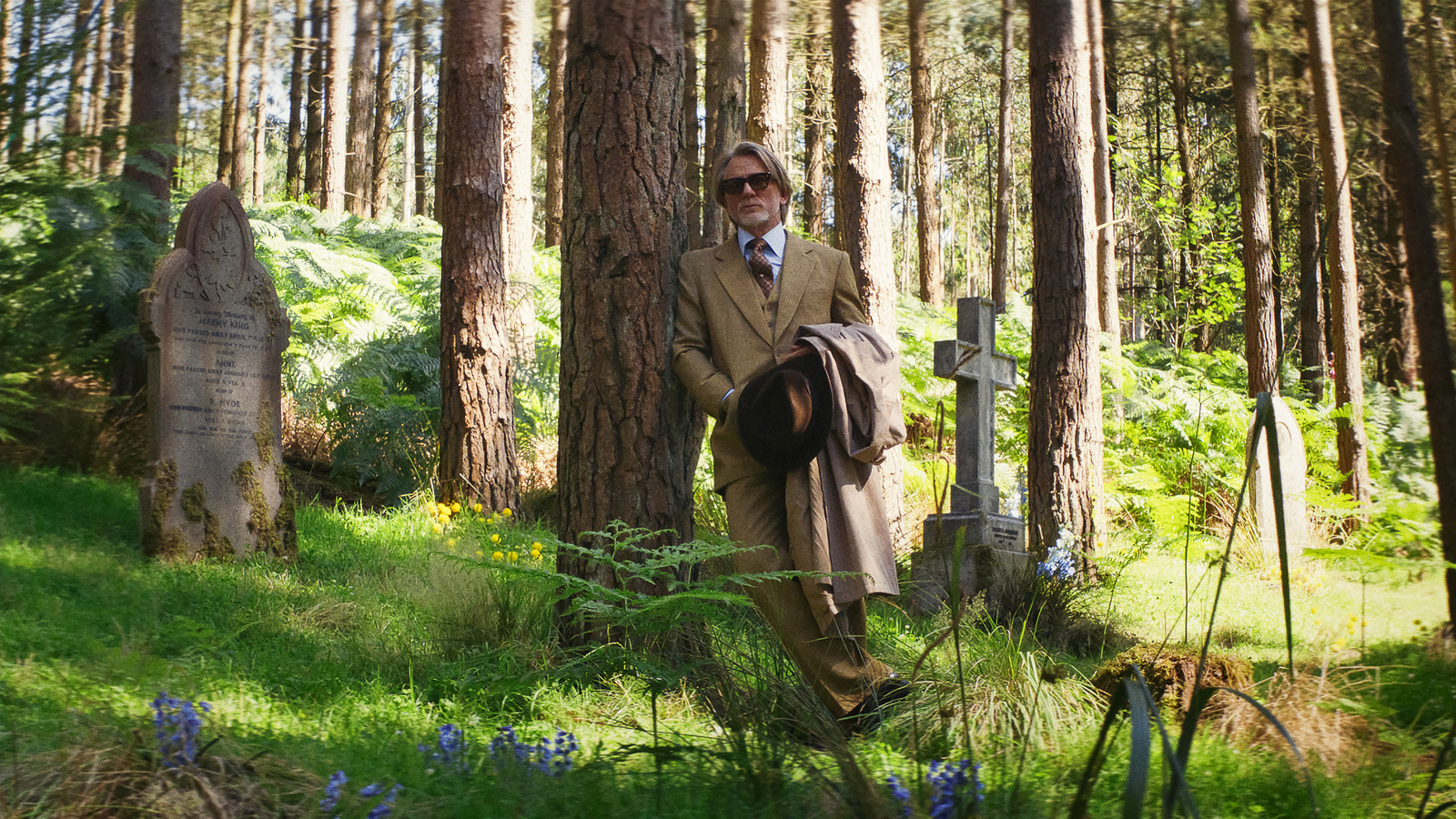
Contains spoilers for “Wake Up Dead Man: A Knives Out Mystery”
Rian Johnson’s “Knives Out” franchise thrives on elaborate plotting, built around small details you might miss. The third film, “Wake Up Dead Man: A Knives Out Mystery,” is the series’ most complex mystery yet. The first two installments, “Knives Out” and “Glass Onion: A Knives Out Mystery,” each involved two murders for Benoit Blanc (Daniel Craig) to solve; “Wake Up Dead Man” not only ups the body count higher yet, but its third act also throws in a healthy dose of what one character refers to as “Scooby Doo sh–.” The inciting murder is an “impossible” locked-room mystery, and the solution to the whole web of crimes involves multiple conspirators.
“Wake Up Dead Man” is a complicated film to summarize, and with its Catholic setting raising compelling questions of belief and morality, it’s also a fascinating one to analyze. Now that the public has finally had the chance to watch this movie, it’s time to dig into the spoilers of the how the mystery gets solved, why Blanc steps back from his usual big reveal speech (a different approach Johnson has called “Christ-like”), and what the narrative’s resolution has to say about the culture at large.
What you need to remember about the plot of Wake Up Dead Man
“Wake Up Dead Man” opens with Reverend Jud Duplenticy (Josh O’Connor) writing his story for Benoit Blanc. Jud was recently assigned to work at Our Lady of Perpetual Fortitude in upstate New York, run by the firebrand Monsignor Jefferson Wicks (Josh Brolin) and his right-hand woman Martha Delacroix (Glenn Close). Wicks tried to provoke Jud’s anger, and he had a small but devoted group of followers: Doctor Nat Sharp (Jeremy Renner), writer Lee Ross (Andrew Scott), lawyer Vera Draven (Kerry Washington), political YouTuber Cy Draven (Daryl McCormack), and disabled ex-cellist Simone Vivane (Cailee Spaeney).
During a furious Good Friday sermon pledging to have “Eve’s Apple returned to the tree,” Wicks collapsed in the pulpit’s side-room. Jud noticed blood and a plastic demon head — which Jud previously took from a devil-themed bar — sticking out of Wicks’ vestments; Nat inspected the body and found the head was attached to a knife. Jud was immediately suspected by police chief Geraldine Scott (Mila Kunis), but Benoit sensed his innocence and started investigating this “impossible mystery.”
Reading Jud’s recollections, Benoit realizes Jud omitted a significant detail: Wicks was drinking before he died. The reason Jud left the church after everyone else was to hide Wicks’ flask. Jud justifies this as sensitivity to recovering alcoholic groundskeeper Samson (Thomas Haden Church). The duo continue their investigation, finding plans to open the Wicks’ family tomb before the death. Cy’s video recordings offer potential motives: after his illicit parentage of Cy was exposed, Wicks planned to retire and destroy every one of his congregants. Geraldine realizes Benoit made his own omissions: when going through possible solutions to locked-room mysteries, he didn’t acknowledge that there was enough time between witnesses for Jud to have stabbed Wicks.
If you or anyone you know needs help with addiction issues, help is available. Visit the Substance Abuse and Mental Health Services Administration website or contact SAMHSA’s National Helpline at 1-800-662-HELP (4357).
What happened at the end of Wake Up Dead Man?
Before the mystery gets solved, it gets weirder: the door falls off the tomb and Wicks appears to walk out of it! Jud witnesses this seeming resurrection before getting sucker-punched. When he regains consciousness, Samson lies dead next to him. Jud tries to turn himself in for the murder he believes he’s committed, but Benoit stops him. They go to Nat’s house and find he’s been killed in a vat of acid, alongside Wicks’ actual corpse.
Jud goes to the church, where Wicks’ followers have gathered, to confess his guilt, only to be interrupted by Benoit explaining how he’s solved the case. Wicks fell unconscious from tranquilizers in his drink. There were two demon ornaments: one sewn into the fabric of Wicks’ vestments (painted red to blend in) and attached to a remote-controlled squib of fake blood, and one Nat placed while Martha’s screams distracted everyone. Before he gets to explaining the “resurrection,” however, Benoit stops to claim the mystery was “unsolvable.”
This is an act of mercy to allow Martha, whose pallor shows she is fatally poisoned, to confess her sins. She had intended to confess how she lied to cover up the location of the Wicks family’s “Eve’s Apple” jewel — swallowed by Jefferson’s grandfather, Prentice (James Faulker), to keep it from his mother Grace (Annie Hamilton) — to Jud, but accidentally made the confession to Wicks himself. She convinced Nat to go along with her murder plan to “save” the church, and had her lover Samson disguise himself as Wicks and hide in the casket before the Easter “miracle.” Jud witnessing this was not part of the plan, and so Nat killed Samson and framed Jud. Nat then tried to poison Martha, but she figured it out and poisoned him. Jud accepts her confession right as she dies.
What happened in the epilogue of Wake Up Dead Man?
There’s a hell of a lot of story to wrap up in the final act of “Wake Up Dead Man,” so, after Martha’s confession, the film resolves its loose ends in a one year later epilogue. Lee publishes his book celebrating Wicks. Vera moves out of town for a fresh start. Simone never got the cure she was desperate for, but she finds a more realistic miracle: she gains the courage to do what she’s good at, despite her chronic pain, and returns to playing the cello. Cy is on Jud’s case, convinced the priest is holding onto Eve’s Apple somewhere, but Benoit helps Jud deny this accusation.
Jud prepares to reopen the church, now renamed Our Lady of Perpetual Grace in honor of Jefferson’s tragically slandered mother. Langstom (Jeffrey Wright), the bishop who sent Jud there to begin with, warns that while he’s tried to spread the truth about what happened, conspiracy theorists emboldened by Lee’s book and Cy’s videos continue to deny it. They believe in the “miracle” and continue to blame Jud. That’s not the “fun” kind of conspiracy theory, which can change the way you watch twisty films like this one.
Jud’s church will be “popular,” he says, “but not in a good way.” Benoit bids Jud his goodbyes, having absolutely zero interest in attending mass. In the end, Jud welcomes a new family into the parish as the camera pans up to reveal Eve’s Apple hidden within the chest of the church’s newly carved wooden Christ on the cross.
What the ending says about faith and forgiveness
“Wake Up Dead Man” pits two different visions of Christianity against one another. Wicks sees the role of the church as fighting the world, where Jud sees its purpose as healing the world. For Jud, the fighting vs. healing conflict is personal: he used to be a fighter by profession, and it was his remorse over killing a man in the boxing ring that led him to seek religion in the first place. He still has his violent instincts when faced with hate — he’s sent to Our Lady of Perpetual Fortitude as a consequence of punching another priest who, according to Langstrom, kind of deserved it — and Wicks did everything he could to provoke that instinct in Jud. Jud, meanwhile, does his best to stick to his more forgiving ideals.
Jud’s gentler approach to faith is what ultimately gets Martha to confess her crimes. Martha is in a curious place somewhere between Jud and Wicks’ religious philosophies: she’s aligned herself with Wicks’ cultural conservatism, but she’s also a true believer who feels remorse for her sins in contrast to the purely self-interested Wicks. The divide between her and Wicks led her both to plot his murder and then feel guilt over said murder, leading her to seek forgiveness before death the only way she knows how: confession. Jud finds out everything he needs from her without having to be confrontational. It’s a victory for his philosophy of healing over fighting.
What the ending says about truth and justice
While Jud’s forgiveness-based approach is able to uncover the truth through Martha’s confession, the flipside is the congregation isn’t there to hear this confession, making it easier for them to disbelieve the whole thing. Benoit was prepared to reveal the full solution to the mystery before the whole congregation but, out of sympathy for a dying woman, and respect for her and Jud’s beliefs, he chose to hold back his accusations. Instead he pretended that the mystery was “impossible” to solve — a soundbite that Cy can easily turn into misinformation. It’s barely better than pretending that birds aren’t real, and says some tough things about the struggle for truth in the modern era.
In a way, the ending of “Wake Up Dead Man” illustrates the difficulty of being moral in an age of misinformation. Jud and Benoit did the right thing and got the results they needed, but now Jud has to suffer the slings and arrows of today’s fake news ecosystem. Of course, this lie might spread even if there had been a more public reveal, and Jud is prepared to continue serving those in need even as others still target him with suspicion. The film’s message, it seems, is that it is worth maintaining kindness, even towards those who seem like they don’t deserve it. The film also says to not worry so much about those who will hate you based on lies, but keep advocating for the truth.
What Rian Johnson says about the ending
Following an advanced screening of “Wake Up Dead Man” at the Paris Theater in New York City on November 4, writer-director Rian Johnson (who has had quite the journey from his first indie “Brick” to being a powerhouse blockbuster director) took part in a Q&A with Gold Derby’s Ethan Alter. A question about the film’s dramatic lighting — Johnson felt like he was “playing God with light” — led into discussing some big spoilers.
Regarding how the new film puts a fresh twist on the series’ expected “Benoit Blanc explains it all” climax, Johnson said during the Q&A that his scripts “are built less around the reveal of the mystery and more built around the central relationship between Blanc and the main characters … In this one, it was all about him and Jud, and so it was all about what he would take from Jud at the end. I knew it wasn’t honest for Blanc to have some kind of actual conversion, but the notion that he sacrifices the thing that’s most important to him… his ego and ability to perform on this stage … and he does it for the person in the story who deserves it the least and he does it as a moment of grace, to give her this graceful moment at the end of her life and this thing that she believes in and he does not.” Johnson describes Benoit’s act of grace towards Martha as “the most Christ-like thing anyone does in the whole movie.”
What the ending does NOT mean for the Knives Out franchise
Further “Knives Out” films have yet to be announced, but Rian Johnson told The Hollywood Reporter at the 2025 London Film Festival, “As long as Daniel and I have fun doing it and he wants to do them, as long as audiences like them, and also as long as we can keep challenging ourselves and coming up with something that’s genuinely new.”
If you’re looking for any hints about what to expect from the fourth movie from watching the third, you won’t find anything. All three “Knives Out” installments have been completely self-contained mysteries. Unlike the stories of the “Star Wars” trilogies (which have unfortunately moved on without Johnson), the director has been clear that “Knives Out” is only a “trilogy” inasmuch as there’s been three so far. The sole scrap of connective tissue between these stories is Benoit Blanc, and that character remains such a constant that, even if the events of an individual case move him in the moment, he can’t grow or change too much as a character.
Blanc might come away from “Wake Up Dead Man” with a greater understanding and respect for Jud’s faith, but he’s still a proud “heretic” as disinterested in church at the end of the film as he is at the beginning of it. Even those minor shifts in his perspective are unlikely to have any impact on a new “Knives Out,” because the next movie wouldn’t be about religion, but something new. As Johnson told THR, “I think it’s good to totally empty the well and then start from scratch on the next one.” In the meantime, fans patiently waiting for the next installment can check out Looper’s list of 25 movies similar to “Knives Out.”