
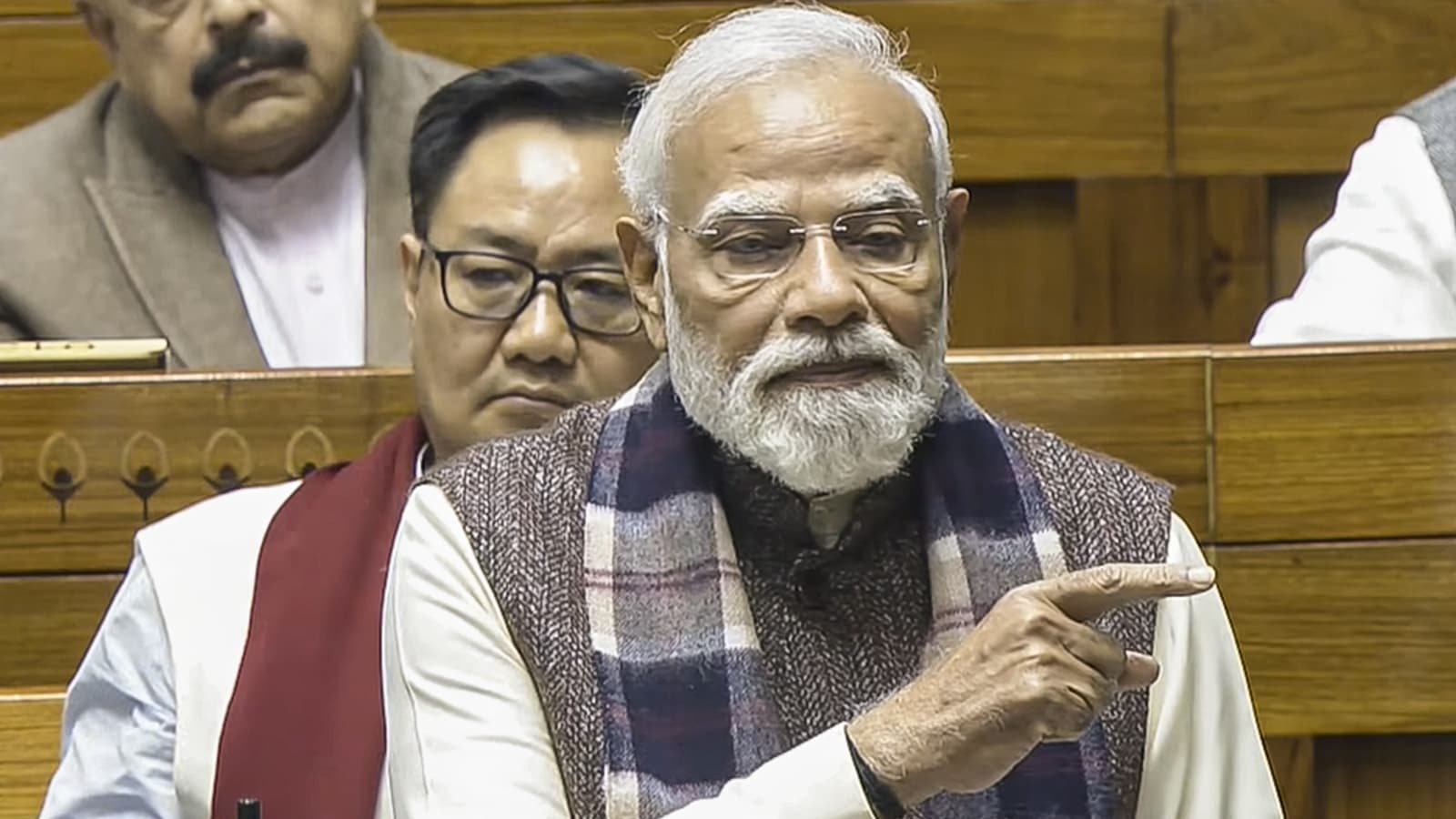
Framing Vande Mataram as Bankim Chandra Chattopadhyay’s challenge to the British insistence on taking their national anthem to Indian homes, Prime Minister Narendra Modi on Monday targeted the Congress during a discussion on 150 years of the national song, accusing the grand old party of truncating it to appease the Muslim League and Mohammad Ali Jinnah. The PM said Jawaharlal Nehru agreed with Jinnah’s concerns about the song and important stanzas were omitted from it, putting the country on the path of “appeasement politics” that ultimately led to the Partition.
Modi attempted to lay claim to the legacy of the freedom struggle through the expression of reverence for Vande Mataram and tried to portray the Congress as the party that allowed the national song to be fragmented. The PM once again called the Congress “MMC”, or Muslim League-Maoist Congress, a term he first used in his victory speech after the Bihar election results last month.
Vande Mataram, Modi said, “was composed at a time when, after the 1857 freedom struggle, the British Empire was unsettled and imposed various pressures and injustices upon India … that during that period, the national anthem of the British, ‘God Save The Queen’, was being spread into every household in India”.
“It was then that Bankim da issued a challenge, responding with greater force, and from that defiance Vande Mataram was born,” Modi said, before agreeing to refer to the novelist and poet as “Bankim babu” amid objections raised by the Trinamool Congress (TMC).
Recalling that Mahatma Gandhi had considered Vande Mataram to be almost like India’s national anthem, Modi said, “In the weekly journal, ‘Indian Opinion’ published from South Africa, Mahatma Gandhi had written on December 2, 1905, that Vande Mataram … had become immensely popular across Bengal, and during the Swadeshi movement massive gatherings were held where lakhs of people sang Bankim’s song.” Mahatma Gandhi emphasised that “the song had become so popular that it was almost like the national anthem”, the PM said.
Claiming that Vande Mataram had suffered “grave injustice in the last century”, Modi targeted the Congress. “The Muslim League’s politics of opposition to Vande Mataram was intensifying, and Mohammed Ali Jinnah raised a slogan against Vande Mataram from Lucknow on October 15, 1937. Instead of firmly countering the baseless statements of the Muslim League and condemning them, Jawaharlal Nehru, then Congress president, did not reaffirm his and the Congress party’s commitment to Vande Mataram and began questioning Vande Mataram itself. Just five days after Jinnah’s opposition, on October 20, 1937, Nehru wrote a letter to Netaji Subhas Chandra Bose, agreeing with Jinnah’s sentiment and stating that the ‘Anandamath’ background of Vande Mataram could irritate Muslims,” he said.
Quoting Nehru, he said, “I have read the background of the Vande Mataram song. I feel that this background may provoke Muslims.”
According to the PM, following this, the Congress released a statement on October 26 1937, saying the Congress Working Committee (CWC) would meet in Kolkata to “review the use of Vande Mataram”.
“The entire nation was stunned and shocked, and patriots across the country opposed the proposal by organising morning processions and singing Vande Mataram … Unfortunately, on October 26, 1937, the Congress compromised on Vande Mataram, fragmenting it in their decision. This decision was cloaked under the guise of social harmony, but history bears witness that the INC bowed before the Muslim League and acted under its pressure, adopting a politics of appeasement. Under the pressure of appeasement politics, the Congress bent for the division of Vande Mataram, and therefore, one day had to bend for the Partition of India. The INC has become MMC,” he said.
The PM said when Vande Mataram turned 50, the country was still a “slave” to the British and the song’s centenary coincided with the Emergency and the “stifling” of the Constitution. “When attempts were made to crush India’s freedom, when the Constitution was stabbed and the Emergency imposed, it was the strength of Vande Mataram that enabled the nation to rise and overcome,” he said.
Modi said that “the spirit of Vande Mataram nurtured the dream of freedom, (and) it will also nurture the dream of prosperity”. He called upon people to move forward with this sentiment “to build a self-reliant India and to achieve the vision of a developed India by 2047.”
“When we say Vande Mataram, it reminds us of the Vedic declaration meaning that this land is my mother and I am her son,” the PM said, adding that “this very thought was echoed by Lord Shri Ram when he renounced the grandeur of Lanka”. “Vande Mataram is the modern embodiment of this great cultural tradition,” he said.
During the British era, Modi said, “a fashion had emerged to portray India as weak, incompetent, lazy, and idle, and even those educated under colonial influence echoed the same language”. However, Chattopadhyay, “shook off this inferiority complex and revealed India’s powerful form through Vande Mataram”, he said.
Modi said there were instances of children being “attacked for saying Vande Mataram”, which was banned by the British. “The British banned Vande Mataram. Singing or publishing, or even uttering the words Vande Mataram, could result in punishment.” Mentioning V D Savarkar, Modi recalled how revolutionaries at the India House in London, which was the hub of their activities, sang the song. He said when the British committed the “sin of partitioning Bengal” in 1905, “Vande Mataram stood firm like a rock”.
“Although the Partition of Bengal took place, it gave rise to a massive Swadeshi movement, and at that time Vande Mataram resonated everywhere …. Nowhere else in world history can there be found a poem or a song that for centuries inspired millions towards a single goal, urging them to dedicate their lives, as Vande Mataram did,” he said.
Emphasising the pan-India appeal of the song, Modi said poet Subramania Bharati translated the song into Tamil, while Bipin Chandra Pal and Aurobindo Ghosh published newspapers called Vande Mataram
“As we pursue the dream of an Atmanirbhar Bharat, Vande Mataram remains our inspiration. While times and forms may change, the sentiment expressed by Mahatma Gandhi continues to hold strength even today, and Vande Mataram unites us,” Modi said.