
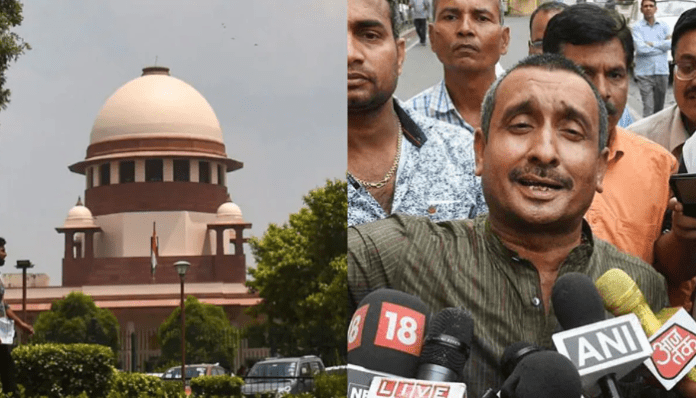
On 29th December (Monday), Kuldeep Singh Sengar’s bail was stayed by the Supreme Court. The earlier ruling was pronounced by the Delhi High Court in relation to the 2017 Unnao rape case. However, the vacation bench of Chief Justice of India Surya Kant, Justice JK Maheshwari and Justice AG Masih ordered Sengar to submit a reply in four weeks before scheduling the matter for the last week of January.
The verdict transpired at the hearing of a plea contesting the suspension of his sentence by Solicitor General Tushar Mehta. He was representing the Central Bureau of Investigation (CBI) and prayed, “This is a horrific case of rape of a child. Charges were framed under Section 376 of the IPC (Indian Penal Code) and Sections 5 and 6 of the POCSO (Protection of Children from Sexual Offences) Act.”
SG: 376.. Whether one or two.. life imprisonment is there. Whether 20 or biological life..
CJI: Are you saying concept of public servant is irrelevant if the victim is a minor?
SG: Yes. Penetrative sexual assault is an independent offence. Now clause 4 provides for the…— Bar and Bench (@barandbench) December 29, 2025
Mehta added, “Conviction is on two counts. I have quoted all relevant parts. Paragraph 3 of my note has the conviction order. There is a finding recorded which says the child was less than 16 years old, 15 years and 10 months. Against this conviction, the appeal is pending.”
Mehta also argued that Sengar was a public servant at the time of the incident and requested a minimum 20-year sentence. “Public servant is not defined in the POCSO Act by reference. Whatever is defined in the IPC will be the definition. Public servant would mean a person in a dominant position over a child,” he expressed.
CJI: The word "context otherwise requires" …
SG: suppose for the sake of argument we say that he is not a public servant under section 5. Then he falls under section 3. Amendment did not create a new offence but only enhancement of punishment. So new offence cannot be…— Bar and Bench (@barandbench) December 29, 2025
Meanwhile, CJI Kant noted, “Tentatively, we are inclined to stay the order. Generally, the principle is that once a person has walked out, the court does not take away liberty. But here, the situation is peculiar since he is inside the jail for another case.”
The Chief Justice brought up the ramifications of the high court’s interpretation during the hearing, outlining that if it were accepted, even a constable or patwari would be considered public servants, whereas an MLA or MP might be excluded and claim exemption.
The court declared, “We are conscious of the fact that when a convict or an undertrial has been released, such orders are not ordinarily stayed by this court without hearing such persons. But in view of peculiar facts, where the convict is also convicted for a separate offence, we stay the operation of the Delhi High Court.”
Sengar was found guilty and sentenced in another case under Section 304 Part II of the IPC as he continues to be in jail on that charge. It also notified the convict on another motion opposing the decision of the high court that was presented by attorneys Anjale Patel and Pooja Shilpkar.
The victim’s attorney also requested permission to intervene, but the court mentioned that she could bring an independent appeal instead. The court further emphasised that the victim does not need its approval to submit a separate special leave petition because she has a statutory right. It further explained that although she could pursue the case through her own lawyer, the Supreme Court Legal Services Committee would offer free legal aid if requested.
Sengar was deemed culpable of rape by a Delhi court in 2019 and given a life sentence. He was likewise convicted in other cases involving the demise of the victim’s father in custody and attempting to manipulate witnesses. Several of his relatives and accomplices were also convicted in connected cases.