
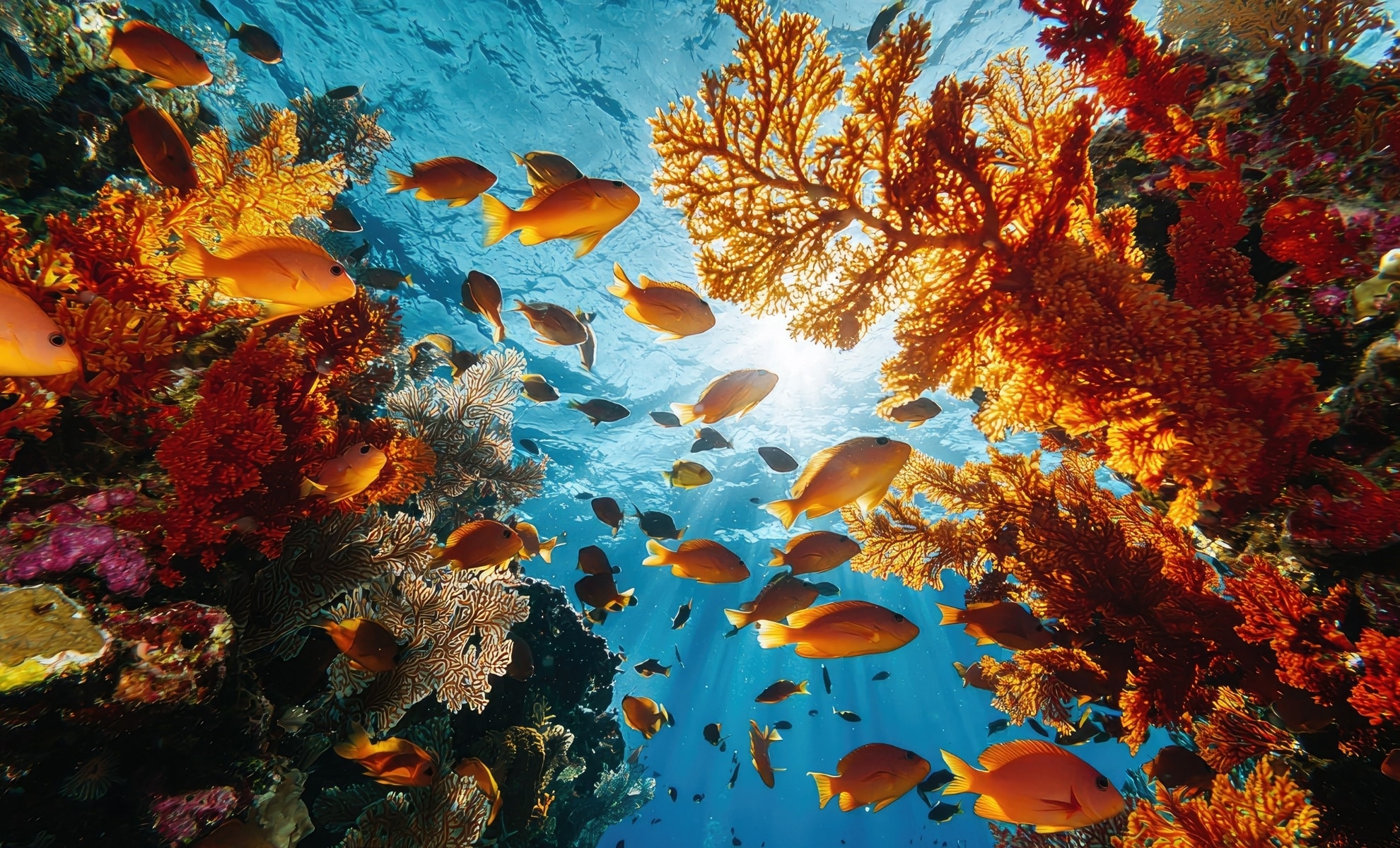
A newly developed acoustic camera has captured the most extensive collection of wild fish sounds ever recorded, revealing the surprising diversity of communication on coral reefs.
The device, known as the UPAC-360°, uses an innovative combination of audio and video to isolate and identify the individual calls of fish species in their natural habitat. Scientists deployed the system off the coast of Curaçao and were able to record 46 different fish species; none of which had ever been documented making sounds in the wild. The results were recently published in the journal Methods in Ecology and Evolution.

Until now, researchers have struggled to study fish communication without disrupting the animals’ natural behavior. Most recordings were done in captivity, often under stress-inducing conditions like handling or electric shocks. In complex environments like coral reefs, where dozens of species co-exist and background noise is constant, identifying which fish is making which sound has been nearly impossible. The UPAC-360° overcomes these barriers with a method that finally lets scientists listen in on reef life without interference.
Isolating Voices in a Crowded Reef
The Underwater Passive Acoustic Camera (UPAC-360°) records continuous 360° video and audio, making it possible to determine both the direction and source of a fish sound. When a noise is detected, the system cross-references it with the video feed, narrowing down the possible visual matches until a specific fish is identified. Even when many fish are present, the device can pinpoint which one made a particular sound, reports ZME Science.
This capability is critical because, unlike marine mammals such as whales and dolphins, whose loud, long-range calls make them easy to study, fish tend to produce short, subtle sounds. These are easily lost in the ambient clamor of a coral reef. Fish also tend to stay motionless while vocalizing, making it harder to visually link a sound to a specific individual. The new camera solves both challenges.

“We were shocked about how many fish we could record and identify in a relatively short amount of time,” said Aaron Rice, an ecologist at Cornell University and coauthor of the study. Spectrograms generated by the device show the volume and direction of a fish sound, which researchers then map onto the video to extract the exact fish responsible; even in the middle of a busy scene.
The Largest Wild Fish Sound Library to Date
For the study, divers deployed the small UPAC-360° camera at 13 different coral reef sites around Curaçao. The camera, which is surrounded by four hydrophones, recorded fish activity over an 11-day period. The result: confirmed sound recordings from 46 different fish species, each identified visually and acoustically for the first time in the wild.
The porkfish (Anisotremus virginicus) is among the newly documented vocalists, alongside other reef inhabitants whose sounds had never been captured in natural settings. According to the study, none of the 46 species had publicly available wild recordings prior to this research.

By tracking fish acoustics, scientists hope to understand more about species behavior, habitats, and population shifts. With over 4,000 fish species listed as vulnerable, endangered, or critically endangered by the IUCN, being able to locate and monitor them through sound may prove valuable for conservation. The data also sheds light on behaviors that could make certain species more prone to predation.
Building Tools for the Future of Marine Ecology
The findings are already being used to expand public access to marine bioacoustics. All of the sounds recorded are now available at fisheyecollaborative.org/library, a growing repository dedicated to fish vocalizations. One of the researchers not involved in the project, Audrey Looby, called the results a major step forward. Looby, a postdoctoral researcher at the University of Victoria, recently compiled a global review of fish-sound studies and found that less than 3 percent of the estimated 35,000 fish species had ever been recorded.
That discovery led her to launch FishSounds.net, a global database that now includes sounds from 1,258 fish species. “We suspect that fish sound production is incredibly widespread and important to most ecosystems and fish families, but being able to actually go out and find them is very difficult,” Looby said. “This paper describes the next evolution of tools that will be available to help fill in that gap.”
Despite its success, the UPAC-360° system currently has limitations. Since it must be deployed manually by divers, recordings are limited to depths of around 45 meters (150 feet). Additionally, the video system relies on natural light, which makes nighttime data collection impossible for now. The research team is already working on future versions that can operate in deeper and darker conditions.
Still, even with these constraints, the study has changed the way scientists think about fish communication. “We are constantly learning new things that cause us to fundamentally rethink how we think about fish in their environment,” said Rice.