
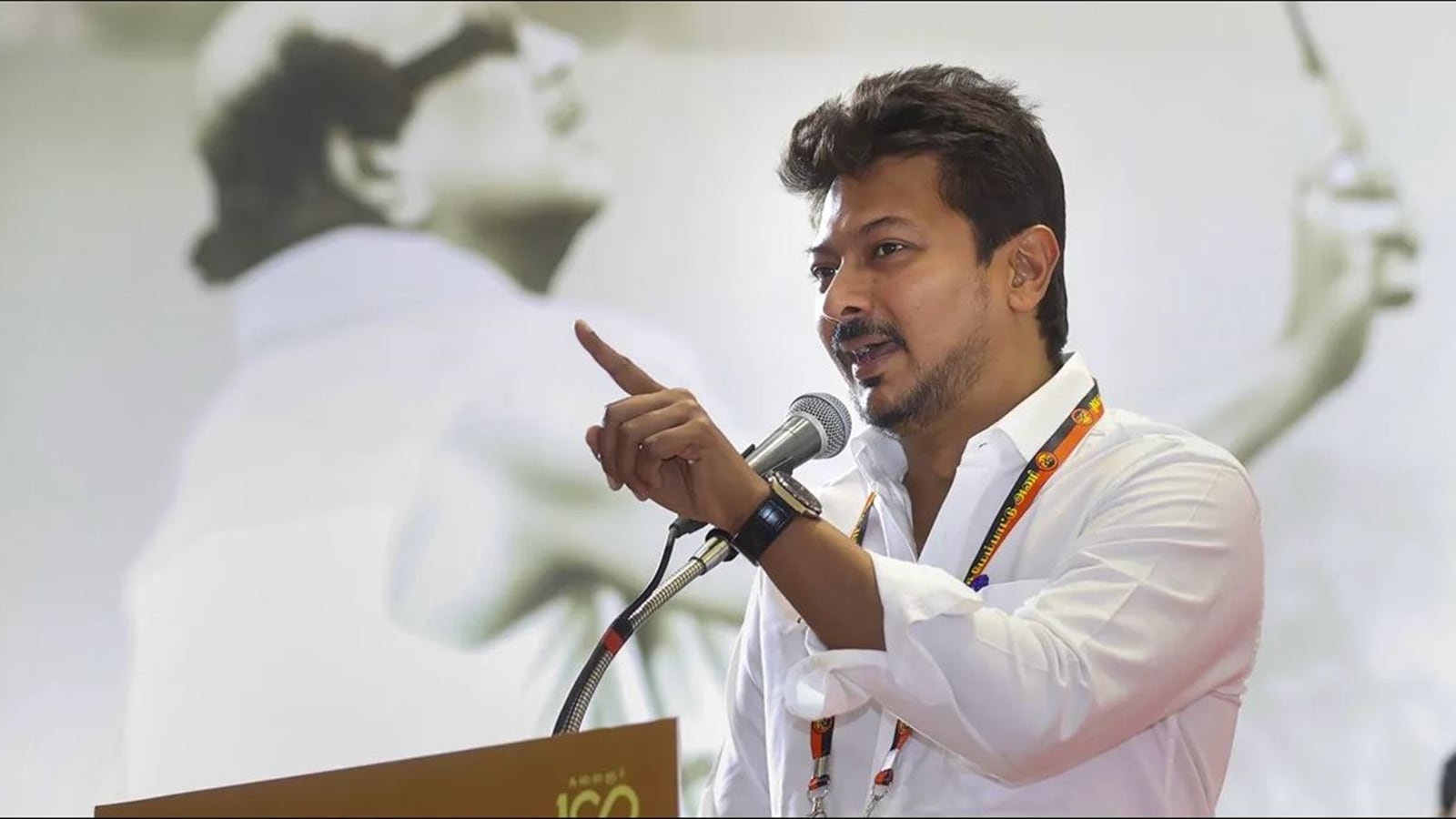
When Tamil Nadu Deputy Chief Minister Udhayanidhi Stalin stood on a Chennai stage on November 21 and described Sanskrit as a “dead language”, the immediate controversy focused on the tone: a political leader belittling a centuries-old tongue. But behind the phrasing lay a grievance about an imbalance in central funding for classical languages.
“Only Rs 150 crore was allotted for Tamil Development,” Udhayanidhi said at the book launch event. “In contrast, Sanskrit, a dead language, is getting Rs 2,400 crore.”
The Tamil Nadu leadership has repeatedly raised questions about disparities in funding — Udhayanidhi, Chief Minister M K Stalin, and Finance Minister Thangam Thennarasu have raised this issue — arguing that language policy and budgetary decisions reveal deep disparities. The concern is not that Sanskrit receives funding, but that other ancient languages are structurally under-resourced at the national level.
The BJP’s immediate pushback, however, did not centre on Budget numbers. Instead, party leaders accused Udhayanidhi of cultural denigration. Former state BJP president Tamilisai Soundararajan told PTI that “no one has the right to call any language dead, especially the one that is still used today in prayers and rituals across the country”. She warned against normalising a politics in which celebrating one language requires diminishing another, calling it “fundamentally wrong” and urging “more responsible” leadership.
Soundararajan also offered a linguistic genealogy rather than a political defence. “Tamil is an open-hearted language that has absorbed words and ideas from many tongues, including Sanskrit. This shows its strength, not its weakness.” Her remark echoed academic consensus that classical languages in South Asia developed not in isolation, but through exchange, migration, worship, trade, and translation.
K Annamalai, another former Tamil Nadu BJP chief, reframed the criticism altogether, arguing that “the state government itself has failed to develop Tamil”, suggesting that if Tamil requires greater institutional support, the DMK, not Delhi, should be held accountable.
However, this episode serves to illustrate a recurring pattern in Udhayanidhi’s political grammar. This is not the first time the DMK scion’s phrasing has triggered a political storm. In 2023, he characterised Sanatana Dharma as inherently discriminatory and therefore something that “must be eradicated”, prompting BJP leaders to accuse him of attacking Hinduism itself. But to many within the Dravidian movement, this sort of language is historically rooted, a political tradition forged in protest movements, self-respect rallies, and Constitutional battles over representation.
Story continues below this ad
The funding gap is less a matter of opinion and more a matter of accounting. Sanskrit receives central funds through multiple avenues: the Central Sanskrit University in Delhi (earlier, the Rashtriya Sanskrit Sansthan), central schemes for Sanskrit promotion executed through it, manuscript missions, scholarships and fellowships, and university departments under the Ministry of Education and allied ministries.
According to a reply to the Lok Sabha on December 19, 2022, the Central Sanskrit University (CSU), New Delhi, itself received about Rs 1,487.84 crore in grants between 2014-15 and 2021-22 for the promotion of Sanskrit, along with Pali and Prakrit languages. In contrast, the Central Institute of Classical Tamil (CICT), Chennai, received Rs 74.1 crore according to the reply.
The CICT has faced periodic controversies over administrative control, staffing, research stagnation, and inadequate expansion funding. Scholars have long argued that Tamil’s survival and flourishing have relied more on state government policy, diaspora patronage, and cultural emotional investment than sustained central institutional backing. This structural asymmetry is what Tamil Nadu leaders have repeatedly protested.
The Union government has defended Sanskrit allocations by invoking heritage preservation, academic continuity, and its relevance to philosophy, mathematics, linguistics and religious studies. Sanskrit is one of the 22 languages listed in the Eighth Schedule of the Constitution, is taught in universities and monasteries, and continues to shape Hindu liturgical life. Calling it “dead,” many scholars argue, is factually misleading, even if its conversational usage has diminished, or there is little commercial scope for it currently in the job market.
Story continues below this ad
But leaders in Tamil Nadu reason that Tamil, with its longer unbroken literary tradition, global diaspora, modern publishing ecosystem, digital evolution, and continued everyday use, receives disproportionately less recognition and support from the Centre. If government funding is an expression of cultural policy, then that cultural policy itself is contested by them.
‘Tamil is asking for parity’
With the language battle seen as a proxy for debates on autonomy, federalism, representation, and identity, in a state historically resistant to centralisation and going to the polls next year, some scholars asked if Udhayanidhi’s criticism of Sanskrit was justified.
The Tamil language scholars who spoke to The Indian Express on the condition of anonymity said Sanskrit was a language of extraordinary beauty, too.
“It is home to Kalidasa’s poetry, Bharata’s dramaturgy, Panini’s linguistic precision, Aryabhata’s mathematics, and philosophical traditions that have influenced the world. The language is not responsible for historical social exclusion. I agree and believe in this crucial political debate surrounding cultural politics, but better you blame political and religious institutions, not the language,” said a leading scholar.
Story continues below this ad
Tamil, he said, does not require Sanskrit’s diminishment to prove its greatness. “It stands on its own, with Sangam literature, Thirukkural, Silappadhikaram, Siddha poetry, Bhakti movements, grammatical works like Tolkappiyam, and a contemporary cinematic, academic and global cultural presence unmatched among Indian languages.”
Another scholar said the controversy was not a debate between pro and anti-Tamil forces or between secular politics and religious identity, but over what India chooses to remember, preserve, archive, translate, and teach to future generations. “While Udhayanidhi’s phrasing may have provoked unnecessary antagonism, the financial disparity he flagged is real and documented,” he said.
Asked if a cultural policy could be built without creating hierarchies among languages, another scholar said Tamil does not ask for superiority. “It asks for parity. And Sanskrit, which is elegant, ancient, and enduring, is not the villain in that demand. The policy choices are the villains,” he said.