
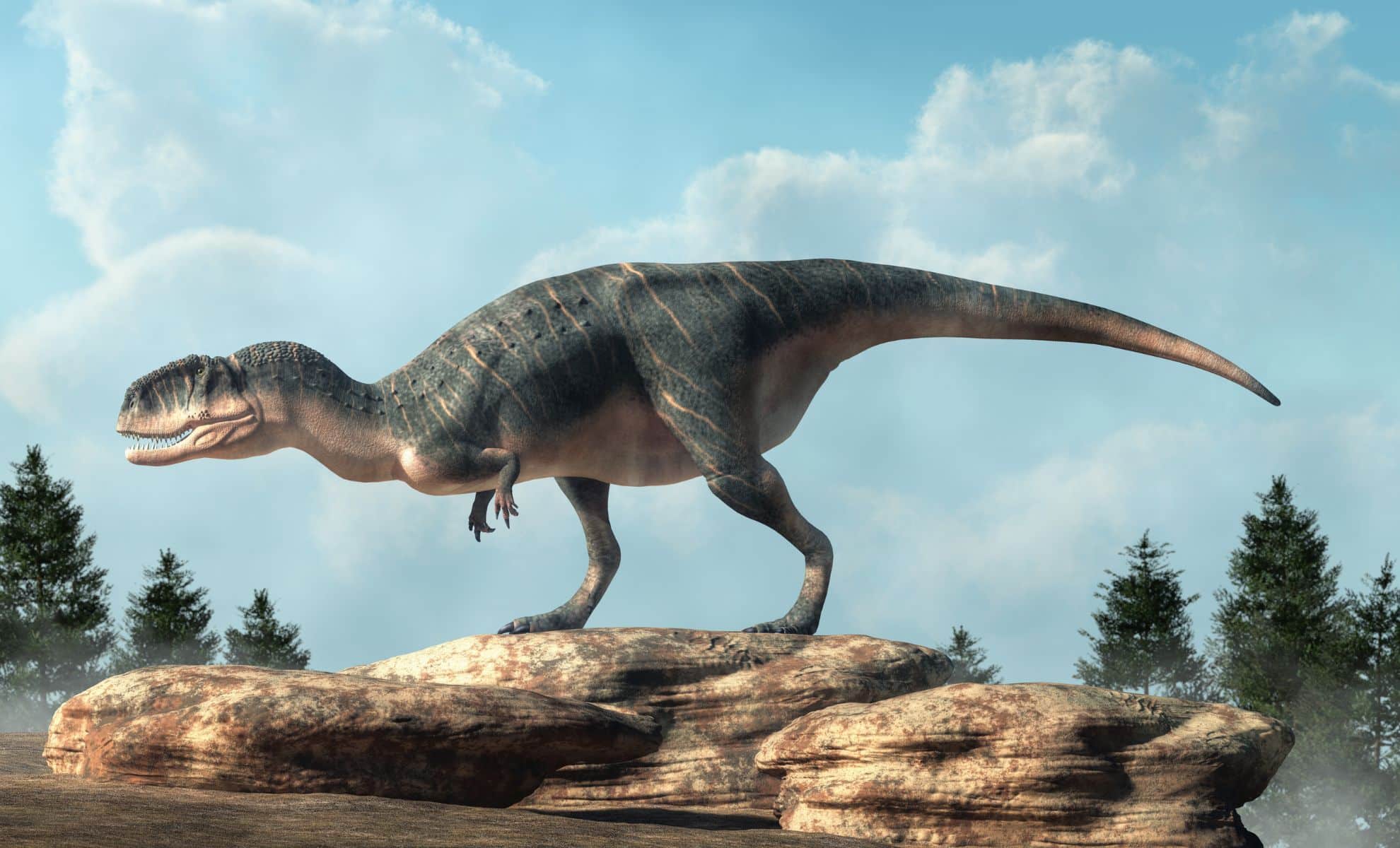
This groundbreaking find comes from the Otog region in Ordos City, China, where researchers uncovered multiple dinosaur trackways embedded in Lower Cretaceous sandstone. Among them, one in particular stood out: five consecutive prints showing a straight, sprint-like pattern, with deep toe impressions and barely visible heels, hallmarks of a dinosaur running at full tilt.
The study, led by Professor Wang Xiaolin and Associate Professor Jiang Shunxing from the Institute of Vertebrate Paleontology and Paleoanthropology (Chinese Academy of Sciences), confirms long-held theories about theropod mobility. Mid-sized, bipedal carnivores have often been modeled as agile hunters, but physical evidence of their top speeds remains rare. This newly documented trackway offers tangible proof of their athletic capabilities, placing the runner’s speed in the same category as modern professional cyclists.
An Unexpected Burst of Speed through Ancient Sediment
The trackway, designated T1, was preserved in the Jingchuan Formation, a fine-grained sedimentary layer formed in a shallow lake environment during the Lower Cretaceous. Measuring five clear footprints, each about 25 cm in length, the trackmaker is believed to belong to the ichnofamily Eubrontidae. The prints show sharp claw impressions at the toes, while the heel marks are faint or absent.
Researchers calculated the dinosaur’s hip height at around 1.01 meters and its body length at 2.65 meters, with a weight estimate of 109 kilograms. Using stride length and hip height ratios, they determined a relative stride length of 5.25. According to the study published in Springer Nature, a relative stride length above 2.9 signals running; a score above 5 is exceptionally rare. As noted in the publication, “This speed represents the fastest known theropod trackway in the Cretaceous period,” supporting estimates from previous biomechanical models.
The straight trajectory of the footprints and pace angulation near 180° further support the hypothesis of a high-speed sprint. The running pattern was so precise that researchers believe the dinosaur was likely operating near its physiological limit, achieving 45 km/h according to formulas by Thulborn and 41 ± 4.9 km/h by Ruiz and Torices.

Biomechanical Models Meet Fossil Reality
Before this discovery, much of what scientists knew about dinosaur speeds came from digital modeling and comparative anatomy. According to findings published in the same study, these trackways validate key assumptions from past analyses. Small to mid-sized theropods were expected to be faster runners than their massive relatives, such as Tyrannosaurus rex, whose size limited acceleration and endurance.
As stated by the researchers, “The running speed of the mid-sized theropod identified in this study aligns with predictions from existing biomechanical models,” including estimates by Sellers and Manning (2007), Hirt et al. (2017), and Hutchinson (2004), which all placed medium-sized theropods in the 40–50 km/h range.
This connection between theoretical work and physical trace evidence strengthens confidence in current methodologies used to study dinosaur motion. The ability to match fossilized behavior with digital reconstructions also allows scientists to revisit older sites with fresh perspectives, using refined models and improved data collection techniques.
A Rare Record of Dinosaur Behavior Etched in Stone
What sets this particular trackway apart isn’t just the speed, it’s also the clarity of movement preserved. Many fossilized trackways around the world are fragmentary or show signs of wandering, hesitation, or multiple animals interacting. In contrast, this one is nearly a straight line, suggesting deliberate motion, likely with a specific goal, whether hunting, fleeing, or chasing a rival.
According to the research team, large theropods like Chapus lockleyi also left tracks on the same layer, though they were walking at slow speeds. This mix of activity on a single surface hints at a moment in deep time when different dinosaur species moved through the same area, some at rest, some at full sprint.
As noted in the study, only a handful of such high-speed trackways have been recorded globally. This new discovery from China joins an exclusive group of fossil finds in countries like the United States, France, and South Africa. Yet even among that group, this trackway stands out as the fastest from the entire Cretaceous. And while skeletal fossils can tell us what a dinosaur looked like, only footprints can show how it lived, moved, and possibly even what it was doing in that ancient moment, one frozen in time beneath the surface of Inner Mongolia.