
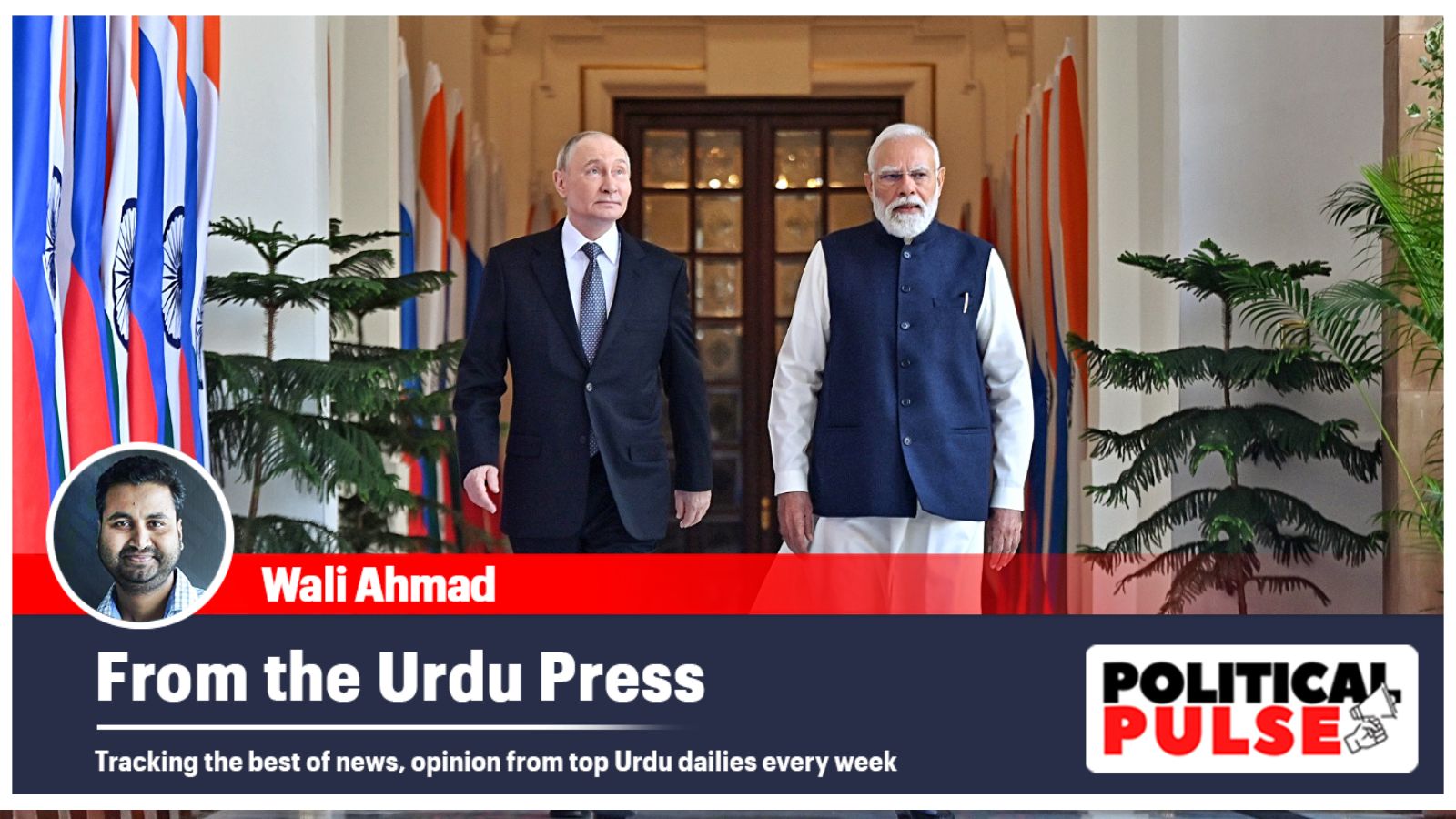
From the Vande Mataram debate in Parliament to Russian President Vladimir Putin’s two-day India visit, the Urdu Press touched upon several key issues that dominated the headlines over the past week. While the Urdu Times was scathing in its editorial on the Vande Mataram issue, Bengaluru-based Salar called Putin’s visit significant in further cementing the India-Russia ties. Roznama Sahara expressed deep concern over the recent Supreme Court observation on alleged “calls for economic boycott of a particular community”.
In its December 9 editorial, the Urdu Times was critical of the Centre over the debate on Vande Mataram in Parliament, saying the main objective of the BJP-led ruling dispensation was to make gains in the upcoming assembly elections in West Bengal. “Vande Mataram is a song, not a national anthem. The BJP and the Modi government are giving it undue importance,” it said.
The daily asked as to why there was such a fuss over Vande Mataram now. “This song inspired a lot of freedom fighters, but after 75 years, why is there a need to debate it now? Those whose ancestors did not even participate in the freedom struggle are also making allegations. The most valuable ten hours of Parliament were spent in debate but nothing was achieved,” the daily wrote.
“The BJP is trying to give it a communal color because it knows that Muslims will not recite it. This is why the BJP and other Hindu groups are trying to teach it to the masses. Jan Gana Mana, Vande Mataram and Sare Jahan Se Achcha Hindustan Hamara have been recited with equal fervour and devotion in the country. Even today, the Maharashtra Police Band plays Sare Jahan Se Achcha Hindustan Hamara,” the Times wrote.
The daily argued that there should be no compulsion to sing the song. “Whoever wants to sing it, let him/her sing it,” it said. The editorial felt the Modi government was trying to make the song a test of patriotism, underlining that only Muslims were being targeted. The daily noted that the secular fabric of the country is strong enough to withstand any attempt to break it.
Salar
Bengaluru-based Salar spotlighted Russian President Vladimir Putin’s two-day India visit, calling it a milestone in strengthening India-Russia ties. “The visit has not only stabilised relations but also sent a clear message to the entire world, including America, that if a friendship is strong, no power in the world can create a rift in it. Relations between India and Russia span approximately 8 decades, and both countries have always kept the doors of cooperation open,” the editorial noted.
Putin’s visit serves as a new milestone in strengthening India-Russia ties, which are already established on solid foundations, the daily said.
The editorial said India clarified that its foreign policy was determined by its national interests and the needs of its people. “This independent policy will continue in the future as well. India pledged to play a role in ending the Ukrainian war, but simultaneously stated that it would not bow to any pressure,” it said.
About the timing of Putin’s visit, the daily said, “The circumstances under which Putin visited India this time – understanding India’s stance with an open mind and agreeing to work together to strengthen cooperation – are significant. It is no secret that the recent punitive tariffs and sanctions by the United States have led to a complex international situation. Countries affected by these sanctions now face the challenge of searching for new options.”
Roznama Sahara
Roznama Sahara took a grim view of the recent observations of the Supreme Court on alleged “calls for economic boycott of a particular community”. On November 25, the Supreme Court had said that it was not inclined to either legislate or monitor every incident of hate speech across the country as legislative measures, police stations and high courts were already in place.
The daily observed that the order may seem practical from an administrative point of view, but from a constitutional point of view it raises deep concerns. “When hate speech is being normalised that leads to violence and undermines constitutional integrity, calling it a mere local law and order issue is tantamount to ignoring its systemic nature,” it noted.
“State institutions (police and high courts) are already in place, but the question is, if these same institutions are failing to prevent it, then how can the Supreme Court’s silence or abdication of its legal responsibility be justified in this situation? In its commendable judgment of 2018, the Supreme Court had declared the prevention of hate crimes as a sacred duty of the state, but now this sacred duty is fading away,” the editorial said.