
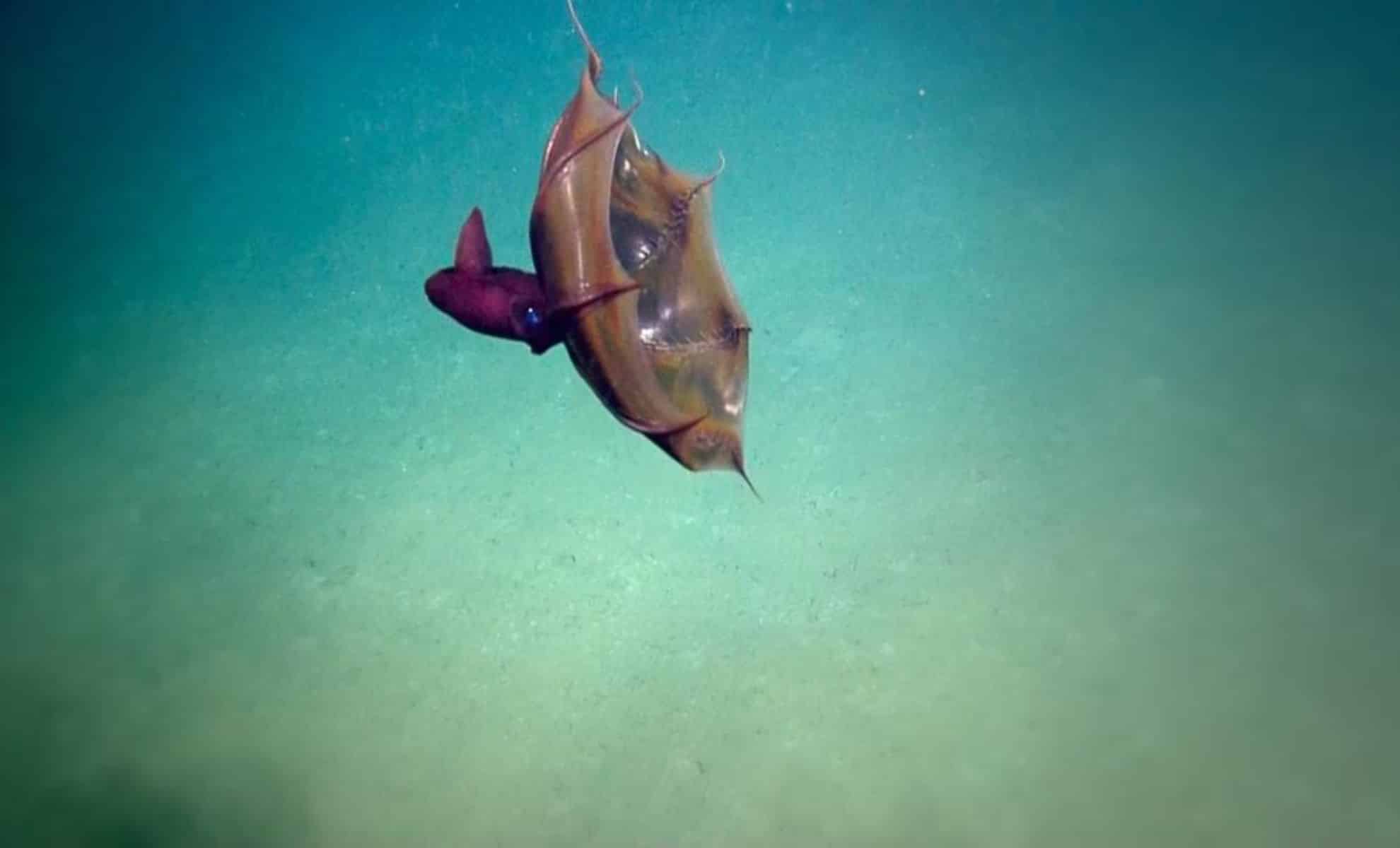
The vampire squid is the last surviving member of an ancient group called vampyropods, a lineage that dates back at least 165 million years. Despite being part of the octopus group, it shares many chromosomal features with squids and cuttlefish, organisms from a separate branch known as decapodiforms. This surprising genetic overlap has puzzled researchers for decades. Now, thanks to an international study led by the University of Vienna, scientists have sequenced its massive genome, revealing preserved DNA structures that act like time capsules from deep evolutionary history.
The study, published in iScience, confirms that the vampire squid stands at a crucial junction between octopuses and squids. Though it outwardly resembles an octopus, with eight arms and no tentacles, its chromosomes tell a different story. According to genomicist Oleg Simakov, one of the study’s lead authors, “The vampire squid sits right at the interface between octopuses and squids,” helping to bridge a long-standing gap in evolutionary research.
A Genome from the Depths
Clocking in at over 11 billion base pairs, the vampire squid genome is the largest ever sequenced in any cephalopod. It’s significantly larger than those of squids like Doryteuthis pealeii (4.4 Gb) and even surpasses the common octopus, Octopus vulgaris, which has a genome size of just 2.7 Gb.
Despite its size, the genome remains remarkably stable. More than 60% of it consists of repetitive elements, yet it shows little of the chaotic rearrangement seen in modern octopuses. This genomic stability is what led scientists to call it a “genomic living fossil.” The structure of the vampire squid’s chromosomes resembles those of ancient squids, preserving a pattern that likely existed before the major cephalopod branches diverged.
This makes the vampire squid a unique resource for researchers tracing the evolutionary steps that led to the modern diversity of cephalopods. “Although it is classified as an octopus,” explained biologist Emese Tóth from the University of Vienna, “the vampire squid retains a genetic heritage that predates both lineages.”
Chromosomal Reshaping in the Octopus Line
The study published in iScience also sequenced the genome of another species, the pelagic octopus Argonauta hians, and used it to compare chromosomal arrangements across cephalopods. What the researchers found was striking: octopus genomes have undergone widespread fusion events and chromosomal mixing, a process described as “fusion-with-mixing.” These changes are irreversible and have resulted in new regulatory regions that likely influenced the evolution of major traits.
According to the researchers, these fusion events reshaped the genetic map of octopuses, combining pieces of ancient chromosomes into entirely new units. This was not the case for the vampire squid, which retained much of the original layout seen in squids and cuttlefish.
The genetic architecture of the vampire squid shows that its lineage diverged before these major changes took place. The genome of Vampyroteuthis offers the strongest evidence yet that octopuses descended from squid-like ancestors and not the other way around. This chromosomal history is now seen as central to understanding how modern cephalopods came to be.

A Living Link to Vanished Ancestors
Beyond its size and structure, what sets the vampire squid apart is its position in the evolutionary tree. It represents the last living branch of vampyropods, a group that once occupied many marine niches but largely disappeared after the Cretaceous period. Its survival and preserved genome provide a rare snapshot of evolutionary stages that no longer exist in other species.
This unique position allowed the vampire squid to act as a “Rosetta Stone” for decoding cephalopod evolution. The researchers found that, while most octopuses exhibit intense chromosomal rearrangement, the vampire squid’s chromosomes remained largely untouched. That contrast is what makes it such a powerful model for studying how traits like arm specialization and shell loss developed, not through new genes, but through changes in chromosomal layout.
“The vampire squid retains a genetic heritage that predates both [squid and octopus] lineages,” said Emese Tóth in the same report, highlighting the value of this organism in evolutionary biology. While one of the rarest and most elusive creatures of the deep, the vampire squid has long captivated scientists with its appearance. Now, its genome has given researchers something far more valuable: a clear, preserved link to an ancient world that shaped the creatures still swimming today.