
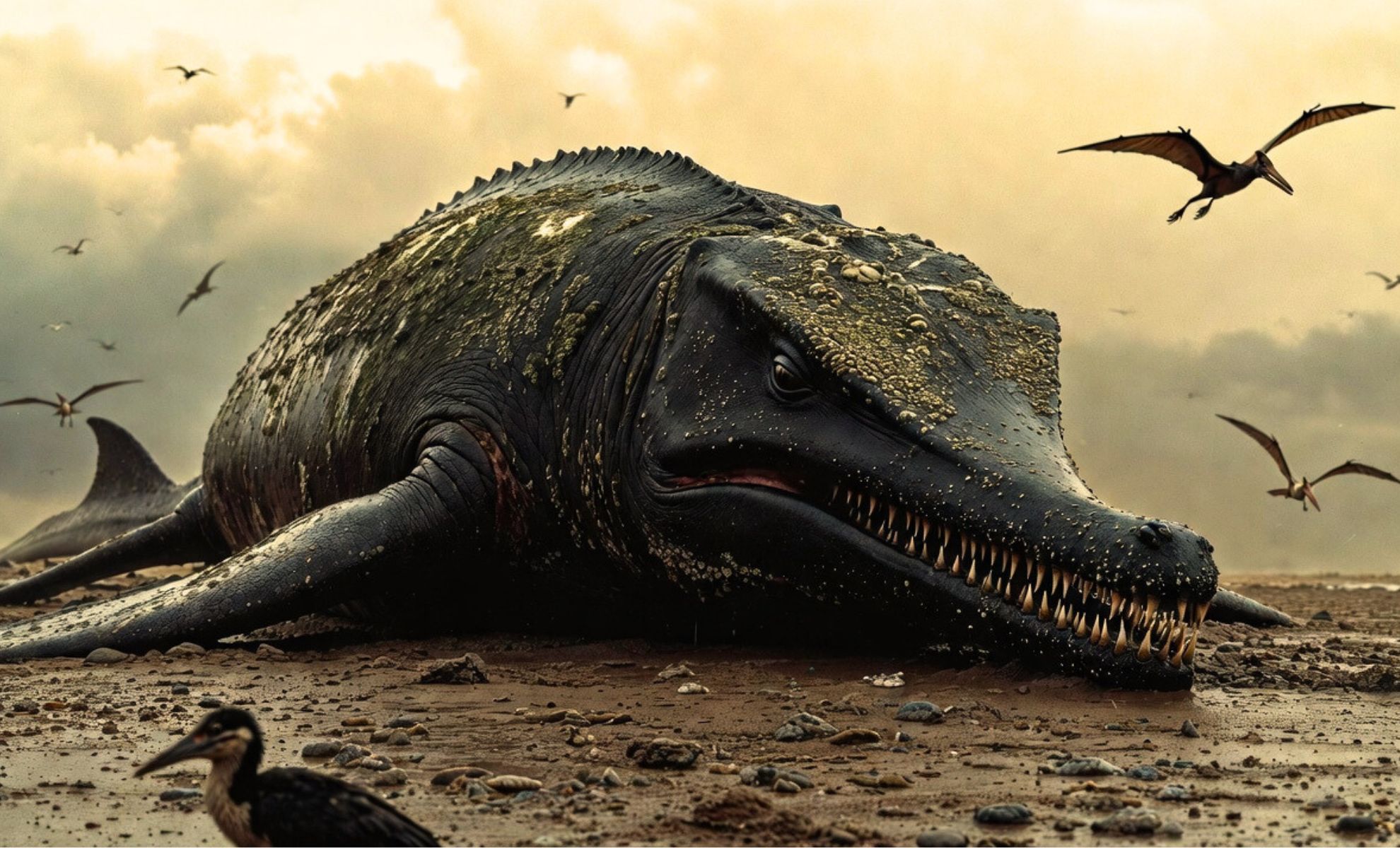
A significant fossil uncovered on the southwest coast of England has led scientists to identify a new prehistoric marine species, one that may represent the largest marine reptile ever recorded. The fossil, consisting of a lower jawbone over two metres long, belongs to a newly named giant ichthyosaur species: Ichthyotitan severnensis.
The bone was discovered in 2020 by 11-year-old Ruby Reynolds and her father during a routine fossil-hunting trip to Blue Anchor in Somerset. It matched in form and size a previously unearthed jaw fragment found in 2016 at Lilstock, roughly 10 kilometres away. Both fossils come from the Westbury Mudstone Formation, dating to the very end of the Triassic period, around 202 million years ago.

Researchers from the University of Bristol and University of Manchester analysed the fossils and confirmed their shared characteristics. These findings were formally published in a peer-reviewed study in PLOS ONE. The analysis suggests that the marine reptile may have reached a total body length of approximately 25 metres, placing it within the size range of today’s blue whales.
A New Giant Ichthyosaur Species
The fossil from Blue Anchor (catalogued as BRSMG Cg3178) was identified as a surangular, a key part of the lower jaw in ichthyosaurs. A similar specimen (BRSMG Cg2488) found at Lilstock had previously been described in 2018 but lacked the completeness necessary to define a new species. The new fossil preserved nearly two-thirds of the jaw, allowing for more accurate anatomical comparisons.
Detailed examination revealed several features not previously observed in known ichthyosaurs. These included a 90-degree curvature at the jaw’s posterior end, a laterally displaced coronoid process, and distinctive internal bone textures.

The researchers concluded that these traits, combined with the fossil’s exceptional size and shared geological context, support the classification of a new genus and species.
Both fossils come from the latest Rhaetian age, a critical interval just before the Triassic-Jurassic extinction event. The bone’s preserved structure indicates a large, fast-growing individual, distinct from smaller ichthyosaurs found in later periods.
Size Estimates and Anatomical Comparisons
Researchers used comparative anatomy to estimate the total length of Ichthyotitan severnensis. By comparing the jawbone’s dimensions with known ichthyosaur specimens, including Shonisaurus sikanniensis and Ophthalmosaurus icenicus, the team calculated a likely body length in the range of 20 to 25 metres.
The 2016 Lilstock jaw had originally been estimated at this size, but new findings from the Blue Anchor specimen allowed for more precise scaling. The team compared the distance between specific anatomical landmarks, such as the muscle attachment ridge and the coronoid process, to corresponding regions in other species. In each case, Ichthyotitan emerged as significantly larger.

In the published study, the authors caution that such size estimates remain tentative without a full skeleton. However, they emphasise that both jaw specimens show consistent scaling patterns and morphology, strengthening the conclusion that they belonged to a single, very large species.
Bone microstructure analysis also confirmed rapid growth. Thin sections revealed dense vascularisation, signs of continuous bone deposition, and a lack of growth halts. These features suggest that the animal was still growing when it died, supporting the possibility that some ichthyosaurs attained extreme sizes under favourable environmental conditions.
Fossil Context and Evolutionary Significance
The jawbone was embedded in sedimentary rocks from the Westbury Mudstone Formation, known for preserving fossils from the latest Triassic. This formation lies directly below the Cotham Formation, which contains geological evidence of the end-Triassic mass extinction, one of the five major extinction events in Earth’s history.
The study notes that Ichthyotitan may have been among the last of the giant marine reptiles before this extinction. After this event, ichthyosaurs survived but never again reached similar sizes. Later marine reptiles, including pliosaurs and mosasaurs, filled many of the ecological roles once held by ichthyosaurs, but evolved along different lines.

Additional bones, including vertebrae and ribs, were also recovered near the Blue Anchor site but have not been definitively linked to the jaw specimen. Some show signs of abrasion or belong to different layers. As a result, they were excluded from the formal description of Ichthyotitan.
Despite the limited fossil record, the researchers maintain that the morphological consistency between the Blue Anchor and Lilstock jawbones justifies their classification under a single taxon.