
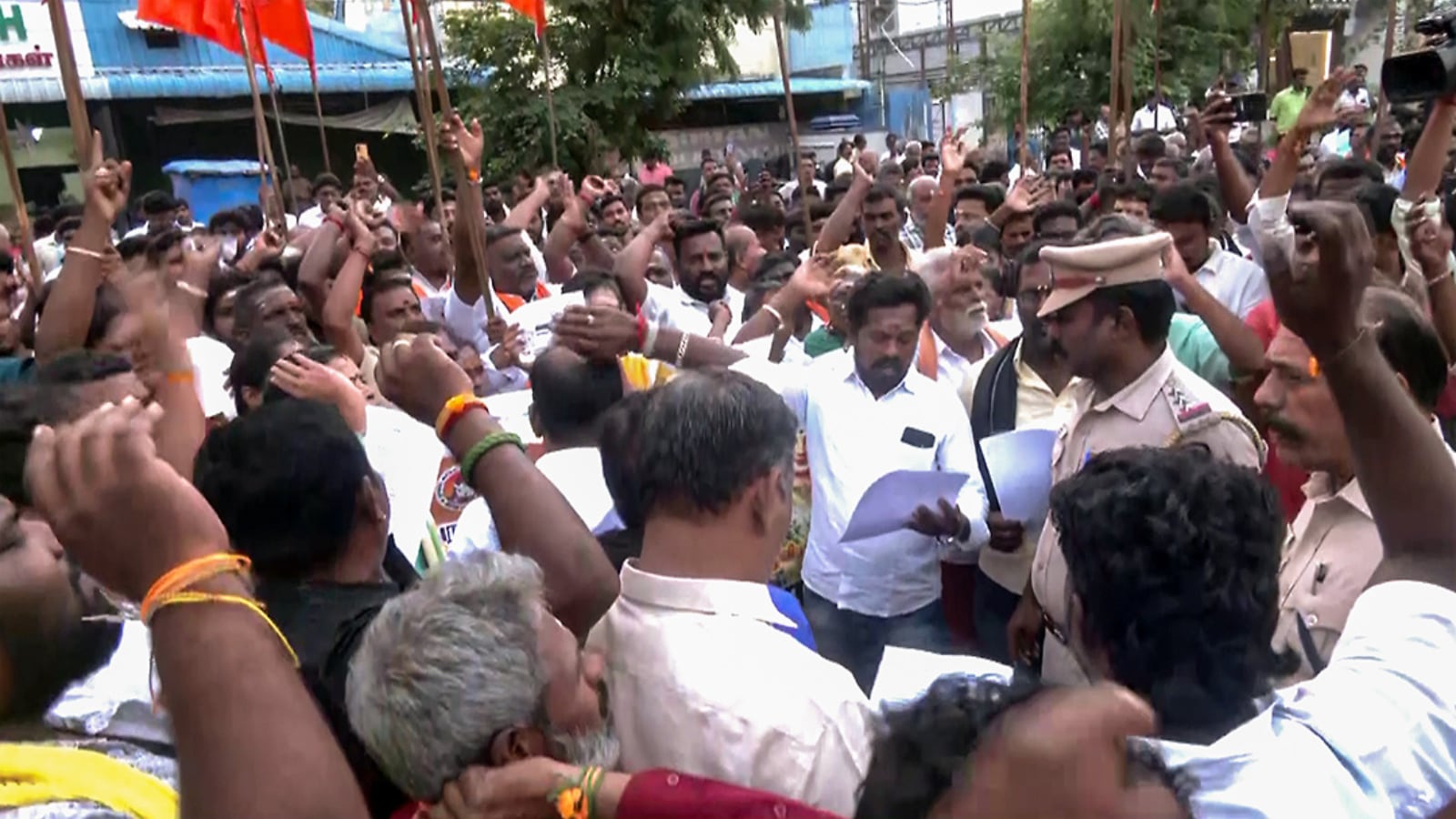
On an early December evening in Madurai, lighting the Karthigai Deepam flame at Thiruparankundram hill stopped being just a temple ritual and turned into a flashpoint in a state set to go to the polls in the next few months. As CISF personnel ring-fenced a disputed stone pillar between a Murugan temple and a dargah, a small but familiar group reassembled outside: functionaries, lawyers, and allies of the Hindu Munnani, a fringe organisation that had pushed the matter in court and onto television and mobile screens.
For four decades, that has been the Hindu Munnani’s job in Tamil Nadu. The outfit appears dormant for long stretches and then surges into view around a festival, any political violence, or, increasingly, a lawsuit, especially when elections are around the corner.
The Hindu Munnani was founded in the early 1980s by longtime RSS organiser Rama Gopalan at a time when the state was on the edge following the 1981 mass conversion of Dalits to Islam in Tirunelveli district’s Meenakshipuram. The organisation was conceived as the Sangh’s platform in Tamil Nadu, tasked with building Hindu identity politics in a state dominated by Dravidian parties and rationalist rhetoric.
From the early 1980s, Hindu Munnani built its base through attempts to reshape public religious practices. In Tiruppur in 1995, the “Hindu Mothers’ Munnani” organised a 10,008-lamp Tiruvilakku Puja, with women camping in a marriage hall to cook, collect donations, and prepare offerings. The group claims in a hagiographic account that “terrorists” came to plant a bomb at the event, but its volunteers nabbed them, but the police allowed the culprits to flee. The same narrative of “heroism” is projected onto its campaign to revive the massive Thiruvarur car festival, which Hindu Munnani frames as a rescue mission from “atheist hypocrisy jokes” and corrupt temple administrators.
In the 1980s and 1990s, activists from the outfit and allied groups were the “principal initiators” of Vinayaka Chaturthi street processions, using them to build local networks and occasionally triggering communal clashes. A senior functionary of Hindu Munnani said they were still pursuing such ideas, such as replicating Kumbh Mela in many more places in Tamil Nadu and even Kerala.
Enemies in the mirror
If festivals are the vehicle for soft power, the outfit clearly identifies its enemies. On its website, the Hindu Munnani states that the threat of “proselytisation” carried out by “Christian missionaries” and plays up the victimhood narrative when it comes to Muslims.
That rhetoric that seeks to tap into manufactured fears has translated into street-level confrontations. In 2020, after a politically charged campaign over the suicide of a schoolgirl in Thanjavur and an alleged conversion, four Hindu Munnani youth in Coimbatore were arrested for entering a church-school campus at night and defacing statues. Earlier episodes included the assault on Christian pilgrims en route to Velankanni and repeated efforts to block or disrupt small prayer and “faith-healing” meetings.
The group presents itself as a victim rather than an aggressor when it comes to the Muslim community. Its leaders cite a chain of murders, from that of state president Rajagopalan in 1994 and that of Vellore leader S Vellaiappan, to Tiruvallur district organiser K P S Suresh Kumar’s killing and most recently the 2016 murder of its Coimbatore spokesman C Sasikumar for which the NIA probed the role of Popular Front of India (PFI). The PFI, an Islamist organisation formed in 2006 that positioned itself as a counter to Hindutva groups, was banned nationwide in 2022 under UAPA for alleged involvement in terrorism.
Even outside communal flashpoints, the Hindu Munnani has learned to seize moments that serve as points of political symbolism. When a video surfaced in 2019 of M K Stalin speaking about Vedic wedding rituals, Rama Gopalan demanded an apology from the CM for “offending Hindu rituals, and in particular Brahmins reciting Vedas”. Later that year, the Hindu Munnani cadre burnt the effigy of actor-politician Kamal Haasan in protest against his remark that the “first terrorist of independent India was a Hindu”, a reference to Nathuram Godse.
The group has also tried to control how Islam appears on screen. In 2019, local Hindu Munnani and BJP cadre stormed the shoot of actor Karthi’s film Sulthan near a protected site in Dindigul, believing falsely that it was a biopic of Tipu Sultan, whom right-wing groups view as an anti-Hindu bigot. The film unit had to pack up and leave.
By February 2022, ahead of urban local body polls, the Hindu Munnani made explicit what had long been implicit: a Hindu vote-bank project. A resolution at its Trichy executive committee urged Hindus to take collective decisions, “irrespective of political parties”, for candidates who uphold “Indian values and culture.”
“We also aim to have such a collective and united Hindu front when we, as a community, face troubles,” Subramaniam told The Indian Express, naming an anti-conversion law as a core demand and ranking parties. “When it comes to the DMK and the AIADMK, the latter is better for our cause. And if it is the AIADMK and the BJP, the BJP is better for us.”
The court strategy
In recent years, the Hindu Munnani’s activism has moved towards filing lawsuits in courts. Its office-bearers were petitioners against a circular issued by a college in Thiruvarur in 2023 inviting students to criticise Sanatan Dharma; Justice N Seshasayee’s subsequent order reframed Sanatan as a set of “eternal duties” and warned that free speech on religion should not “inflict harm”.
In 2024, other functionaries approached the Madras High Court seeking the removal of current Deputy CM Udhayanidhi Stalin, state minister P K Sekarbabu, and MP A Raja over their comments on Sanatana Dharma. Though Justice Anita Sumanth refused to act against them while FIRs were pending, their remarks were described by the judge as “perverse and divisive” and “against the constitutional mandate”. Since then, the outfit has cited this as a moral victory.
And now, at Thiruparankundram, Hindu Munnani and allied activists are back again. Earlier this year, they led protests against alleged meat consumption on the hill and demands from some Muslim groups to call it “Sikkandar Malai”, forcing the government to deploy nearly 4,000 police personnel and impose prohibitory orders. In December, a known Hindutva activist with links to the outfit was the primary litigant in the Deepam case.
A small Hindutva organisation, rooted in the anxieties unleashed by Meenakshipuram and hardened by the parallel growth of their Muslim counterparts, has learned to punch above its organisational weight, turning festivals into campaigns, opponents into existential threats, and the courts into an arena to decide who speaks for Hinduism in Tamil Nadu.