
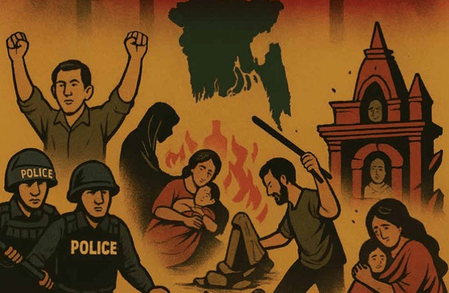
New Delhi, Oct 19 (IANS) Chittagong Hill Tracts or Parbotto Chattogram, comprising three districts — Rangamati, Khagrachhari and Bandarban — is home to Bangladesh’s indigenous population comprising 11 tribes, collectively known as the Jumma. 99 per cent of this indigenous population belongs to minority identities—both religious as well as ethnic, thus, a significant contributor to Bangladesh’s diverse population.
However, since the Partition of India, Chittagong Hill Tracts (CHT) that came under East Pakistan became subjected to widespread discrimination and violence, because of the policy of assimilation, leading to settlement of outsiders, that is, the ethnic Bengalis, coupled with the displacement of indigenous people under the pretext of development projects.
The once enjoyed special status of CHT, stripped off in 1963, remained unrestored after 1971 when Bangladesh achieved liberation as assimilation continued in the hills. Despite the signing of the 1997 Peace Accord, the Jumma population’s indigenous identity remains a contested topic in Bangladesh, while the term ‘adivasi’ or ‘indigenous’ is yet to receive legal recognition.
The section of the population that continues to bear the brunt of political uncertainty in Bangladesh since Sheikh Hasina’s deposition is Bangladesh’s religious and ethnic minorities. The free space given to religious radicalism has ushered in a new wave of majoritarian politics that has been systemically targeting minorities—their belief, culture and identity. This is despite the representation of an indigenous adviser, Supradip Chakma, in the interim government’s Chittagong Hill Tracts Affairs, established with the resolve to form a discrimination-free CHT.
Nevertheless, the complicity of the interim government, along with that of the Bangladesh Army, has further made things worse for the Jumma. Just a year ago, in September, tension erupted in the hills after a case of mob lynching of an ethnic Bengali settler on theft allegation in Khargrachhari was rumoured to be ethnically motivated. The ethnic violence that followed witnessed indigenous homes, businesses, and religious sites under attack—leading to at least four casualties, over 80 injuries and the displacement of indigenous families (as a result of land grab) in just three days.
The settler’s attack on Jumma resulted from provocative hate speeches by Muslim fundamentalists, amplified on social media. The Bangladesh Army was also accused of abetting violence, alleged to be backing the Bengali settlers against the indigenous population. As per Parbotto Chattogram Jana Samhita Samiti’s (PCJSS) annual report, Bangladesh security forces, along with fundamentalist groups, Bengali settlers and law enforcement agencies, have committed over 200 incidents of human rights violations, including about 2,314 illegal land grabbing and the destruction of about 119 indigenous properties and killing of 21 Jummas by Bengali Muslim settlers in the CHT, last year.
Of all the reforms initiated by the interim government, the rightful inclusion and recognition of the indigenous population have been tacitly excluded, irrespective of the new Bangladesh’s push for “pluralism”. Bangladesh is yet to see any fundamental reform surrounding the implementation of the Chattogram Peace Accord (1997), although the interim government formed a committee to monitor the process this January.
The same month, the country’s National Curriculum and Textbook Board (NTCB), giving in pressure from fundamentalists under the banner of Students for Sovereignty, removed the word ‘Adivasi’ from an artwork in a school textbook that symbolised the diversity of Bangladesh. When indigenous students gathered at the NTCB Bhaban in Dhaka to protest this, they were met with brutal attack, not only by Students for Sovereignty but also by security forces—a tight slap to the façade of an ‘all-inclusive’, ‘plural’ ‘new’ Bangladesh. The July Declaration, which is now hotly debated about its implementation, also makes no mention of Bangladesh’s indigenous communities or their issues.
Meanwhile, the CHT has witnessed a surge in sexual violence against indigenous women in the past year, with rape and attempted rape as the most common forms of violence, while abusers, usually Bengali settlers, enjoy impunity. As per the Kapaeeng Foundation, of the 24 incidents of violence against ethnic women reported in the first six months of this year, 21 were reported in the CHT, indicating a systemic pattern. Because of a deep-seated culture of impunity and distrust towards law enforcement, victims rarely pursue legal action, leading to strikingly low filing of cases (only 5 of 17 documented cases filed with police this year). It is also reported that police authorities often obstruct investigations, pressuring medical authorities to dismiss reports of rape, saving the perpetrators from accountability, and enabling the occupation of indigenous lands by Bengali settlers under the pretext of assimilation.
The latest violence in Khagrachhari in late September followed the same script. Following the news break of a gang-rape of an indigenous schoolgirl, widespread demonstrations by indigenous residents erupted in Khagrachhari. The peaceful protest through highway blockade organised by Jumma Chhatra Janata took a violent turn as security forces opened fire on crowds to supress the protest forcefully, imposed a curfew, leading to the killing of three indigenous people and several injuries.
CHT once again came under rampant communal tension when Bengali settlers, too, resorted to arson attacks targeting indigenous properties, forcing the displacement of many. This is believed to be a coordinated action, backed by the armed forces, as CHT came under increased militarisation with the deployment of BGB platoons. The protest is the culmination of frustration over the persistent ignorance of indigenous issues by the interim government, while using the indigenous community as a token of Bangladesh’s political morality.
The reaction of the interim government and the Bangladesh Army confirms this. The home advisor of the interim government, earning a reputation as the man behind Bangladesh’s present lawlessness, swiftly pointed his finger at ‘fascist groups’ sheltered by ‘the neighbouring country’ (indicating India), aimed at destabilising the country, behind the unrest.
The Bangladesh Army accused the United People’s Democratic Front (UPDF) and affiliated groups of inciting communal clashes via outside influence; a larger conspiracy aimed at destabilising the CHT. Senior joint chief coordinator of the NCP, too, echoed a similar sentiment of blaming India for destabilising CHT by using a ‘fabricated rape’ case to create a divide between Bengali settlers and the indigenous people, because India wants to take control over the CHT. This remark triggered a protest within the party, leading to the resignation of the only indigenous representative in the NCP. Like earlier cases, the medical report of the Khagrachhari rape victim released dismissed evidence of rape.
While Bangladesh’s political landscape is changing, the plight of the Chittagong Hill Tracts is turning deeper. The systemic pattern of violence and discrimination continues under the interim government, albeit more intensely. Now with more militarisation, the indigenous population endures land grabs by settlers. The process of implementation of the Chittagong Peace Accord remains a distant dream, as the interim government and political parties engage in paying lip service to the indigenous cause. In the new Bangladesh, the hills remain in a state of despair.
–IANS
uk
Disclaimer
The information contained in this website is for general information purposes only. The information is provided by BhaskarLive.in and while we endeavour to keep the information up to date and correct, we make no representations or warranties of any kind, express or implied, about the completeness, accuracy, reliability, suitability or availability with respect to the website or the information, products, services, or related graphics contained on the website for any purpose. Any reliance you place on such information is therefore strictly at your own risk.
In no event will we be liable for any loss or damage including without limitation, indirect or consequential loss or damage, or any loss or damage whatsoever arising from loss of data or profits arising out of, or in connection with, the use of this website.
Through this website you are able to link to other websites which are not under the control of BhaskarLive.in We have no control over the nature, content and availability of those sites. The inclusion of any links does not necessarily imply a recommendation or endorse the views expressed within them.
Every effort is made to keep the website up and running smoothly. However, BhaskarLive.in takes no responsibility for, and will not be liable for, the website being temporarily unavailable due to technical issues beyond our control.
For any legal details or query please visit original source link given with news or click on Go to Source.
Our translation service aims to offer the most accurate translation possible and we rarely experience any issues with news post. However, as the translation is carried out by third part tool there is a possibility for error to cause the occasional inaccuracy. We therefore require you to accept this disclaimer before confirming any translation news with us.
If you are not willing to accept this disclaimer then we recommend reading news post in its original language.