
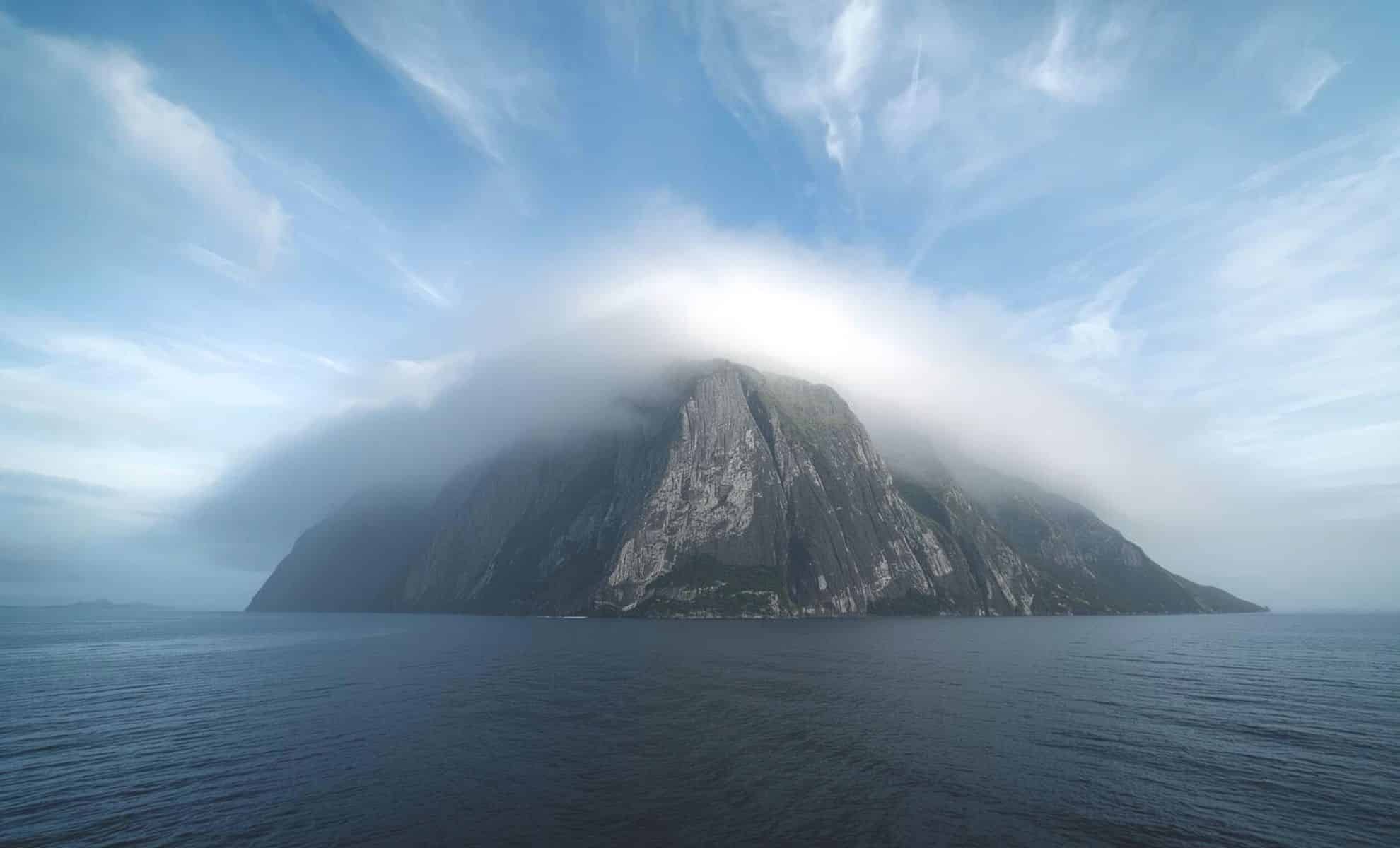
A previously unknown fragment of continental crust beneath the frigid North Atlantic is forcing scientists to rethink how Earth’s landmasses break apart. Researchers have confirmed the presence of a microcontinent hidden beneath the Davis Strait, a stretch of ocean between Greenland and Canada.
The team behind the discovery reconstructed ancient tectonic plate movements, identifying a thick slab of continental crust, 12 to 15 miles (24.14 km) in length, now submerged off Greenland’s western coastline. The find, detailed in a peer-reviewed study published in Gondwana Research, offers new insight into how microcontinents may separate from larger plates and survive intact for tens of millions of years.

This new structure—labeled the Davis Strait proto-microcontinent—was formed during a complex sequence of geological events between 33 and 61 million years ago. What makes it especially compelling is the region’s relative tectonic simplicity. Unlike other locations cluttered by volcanic arcs or fault zones, the Labrador Sea–Baffin Bay corridor is geologically clean, offering rare clarity into the dynamics of microcontinent formation.
Tectonic Shifts Carved a Hidden Landmass
The formation of the Davis Strait began when Greenland and North America started to drift apart nearly 61 million years ago. Initially, plate movement was diagonal—northeast to southwest—giving rise to the Labrador Sea and Baffin Bay. About five million years later, that motion pivoted to a more north-south alignment.
This change applied compressional forces along the crust, producing a thickened slab of continental material—what scientists now call a submerged microcontinent. It remains buried under the Davis Strait, largely undisturbed by major seismic or volcanic activity.

The simplicity of the region’s tectonic record gave researchers a rare opportunity to model the area with high precision. They traced how the combination of shifting plate directions and transpressional stress likely contributed to the landmass’s separation from the main continental crust. These findings are outlined in the full analysis available via ScienceDirect, the journal’s online platform.
Their models point to a tectonic process that could explain the creation of other microcontinents, suggesting that similar hidden landforms may exist in other parts of the world where plate motion histories are clean and traceable.
Global Clues from a Quiet Corner of the North Atlantic
This discovery joins a growing list of evidence that Earth’s crust fractures more often—and more subtly—than previously understood. From Zealandia in the South Pacific to Mauritia beneath the Indian Ocean, researchers have increasingly identified fragments of crust that have detached without forming new, full-scale continents.
What makes the Davis Strait region stand out is how cleanly its tectonic story can be read. The absence of major overprinting—like volcanic activity or later collisions—makes it possible to isolate key processes involved in microcontinent formation.

Meanwhile, another group of researchers has explored deeper beneath the region. A recent study led by the University of Ottawa used high-resolution 3D models to map mantle temperature variations below Greenland. These models indicate that the island passed over the Iceland hotspot, affecting how the crust responded to earlier tectonic shifts. Their work, published in the Proceedings of the National Academy of Sciences, is summarized in detail by EurekAlert!.
This second layer of evidence helps explain why Greenland’s lithosphere behaves the way it does—and how those deep processes contributed to the separation of the Davis Strait fragment.
The Ottawa study also highlights how subsurface temperature gradients impact how ice sheets interact with the underlying crust, adding valuable context to climate models and projections for global sea-level rise.
A Deeper Map of Earth’s Crust Is Emerging
Though buried beneath icy waters, the Davis Strait microcontinent sends a powerful signal: Earth’s crust is far more fragmented and layered than traditional maps suggest. Each new discovery of a submerged continental fragment sharpens our view of the planet’s tectonic architecture.
Findings like this one also expand the toolkit for researchers tracking how continents evolve. Combining seismic imaging, mantle modeling, and plate motion reconstructions is helping scientists build more accurate forecasts—not just for the past, but for the future of tectonic activity.
The Davis Strait discovery may also play a role in improving assessments of seismic risk, guiding natural resource exploration, and refining our broader understanding of plate tectonics. The clarity of this particular site—devoid of overcomplicated fault systems—provides a geologically rare case study of how microcontinents detach and persist.