
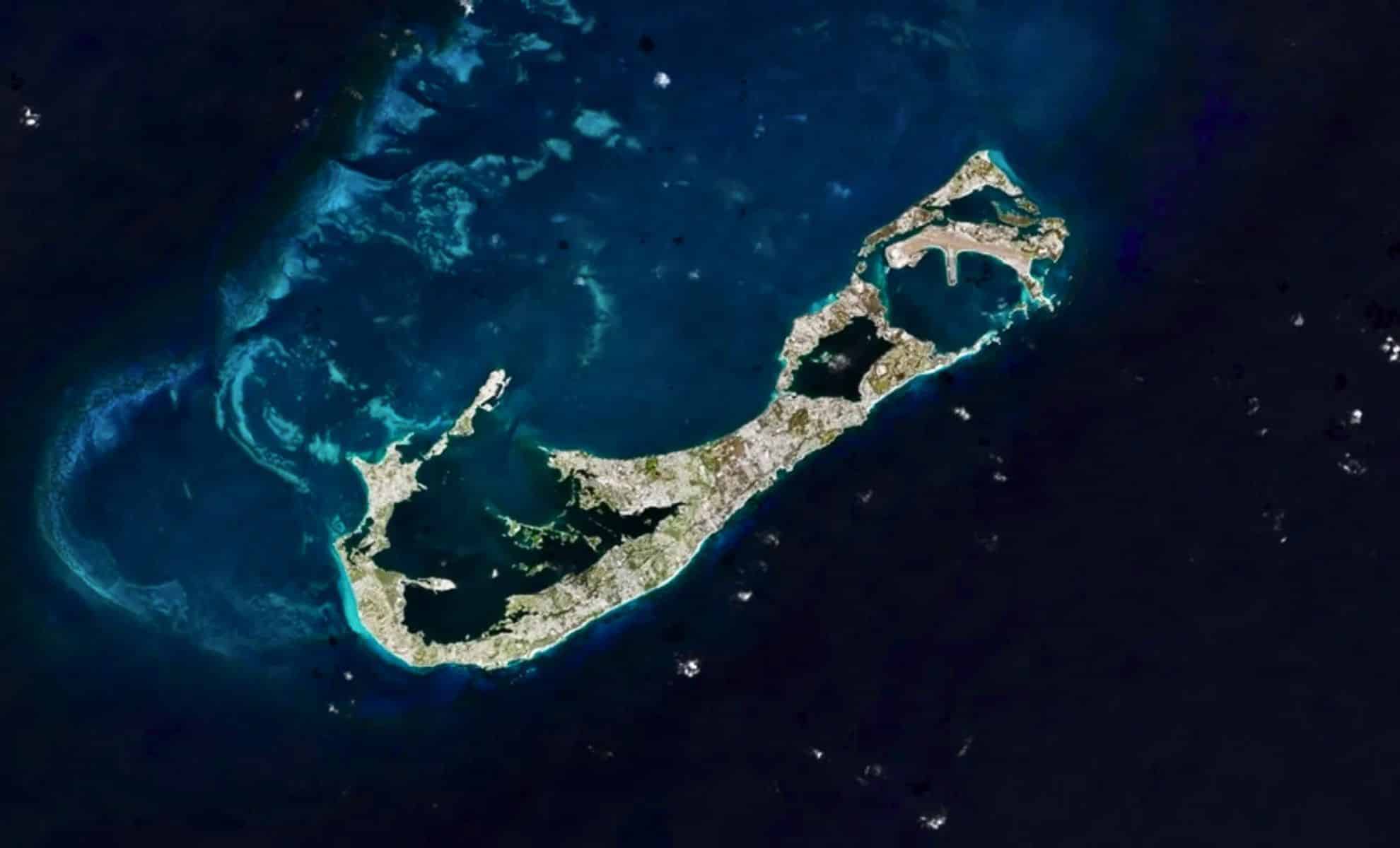
A dense and unusually thick rock formation has been identified beneath the Bermuda archipelago, challenging long-established theories about how ocean islands are formed. Using high-resolution seismic imaging, researchers mapped a hidden 20-kilometer-thick layer deep beneath the seafloor, located between the oceanic crust and Earth’s mantle, a position where such material is not typically found.
The feature, revealed by a research team led by geophysicist Dr. William Frazer of Carnegie Science, appears to be the result of ancient volcanic activity that does not fit traditional “hot spot” models. Instead, the findings suggest an alternative island formation process linked to deep mantle dynamics and continental history.
Elevated roughly 500 meters above its surrounding seabed, the Bermuda platform owes its uplift not to recent tectonic activity but likely to a solidified, low-density rock body injected into the crust millions of years ago. The anomaly helps explain Bermuda’s persistent elevation and opens new avenues in the study of plate tectonics and deep Earth structure.
20-Kilometre-Thick Anomaly Revealed by Seismic Imaging
The study, published in Geophysical Research Letters by Frazer and colleagues, used seismic tomography to examine wave velocity changes through subsurface rock layers. The research, titled “Voluminous Mafic Intrusions Beneath Bermuda Suggest an Atypical Volcanic Origin”, details the unexpected presence of an additional low-density layer beneath the crust.

Bermuda’s unique location made it possible to scan the subsurface to depths of 50 kilometers using a local seismic station. The data revealed a distinct layer measuring approximately 20 kilometers thick, sandwiched between the crust and the mantle. An anomaly absent in most oceanic settings.
Researchers interpret the layer as a massive solidified magma body, injected into the crust around 31 million years ago during a single volcanic episode. This deep-seated intrusion has since formed a rigid platform beneath the island chain, contributing to its elevation long after surface volcanic activity ended.
Bermuda Differs From Traditional Volcanic Island Chains
Oceanic island chains like Hawaii generally form above mantle plumes, known as hot spots, which produce repeated volcanic eruptions as tectonic plates drift overhead. Over time, islands subside and erode after moving away from the heat source.
In contrast, the elevation of Bermuda has remained stable despite the absence of recent magmatic activity. The study’s findings, covered in Live Science’s analysis, suggest the uplift is maintained by a deep, buoyant structure embedded within the crust itself, one not powered by ongoing magma flow.

The research identifies a formation pathway independent of hot spot dynamics, pointing instead to a crustal modification process initiated by mantle-derived magmatism that never breached the surface. This sets Bermuda apart from other mid-ocean islands and introduces a new model for how isolated oceanic landmasses can form and persist.
Carbon-Rich Mantle Source Linked to Supercontinent History
Further evidence supporting this model comes from geochemical research conducted by Dr Sarah Mazza at Smith College. Her work, published in the journal Geology, investigated zinc isotope ratios in volcanic rocks collected from Bermuda.
The peer-reviewed study, Zinc Isotope Constraints on the Cycling of Carbon in the Bermuda Magmatic System, found that the island’s lavas are unusually low in silica and bear a geochemical signature consistent with a carbon-rich mantle source. These findings suggest a deep origin for the magma, with the carbon likely introduced during the formation of the supercontinent Pangaea, between 300 and 900 million years ago.
Rather than forming along modern plate boundaries or volcanic arcs, Bermuda may represent a rare example of an island born from the remnants of ancient continental processes stored in the deep mantle and later activated by isolated magmatic events. The carbon signature, preserved in zinc isotopes, provides a direct chemical link to that deep-seated origin.
Implications for Oceanic Geology and Deep Earth Studies
The presence of this large, low-density structure beneath Bermuda invites comparisons with other mid-ocean islands, many of which have not been extensively studied below the crust. Researchers suggest that similar features could exist undetected in other regions, awaiting discovery through modern imaging techniques.
If these findings are replicated elsewhere, they could revise how scientists interpret the relationship between ancient mantle processes, crustal formation, and ocean island development. The anomaly also holds significance for the study of deep carbon cycling, which plays a critical role in long-term planetary climate and geochemical evolution.