
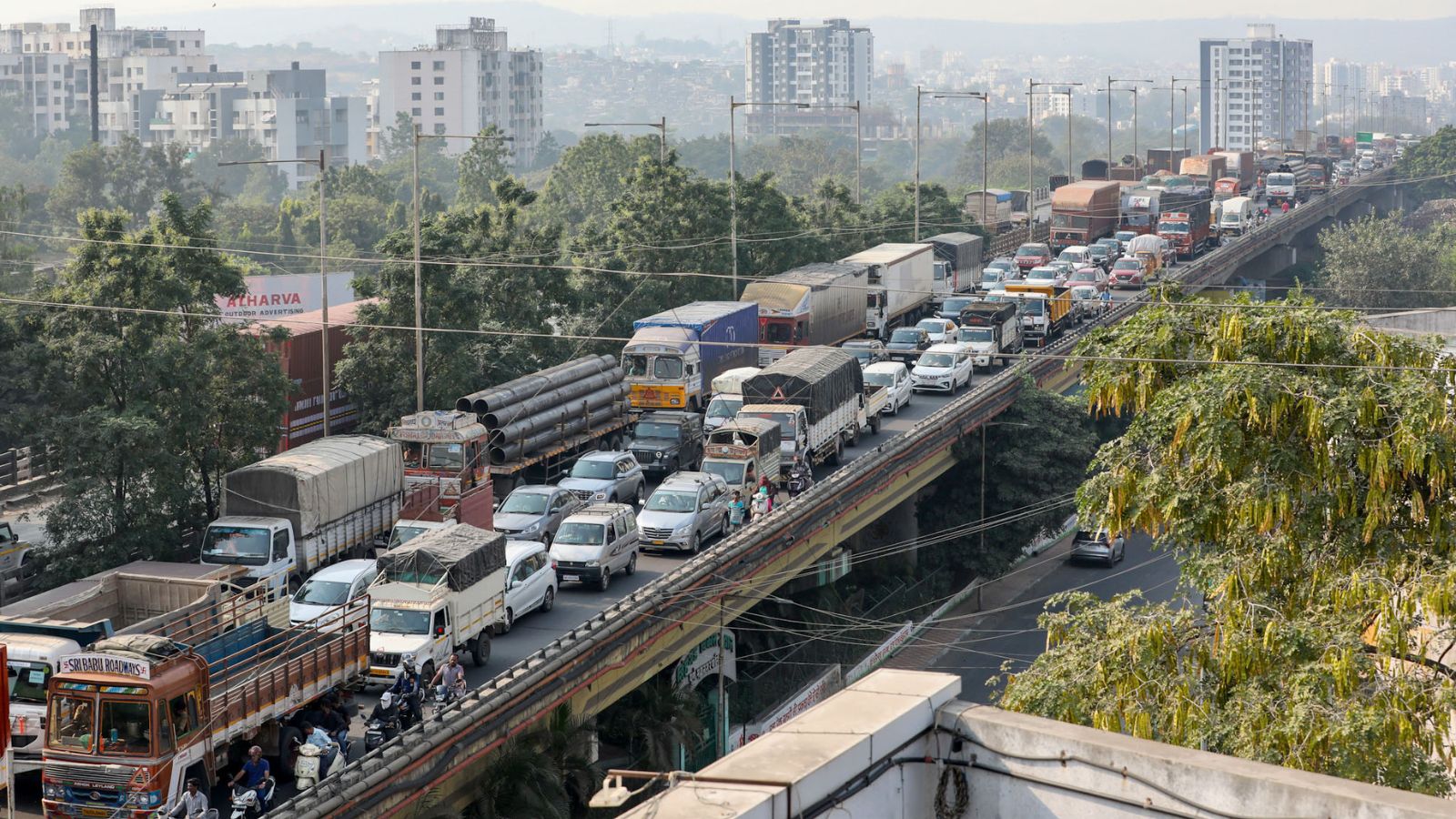
A common joke about Bengaluru traffic is how young techies often find love and companionship — in cars and buses during their commute for work since they spend hours in traffic jams.
On November 20, even astronaut Shubhanshu Shukla, the first Indian to set foot on the International Space Station (ISS), took a dig at the city’s infamous traffic.
To address the Future Makers Conclave at the Bengaluru Tech Summit 2025, IAF Group Captain Shukla had travelled nearly 34 km from Marathahalli in the east to the Bangalore International Exhibition Centre in the north.
“I have spent thrice the time (in traffic) that I am going to be spending on this presentation for you (20 minutes). So you must see the commitment that I have…You can reach space faster than you can reach Tumkur Road from Marathahalli (in Bengaluru),” he had quipped.

So when and how did the traffic situation in Bengaluru spiral?
Considered a sleepy pensioners’ paradise, till the mid 1990s, Bengaluru was a Garden City with its seemingly broad roads lined with large trees. In the early 2000s, the tech boom hit Bengaluru. Ill-prepared for the influx of people and vehicles, the city soon started bursting at the seams.
According to the Karnataka government’s 2020 Comprehensive Mobility Plan for Bengaluru, the city’s growth rate between 1991 and 2001 was 38% — making it the fastest-growing Indian metropolis after Delhi.
Story continues below this ad
Then came the heightened focus on personal vehicles over public transport. All these factors have, over nearly 25 years, given Bengaluru the ignominy of being among the worst traffic burdened cities in the world.
Today, according to the traffic police, nearly 60% of the city’s traffic is concentrated along 200 km of roads in the main traffic corridors. Police data on the morning peak hour (9-10 am) saw congestion of over 100 km across the city, while the same for the evening peak hour (6-7 pm) was spread over 210-230 km.
Bengaluru also has the worst peak hour congestion, with 38% congestion (4% percent higher than 2023) and a congestion ranking of 65 (where a ranking of 1 is the worst) compared to Pune at 127 and Kolkata at 173, according to the TomTom Index.
Road time vs flight time
Despite years of band-aid solutions, peak-hour congestion continues to affect the city’s famous IT corridors, including Silk Board, Hebbal Flyover, Marathahalli, K R Pura Flyover and Outer Ring Road, among others.
Story continues below this ad
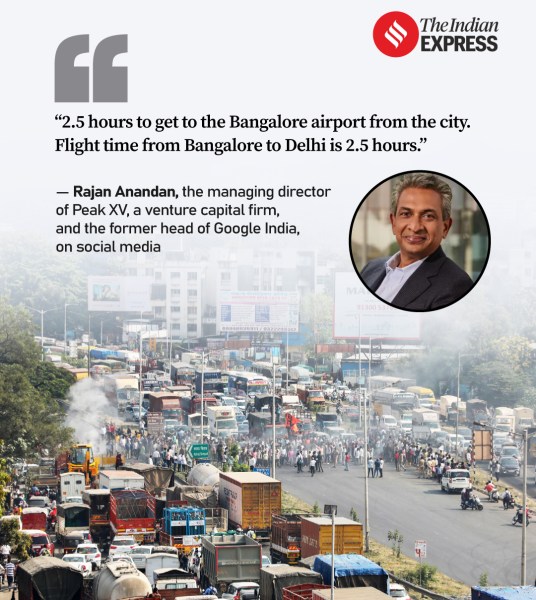
On October 14 this year, Rajan Anandan, the managing director of Peak XV, a venture capital firm, and the former head of Google India, had lamented on social media, “2.5 hours to get to the Bangalore airport from the city. Flight time from Bangalore to Delhi is 2.5 hours.”
He is not alone.
Varsha M, 26, an advertising executive, goes to office five days a week. Earlier a resident of south-east Bengaluru’s Ejipura, she said cabs and autorickshaws would refuse to ferry her to the Central Business District (CBD), the city’s commercial centre, during peak hours due to congestion at Ejipura and Koramangala.
“Besides no metro connectivity, the buses from Ejipura were always packed. So I shifted to Indiranagar, which is closer to the CBD. My daily commute has reduced from over two hours to 40 minutes,” she says.
The problem, according to data and experts, lies in the exponential growth of vehicles in the city. According to the Karnataka Transport Department, the city population went up nearly 50% — from 84 lakh in 2011 to nearly 1.23 crore in August 2025, while the number of registered private vehicles jumped by over 200% during the same period — from 40 lakh to a whopping 1.21 crore. Of these, 82.83 lakh are two-wheelers and 23.83 lakh cars. In comparison, public vehicles stand at a mere 13 lakh.
Story continues below this ad
According to the Ministry of Road Transport and Highways, only Delhi — with 1.54 crore vehicles — ranks above Bengaluru in the per vehicle record. While Mumbai has a vehicle population of over 56.3 lakh, Chennai has around 57 lakh vehicles and Kolkata 37.3 lakh vehicles. Population growth in these cities ranges between 45% and 50%.
Even the TomTom Traffic Index says so. The survey, which rates traffic situations in over 500 cities across the world on the basis of floating car data, confirms that Bengaluru’s traffic situation is truly terrible.
In 2024, the index ranked Bengaluru as having the third worst traffic in the world, with commuters spending nearly 34.10 minutes for every 10 km of travel. City residents also took 38.55 minutes to cover 10 km at an average speed 15.5 km per hour (kmph) in peak morning traffic and 41.59 minutes at an average speed 14.3 kmph in the evening.

Is the traffic situation a new phenomenon?
Drafted by the Karnataka Urban Infrastructure and Development Finance Corporation (KUIDFC), the state-run agency responsible for financing and implementing urban infrastructure projects, a 2011 Comprehensive Traffic and Transportation Plan for Bengaluru blamed the city’s abysmal traffic on the lack of adequate public transport.
Story continues below this ad
The plan states, “Traffic composition on roads indicates a very high share of two-wheelers. The share of cars is also growing. This indicates (an) inadequate public transport system.”
In a draft for a Bengaluru Transit Oriented Development Policy, the plan adds, “Rapid growth of private vehicles, coupled with inadequate road network, has resulted in lower travel speeds, longer commuting time, traffic congestion, road fatalities, vehicular pollution, which, in turn, led to economic costs and had an adverse impact on the quality of life.”
Bengaluru has the lowest share of public transport systems among Indian cities, consistently serving only around 30% of its population. Although this figure has grown to 48% with the metro, it is still abysmal compared to cities like Mumbai and Kolkata, where nearly 80% of the population relies on public transport.
Incidentally, one of the workarounds used by executives flying into Bengaluru to give the city’s traffic a miss is to fly in late at night and leave by an early morning. At 3 am, traffic congestion can be as low as 1.4 km against 20.8 km at 11 pm.
Story continues below this ad
Jams on the Electronic City route — which runs along NH-48 — often spill over onto the Silk Board junction, as commuters going to Electronic City either descend the elevated flyover’s ramps or wait to climb them during peak traffic hours.
The 9.99-km elevated flyover to Electronic City was built after heads of top IT firms in Bengaluru, like Infosys and Wipro, had leaned on the Manmohan Singh-led United Progressive Alliance (UPA). Built around 2010 at a cost of Rs750 crore by the National Highways Authority of India (NHAI), the elevated flyover had temporarily shaved the nearly 150-minute commute time.
Mohammad Akbaruddin, 42, a senior executive at a tech company in Electronic City, is required to be in office just twice a week. Though he takes the company bus, the commute from his east Bengaluru residence to Electronic City takes nearly 90 minutes in the morning and over two hours in the evening.
“There has been a marginal improvement in traffic for east Bengaluru residents over the years. The opening of Namma Metro’s yellow line in August has worked well for south Bengaluru residents,” he says.
Story continues below this ad
The opening of the yellow line from south Bengaluru to Electronic City in August this year reportedly reduced traffic congestion during peak traffic hours on the stretch by 38% (morning) and 37% (evening), according to a traffic police survey. Incidentally, Bengaluru’s metro network is spread across just 96.1 km at present.
While metro ridership is increasing, the ridership rate per day per km is “significantly low compared to Delhi, Mumbai and select global cities,” states a report by the Asian Transport Observatory, which conducts transport sector analysis, published earlier this year.
According to the Asian Transport Observatory’s 2025 report on the state of play for urban transport in Bengaluru, the city has a “low rapid transit to resident ratio at about 2 km per million population compared to the majority of the Indian cities”. In comparison, New Delhi and Chennai have a rapid transit to resident ratio of 10 km for every 10 lakh population, Mumbai of 9 km, Kolkata of 7 km and Hyderabad of 4 km per million population.

In 2020, Bengaluru’s metro ridership was 10,000 per km per day compared to 30,000 for Delhi Metro’s yellow line, 40,000 for the Mumbai rail network, 15,000 for Singapore and 20,000 for Hong Kong.
Story continues below this ad
In a shift from the focus on expansion of roads to fit more cars, the 2020 Comprehensive Mobility Plan (CMP) for Bengaluru suggests expanding the city’s metro rail network and suburban rail services with huge investments as “the way forward”.
However, this is easier said than done. According to a 2025 Asian Transport Observatory report, Bengaluru falls short of the requirements of land share for transportation and communication. “The general norm is 20%, but most cities achieve at least 15%. Bengaluru is bestowed with only 7.3%,” it states.
What Bengaluru’s current road network is like
Over the last 25 years, development in Bengaluru has been largely centered around 200 km of key road corridors falling under the Bengaluru Metropolitan Region. Served by thousands of small roads, often at the scale of village roads in width and traffic capacity, are incapable of handling the traffic linked to the main road corridors.
Spread over nearly 1,294 sq km, the Bengaluru Metropolitan Region falls under the recently created Greater Bengaluru Region. Even the Bruhat Bengaluru Mahanagara Palike, the core metropolitan area that is spread over 712.54 sq km, falls under the Greater Bengaluru Region.

The 2011 Comprehensive Traffic and Transportation Plan pointed out that Bengaluru’s road network capacity is “inadequate”. “Most major roads are four-lane or less, with limited scope of widening…The junctions are closely spaced on many roads. Many junctions in the core area are with five legs. This makes traffic circulation difficult,” it notes.
Recently, the state pushed a plan for a twin tunnel road across a 17-km stretch cutting through the most congested parts of the city in the north, centre and south.
Despite concerns about the long-term feasibility of the Rs 17,968-crore project, Deputy CM Shivakumar said that “only God can stop” him from going through.
Meanwhile, to improve the road network in south-east Bengaluru — around Outer Ring Road, a current choke point due to metro construction on the route — Karnataka Chief Minister Siddaramaiah had written to Wipro chairperson Azim Premji on September 19 requesting a traffic thoroughfare through Wipro’s 30-acre Sarjapur campus.
Siddaramaiah wrote that routing traffic through the Wipro campus, which can accommodate over 30,000 workers, would “go a long way in contributing to a more efficient and livable Bengaluru”.
Declining his request on September 24, Premji cited “significant legal, governance, and statutory challenges since it is an exclusive private property owned by a listed company not intended for public thoroughfare”.
“Moreover, public vehicular movement through a private property would not be effective as a sustainable, long-term solution,” Premji’s letter states.
On October 13, Kiran Mazumdar-Shaw, the founder and chairperson of the Bengaluru-headquartered biotech firm Biocon Ltd, put out a social media post. The post by Mazumdar-Shaw, an advocate for a better Bengaluru for over 25 years and an active participant in improvement measures, tagged Siddaramaiah, his deputy D K Shivakumar and IT Minister Priyank Kharge. Her post states, “I had an overseas business visitor to Biocon Park who said, ‘Why are the roads so bad and why is there so much garbage around? Doesn’t the Govt want to support investment? I have just come from China and can’t understand why India can’t get its act together especially when the winds are favourable?’.
On October 14, Shivakumar posted a reply on social media, “Bengaluru has given opportunities, identity, and success to millions — it deserves collective effort, not constant criticism… Yes, challenges exist, but we’re addressing them with focus and urgency…Major infrastructure works are underway to make Bengaluru more globally competitive.”
Apart from the lack of capacity for the recent traffic growth in the city, another major problem plaguing Bengaluru roads is the constant degradation of existing roads — especially during the monsoons — due to the numerous potholes on tree-lined avenues and the constant digging by different city agencies.
“A single pothole at a traffic signal can increase congestion by 66%. Converting the nearly 200 km of main roads — used by over 60% of the city’s vehicles — into concrete roads is one solution for the pothole problem in the monsoons,” says a senior police official who handled city traffic until recently.

The way ahead
While social media comments on poor infrastructure tend to grab eyeballs and lead to widespread discussion on quick fixes for Bengaluru’s problems, the consensus among urban experts concerned with the city’s development is that focus should be on long-term plans devised through planning exercises like the 2020 CMP rather than knee-jerk fixes.
A recent paper by civil engineering researchers from the Indian Institute of Science, Rohit Singh Nitwal and others, noted that “significant progress towards sustainable development (in Bengaluru) can be attained in all three pillars of sustainability (environment, social and economic) by focusing on urban transport interventions such as advancing metro network coverage, enforcing bus priority corridors and enhancing NMT (non-motorised transport) infrastructure.”

In the paper, titled ‘A composite index for assessing sustainability of urban transport interventions, Sustainable Transport and Livability’, researchers indicated that completion of a 317-km metro network and a 149-km bus corridor network in Bengaluru by 2031, as proposed in the CMP for the city, is key for sustainable transport development.
The last-mile connectivity to metros — currently seen as a key deterrent to using the metro — is another key factor in addressing the city’s traffic issues.
“Car users and two-wheeler users are ready to shift to the metro if it reduces their door-to-door travel time. Seamless integration and travel time were a priority over travel cost,” reveals a recent survey of commuters by the Bengaluru Political Action Committee (BPAC).
“As ORR (the Outer Ring Road) has the maximum daily commuters. Running faster feeder buses from purple line metro stations to tech parks on ORR will make a difference. Commuters should switch to public transport at least twice a week,” said Srinivas Alavilli of WRI India, following the release of the BPAC survey.