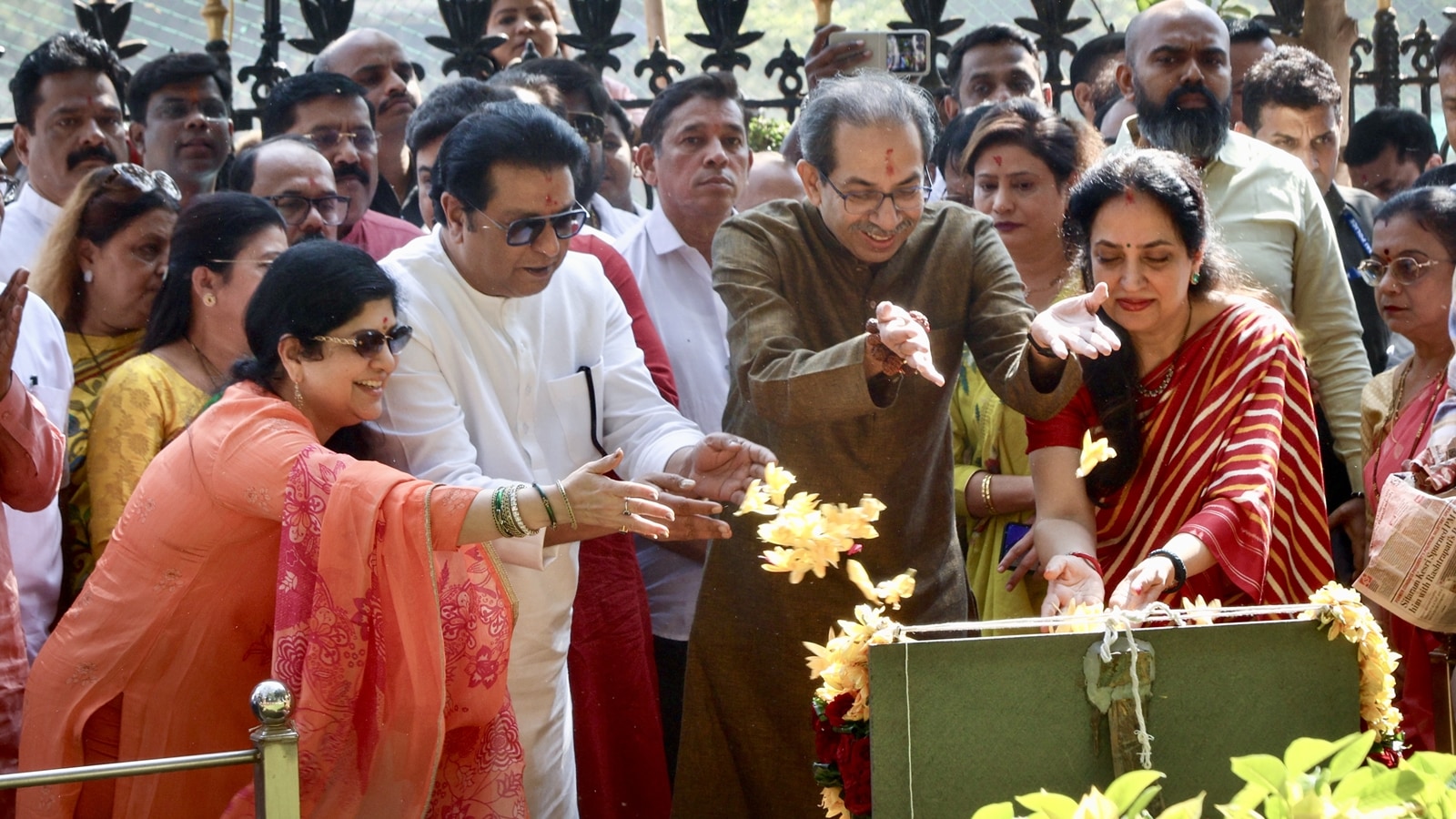
Announcing his reunion with estranged cousin and Maharashtra Navnirman Sena (MNS) chief Raj Thackeray, Shiv Sena (UBT) president Uddhav Thackeray on Wednesday invoked the Samyukta Maharashtra movement and the role of the Thackeray family in it.
“The Samyukta Maharashtra movement was a long battle to retain Mumbai in Maharashtra, in which 106 people sacrificed their lives. Our grandfather, Prabodhankar Thackeray, was among the prominent leaders of the agitation, while my father (Shiv Sena founder Bal Thackeray) and his brother (Raj’s father, Shrikant Thackeray) actively participated in it,” Uddhav said.
The Sena (UBT) chief’s reference to the movement – which was active between 1956 and 1960 and saw political leaders cutting across party lines, along with social stalwarts, writers and thinkers, unite to demand Mumbai’s inclusion in Maharashtra – assumed political significance, with the elections to 29 municipal corporations, including the Brihanmumbai Municipal Corporation (BMC), scheduled for January 15. Although the Samyukta Maharashtra movement was not aimed at political gains, debates over whether Mumbai should be granted independent status or greater autonomy have marked political discourse in the state for over six decades.
Now, the Thackeray cousins’ call to “wake up to Modi-Shah’s designs to undermine Mumbai” seemed to be part of their attempts to woo the city’s Marathi-speaking population (about 26%) ahead of the polls in the BMC, which the Sena has ruled for nearly three decades.
“If we keep fighting among ourselves, it will be an insult to Mumbai. From now on, if anyone looks at Mumbai with an evil eye and tries to break it into pieces through deceitful conspiracies, we will not rest until we finish them off. If you break now, you will be finished. Do not split, do not break, do not abandon the legacy. If anyone comes for the Marathi man’s share, we will not let them go back,” Uddhav said.
However, the reunion has failed to impress the BJP, with minister Ashish Shelar dismissing it as an alliance “forged for power”. “If they were so concerned about the Marathi manoos (sons of the soil), why did they not unite for 20 years? The people will seek answers to this question from the (Thackeray) cousins,” he said.
The Thackerays’ Mumbai pitch also comes against the backdrop of some major projects shifting to Gujarat — a grievance Uddhav has repeatedly raised while accusing the BJP-led Centre of “favouring Gujarat over Maharashtra”.
The proposed “imposition” of Hindi as a third language under the National Education Policy (NEP) was also viewed as an assertion by the BJP-led government in a state where Marathi is the primary language. The Opposition backlash, led by Uddhav and Raj, ultimately forced the Devendra Fadnavis government to roll back the decision.
The BJP camp has dismissed these apprehensions as a “fake narrative” pushed by the Opposition. “Mumbai is an integral part of Maharashtra, and nobody can break it away. On the contrary, both the state and Mumbai have received maximum allocations for development under the Modi government,” Fadnavis had said earlier.
What was Samyukta Maharashtra stir?
The Samyukta Maharashtra movement was launched on August 8, 1956, when prominent leaders of the erstwhile Bombay State came together to ensure that Mumbai remained part of Maharashtra, which was being formed along with Gujarat under the States Reorganisation Act.
Prominent leaders associated with the movement included Shripad Amrit Dange, Shreedhar Mahadev Joshi, Narayan Gore, Uddhavrao Patil, Annabhau Sathe, Prahlad Keshav Atre, Keshav Sitaram Thackeray, Pandurang Mahadev Bapat, Bhausaheb Raut, Amar Shaikh, G. T. Madkholkar, Madhuri Dandavate, Y. K. Saini, Madhu Dandavate and Keshavrao Jedhe. The movement also saw the participation of communist leaders, socialists, and social reformers.
The agitation saw the deaths of 106 people after police opened fire on protesters at Hutatma Chowk (then Piccadilly Circus) in Mumbai. A memorial, Hutatma Smarak, was later erected at the site following the formation of Maharashtra on May 1, 1960.
The process of creation of Maharashtra and Gujarat was fraught as both states staked their claims on Mumbai. Then Prime Minister Jawaharlal Nehru agreed to inclusion of the city to Maharashtra after the proposals to make it a Union Territory or include it in Gujarat triggered a firestorm.
Reunion’s effects
Last month, NCP (SP) president Sharad Pawar, an ally of the Maha Vikas Aghadi (MVA), said the Opposition alliance’s “Satyacha Morcha” against alleged “vote theft” reminded him of the Samyukta Maharashtra movement. However, there have been cracks within the MVA that emerged after its poor performance in the November 2024 Assembly elections.
The Sena (UBT) could win only 20 of the 95 seats it contested in the Assembly polls as part of the MVA. Fighting on its own, the MNS drew a blank.
“It is a do-or-die battle that brought the Thackeray cousins together, setting aside their differences,” a senior Sena (UBT) leader said.
As the Sena (UBT) and the MNS grew closer, another MVA ally Congress announced its plan to contest the BMC polls solo, citing Raj’s “hardline” stance on non-Marathi speakers and Hindutva.
The NCP (SP) has remained non-committal as of now. “We are awaiting an alliance proposal from Uddhav. If it does not come in the next two days, we will proceed with a tie-up with the Congress,” NCP (SP) MLA Rohit Pawar said Wednesday.