
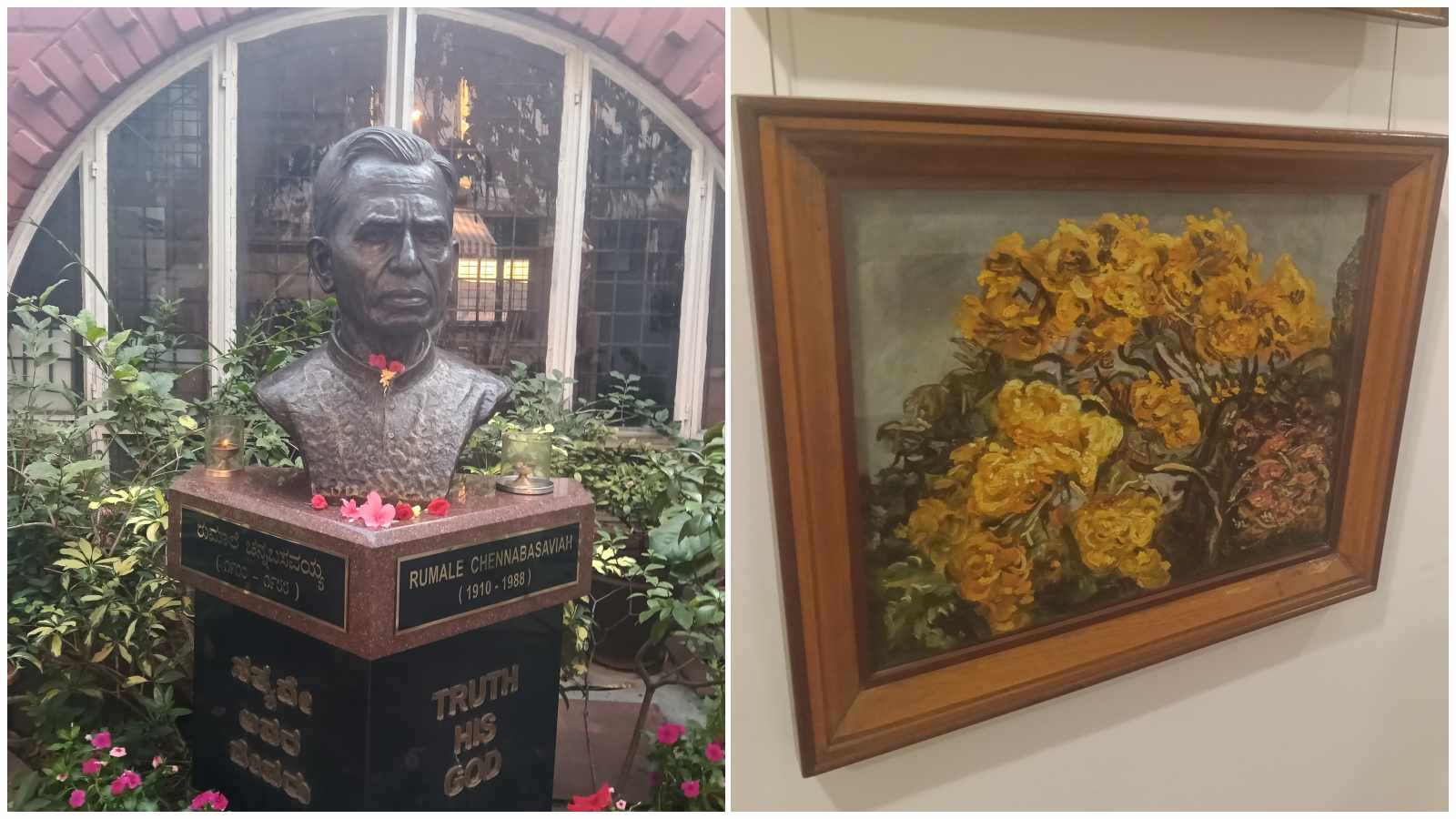
Down a quiet lane in Rajajinagar sits a tranquil house filled with watercolour paintings in a style unseen in most other collections in Bengaluru. Since 1973, this space has been home to the Rumale Art House, the single largest collection of the works of artist and freedom fighter Rumale Chennabasaviah.
The art house has been managed by Sanjay Kabe since the artist’s demise in a 1988 road accident. Sanjay’s father, Madhav, was a close friend of Rumale, besides being a fellow spiritualist and practitioner of meditation. Sanjay and his sister knew Rumale from the time they were children – indeed, the collection at the art house includes portraits of them as youngsters, in Rumale’s highly distinctive style, as well as one of Madhav, deep in meditation. As Sanjay himself recalls, painting itself was a form of meditation for Rumale, who was not as suited to conventional meditation.
While Rumale discovered his own aptitude for art early on, sketching a portrait of Jesus Christ as a child, the bulk of his work was done after he exited public life around 1962. He had studied art in the 1920s at Bengaluru’s Kalamandir School of Art and Mysuru’s Chamarajendra Technical Institute, but chose to commit full-time to the freedom struggle, being heavily involved in the Seva Dal as well as major movements including the Salt Satyagraha. He also endured prison stints in Bengaluru and Ahmednagar, the latter at a time when Nehru was also imprisoned.
Distinctively Bangalorean paintings
For a layperson, Rumale’s art defies easy description – inspired by some of the greatest artists of Europe and beyond, but developing into his own unique style. As Sanjay puts it, “He was influenced by Impressionism, the British watercolour school, Turner, Constable, Van Gogh etc. He wanted to do something similar.” Kabe notes that part of Rumale’s distinctive style was that he did not mix colours on a palette, instead doing so on the medium of the painting itself.
Many of the paintings are distinctively Bangalorean in outlook, depicting parts of the city that visitors may recognise, such as plant life near the Karnataka High Court. He also took on topics such as parts of the countryside which would be inundated by dam construction, painting these areas before they went underwater.
He was also among the early figures instrumental in creating the modern outlook on art in Bengaluru. For instance, he was an associate of the famed Russian artist Svetoslav Roerich, encouraging him to put down roots in Bengaluru.
‘Plein-air’ style, premium materials
While personally austere, he brooked no compromise when it came to the quality of his art materials, obtaining high-quality imported paint and paper to ensure the long life of the paintings, while even the frames of the paintings were made of high-quality wood by the same craftsman who made frames for Roerich.
Story continues below this ad
Apart from the largely urban-natural and countryside subjects of Rumale’s art, another aspect that finds considerable representation in the art house is his personal spirituality. A puja room houses portraits of his spiritual mentors Tapaswi Maharaj and Shivabalayogi, alongside several works featuring temples and their interiors. All of these were done in keeping with Rumale’s habit of painting on the spot, as opposed to working in a studio. This is a method particularly distinctive in his works, depicting nature, and is particularly impressive in the context of the larger paintings, done completely “plein-air” or out in the open.
Considerable effort also goes into maintaining the longevity of the artworks. Temperature and humidity are constantly monitored, with several dehumidifiers placed around the gallery. Apart from ensuring the absence of direct sunlight on paint (which could degrade the material), lighting within the gallery is also maintained within a specific lumen range. The paintings are also inspected at intervals to ensure that no damage has occurred.
Prospective visitors may find Rumale Art House on 45th Cross Road in Rajajinagar’s 3rd Block, open on all days except Tuesday, from 10.30 am to 5 pm. However, visitors are advised to contact Sanjay Kabe at 95356 78111 ahead of visiting. Admission is free of charge.