
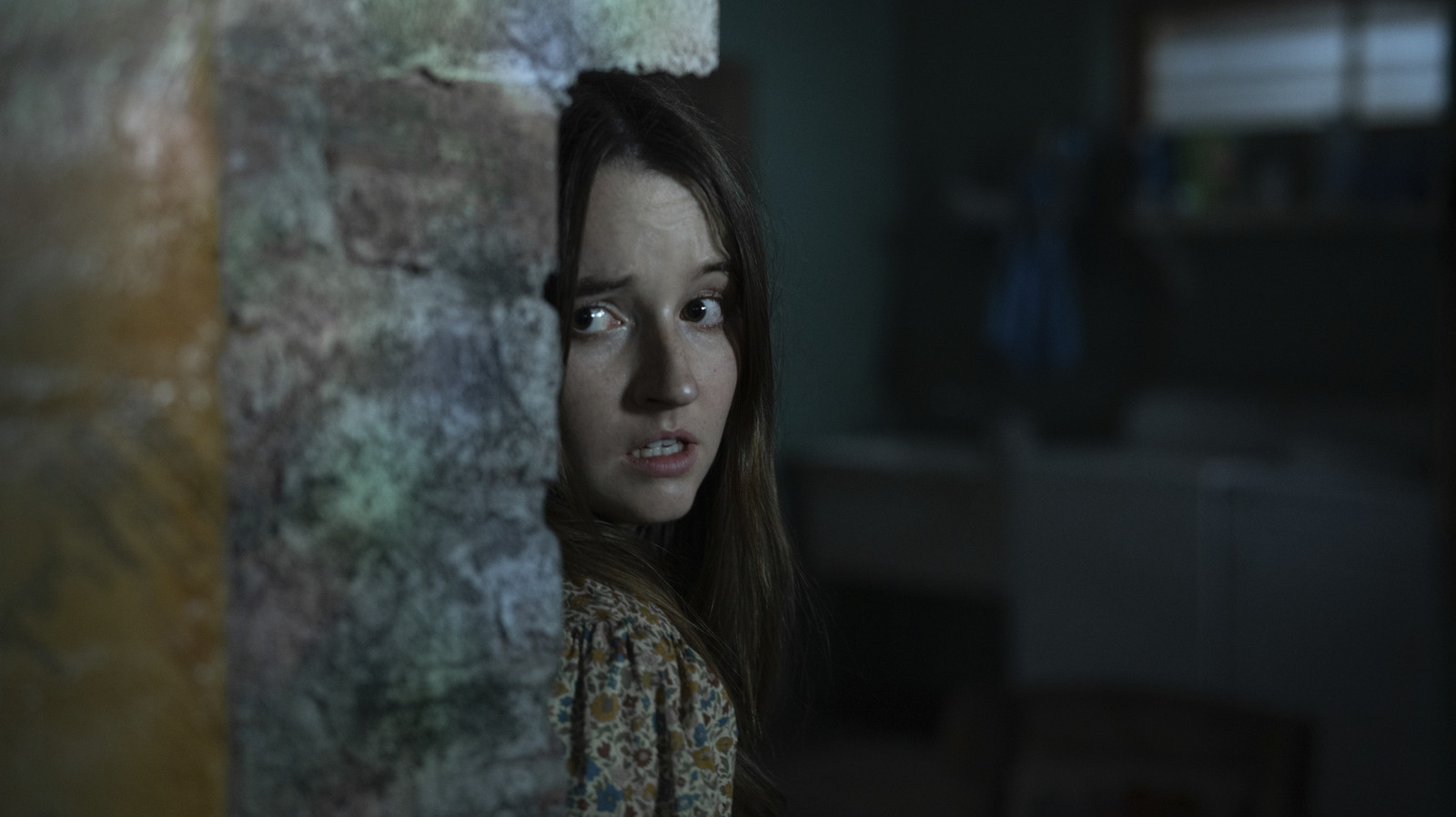
Kaitlyn Dever got her acting start in 2009, and has since built a career to rival Hollywood’s heaviest hitters. Following her career-making role in FX’s “Justified,” Dever has appeared in acclaimed works such as “Booksmart,” “Dopesick,” and “The Last of Us,” the latter two even nabbing her a pair of Emmy nominations. In 2023, she starred in “No One Will Save You,” a Hulu original sci-fi drama you may have missed.
In the film, Dever stars as Brynn, a young woman outcast in her own hometown. While still grieving the death of both her mother and a close friend, she’s confronted by an alien invader in her own home. Fleeing into town, Brynn discovers that the alien visitor wasn’t alone and attacked her neighbors as well. But before long, she realizes that the apparent survivors might be under the control of the invaders.
More than a mere alien invasion film, “No One Will Save You” is a terrifying tale that nearly made our list of horror movies with barely any dialogue — with just five words uttered during its length. Though the film didn’t garner any award nominations, it received strong reviews from critics. Following in the footsteps of classics like “Close Encounters of the Third Kind” and more recent affairs like “10 Cloverfield Lane,” “No One Will Save You” is an underrated sci-fi film that deserves more attention.
No One Will Save You was originally written with dialogue

Containing barely any dialogue at all, “No One Will Save You” is truly distinct in its storytelling, relying on star Kaitlyn Devers’s performance, strong direction, and stylish cinematography to engage the viewer. You might assume that such an ambitious concept was carefully planned from the start, but according to writer-director Brian Duffield, that’s not the case.
Speaking to Collider, Duffield was asked if his initial intent was to make a silent movie. He admitted that he was writing a scene involving Brynn visiting a police station when the idea struck him. “I always knew how that scene was going to wind up, and that scene didn’t have dialogue,” he recounted. “And I got to that point, and I was just very surprised at where we were at.” Confident in the approach, Duffield figured removing any existing dialogue wouldn’t be that difficult, and might even be more interesting. “It just felt like a cool little bit of whipped cream on it as opposed to the main event.”
Ultimately, the film wouldn’t be the same without its silent approach, forcing the viewer to follow the action. The story speaks for itself on screen, and its dialogue-less nature is one of its defining distinctions.