
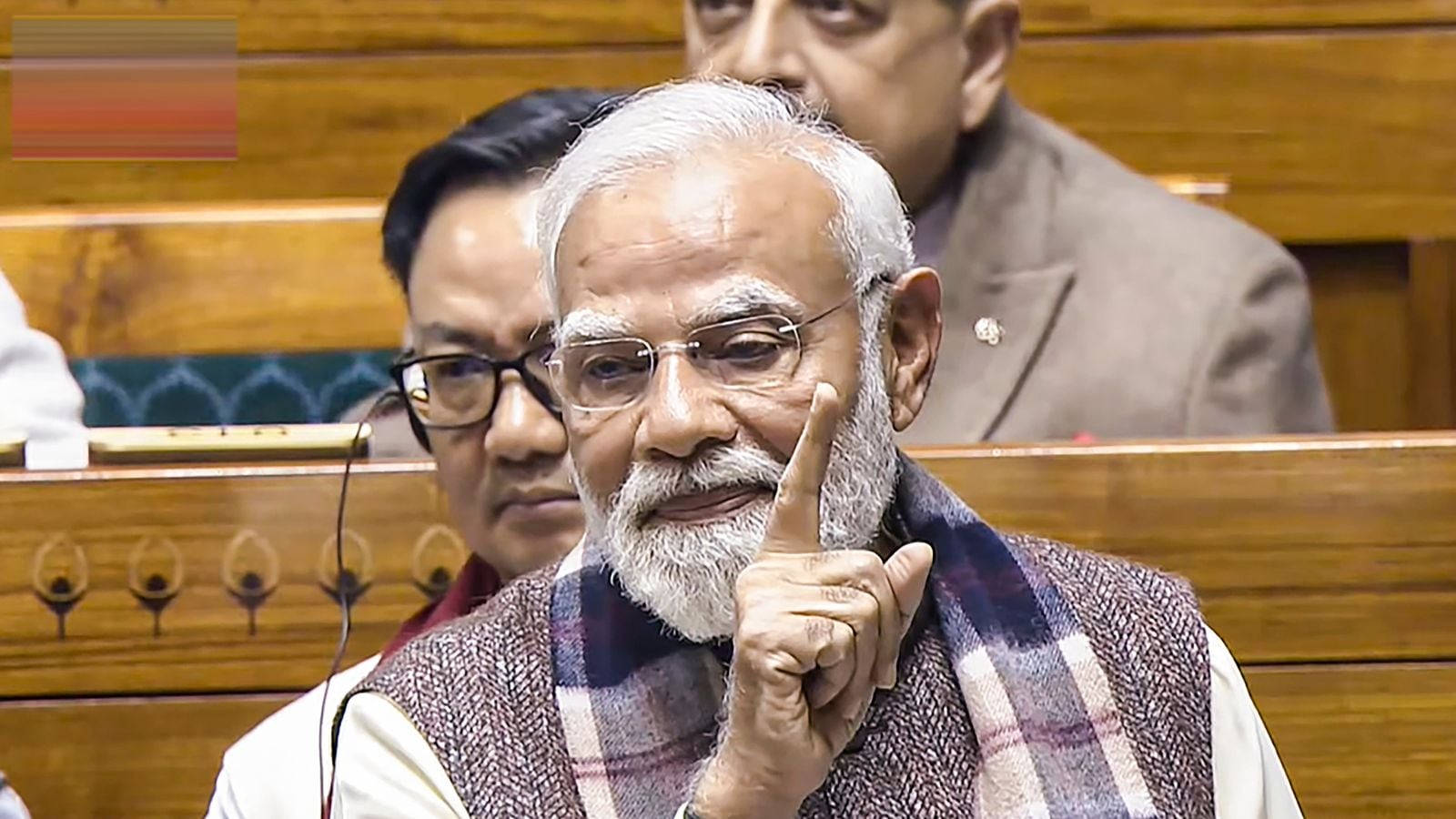
As PM Narendra Modi targeted the Congress in the Lok Sabha on Monday for removing parts of the Vande Mataram and accused it of “minority appeasement”, the BJP’s key ally at the Centre and Bihar, the Janata Dal (United), steered clear of the controversy. In contrast, two other major allies, the Lok Janshakti Party (Ram Vilas) and the Telugu Desam Party (TDP), backed the BJP line. They accused the Congress of “tinkering” with the national song and blamed Jawaharlal Nehru.
While the BJP and most of its allies recounted how, in 1937, certain stanzas of Vande Mataram were culled out, allegedly at Nehru’s behest and against the wishes of Subhas Chandra Bose, JD(U) MP Devesh Chandra Thakur, in his speech during the discussion in the Lower House on the occasion of 150 years of the song, focussed on its greatness and its role in instilling nationalist fervour.
“The Constituent Assembly, after long deliberations, declared it a national song. Jana Gana Mana got the status of National Anthem, but Vande Mataram was accorded equal respect. In the Constituent Assembly, Dr Rajendra Prasad declared that Vande Mataram will get the same respect that the national anthem has,” said Thakur, the Sitamarhi MP.
Calling the song even more relevant today, he said, “It teaches us that our diversity is our real strength. It tells us that despite different cultures and languages, we are all children of Bharat Mata. It tells us that the service of the motherland is the highest dharma.”
The support of the JD(U), the TDP, and the LJP (RV), which together have 35 MPs, has been crucial for the BJP as, with 240 MPs in the Lok Sabha, it required their support to form the government. The JD(U), with 12 MPs in the Lower House and 85 MLAs in the Bihar Assembly, is among its biggest partners of the BJP. And unlike the BJP, the Nitish Kumar-led party, rooted in the socialist tradition, has never pursued communal politics. In the recent Bihar polls, the only Muslim candidate to win on an NDA ticket was from the JD(U); the BJP did not field any Muslims.
During the debate, Thakur said, “Vande Mataram is not merely a confluence of words and notes, but a symbol of our nation’s soul and the dreams of its people. While chanting Vande Mataram, we announce our faith, commitment and sacrifice to the nation.”
He also touched on the history of invasions, from Alexander onwards, and said that “India’s civilizational roots were so deep that they were not successful in eroding it”.
Thakur then referred to the arrival of the British, their efforts to popularise their anthem “God Save the Queen”, and the 1857 war of independence. “The nationalists did not accept the song as it was against our aspiration for freedom. They wanted a song that reflected our culture, civilisation and call for freedom. That is why Vande Mataram not only became our national song but also a proclamation of our national consciousness. The song became an inspiration for thousands of revolutionaries,” he said.
In contrast, Rajesh Verma of the Chirag Paswan-led LJP (RV) stuck firmly to the BJP line. “At a time when we are remembering this (the song’s) glorious history, we should also remember the efforts to tinker with this history. While the song united the country in 1905, in 1937, for votebank and appeasement politics, people tried to break the song,” he said.
Verma said Bose wanted the whole song sung because he understood its power. “But Nehru argued that the song could offend a particular community. And stanzas from the song were removed. I say this with responsibility that this country’s physical partition may have happened in 1947, but its mental partition happened in 1937,” he said.
The Khagaria MP claimed that the “sentiments expressed in the song” were being “fulfilled” through the Modi government’s schemes. He then pivoted to target West Bengal CM Mamata Banerjee. “We need to understand what state Bengal is in. It gave us Vande Mataram and great personalities such as Swami Vivekanand and Rabindranath Tagore … Where Bankim babu saw the splendour of Ma Durga, in that Bengal, Ram Navami processions face stone-pelting. There, those who chant Vande Mataram are called communal and infiltrators are dubbed as ‘our own’,” he said.
TDP’s Byreddy Shabari took PM Modi’s line on the “Macaulay-isation” of the country. She said former Governor General of India Warren Hastings had described sadhus as looters who had “infested” the British Empire. “Yet we remember Hastings, but not our sadhus. This is the Macaulay effect that the PM was talking about. Vande Mataram talks about bowing to the motherland. But few leaders sitting here can’t bow to the motherland. Perhaps, it is their foreign DNA that is resisting. The state where this song was born and where Goddess Durga is worshipped never questioned the Congress for removing references to the goddess from the song. Everyone knows who did this in 1937. We all have the list of leaders from Nehru’s Cabinet who objected to Vande Mataram,” said the Nandyal MP.