
December 30, 2025 11:20 AM IST
First published on: Dec 30, 2025 at 11:19 AM IST
Ahead of the Assam Assembly elections slated for March-April 2026, there has been a flurry of visits by the top BJP leaders to the party-ruled state this month, whose statements have made it clear that the party has decided to vigorously rake up the issues of “Bangladeshi infiltrators” and alleged land encroachment by Bengali-origin Muslims in its poll campaign.
Apart from Prime Minister Narendra Modi, Union Home Minister Amit Shah and the BJP’s newly-appointed national working president Nitin Nabin have visited Assam, among other senior party leaders, to attend various events or address rallies during December.

Last month, following a series of its strategic meetings, the state BJP announced that the Assembly elections will “fundamentally be a contest between the indigenous Assamese populace and the Miya Muslim community of East Bengal (Bangladeshi)-origin”, claiming that “the very future, security, and civilisational continuity of Assam” would hinge on this face-off.
This was also echoed during the state BJP executive meeting last weekend, during which Chief Minister Himanta Biswa Sarma framed the upcoming elections as a “civilisational conflict between Sanatani civilisation and that of the Bangladeshi-origin Miya Muslims”.
Sarma also repeated his claim that by the time the next Census takes place, in 2027, Bengali-origin Muslims will account for about 40% of Assam’s population. On the other hand, the population of indigenous people of Assam was declining, he claimed, raising fear of “demographic change”.
The CM also brushed aside long-held symbols of pluralism in the state – from claiming that Bagh Hazarika, a storied Muslim warrior of the Ahom army which had defeated the Mughals in the Battle of Saraighat, was a “fictitious character” to dismissing as a “false narrative” the popular saying that “Assam is the land of Sankar-Azan (16th century Vaishnavite reformer-saint Srimanta Sankardev and 17th century Sufi saint Azan Faqir).
In recent days, several BJP leaders have highlighted the Sarma government’s hardline actions against Bengali-origin Muslims in the state, flagging especially the wide-scale evictions on Sattra lands, reserved forest, PGR/VGR, khas and other government-owned lands, which the CM has described as a crack-down against “demographic invasion”.
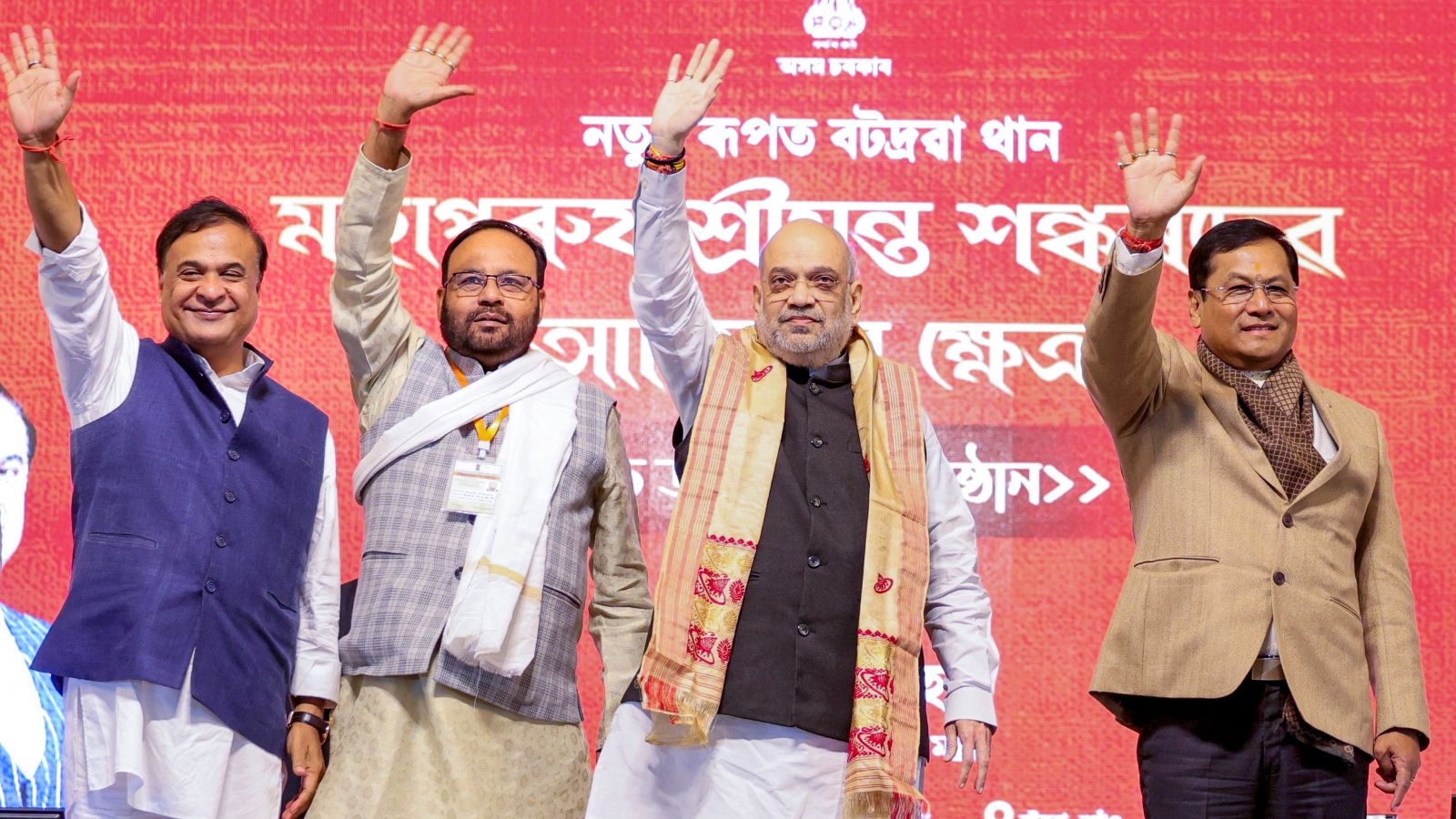
On Monday, Amit Shah’s event in Nagaon district was also marked with symbolism. At Batadrava Sattra, the birthplace of Srimanta Sankardev and one of the most sacred sites for Assamese Vaishnavites, Shah attended the inauguration of the Batadrava Cultural Centre developed by the state government on land which had been the site of a demolition drive three years ago in which 359 Bengali-origin Muslim families had been evicted.
Referring to Bangladeshi infiltrators, Shah said that if the BJP is voted back to power in the state, “all of Assam will be made free of infiltrators”.
While sharpening its rhetoric against Bengali-origin Muslims, the BJP has also been trying to align Assamese sentiments with its other key vote bases including sections of Bihari, Marwari and Bengali Hindus, whose relations have historically been fraught.
While the two major Opposition parties in Assam, the Congress and the AIUDF, have support bases among Bengali-origin Muslims, they are not likely to tie up for the elections. The Congress has been making efforts to forge an alliance with smaller regional outfits and the Left parties.