
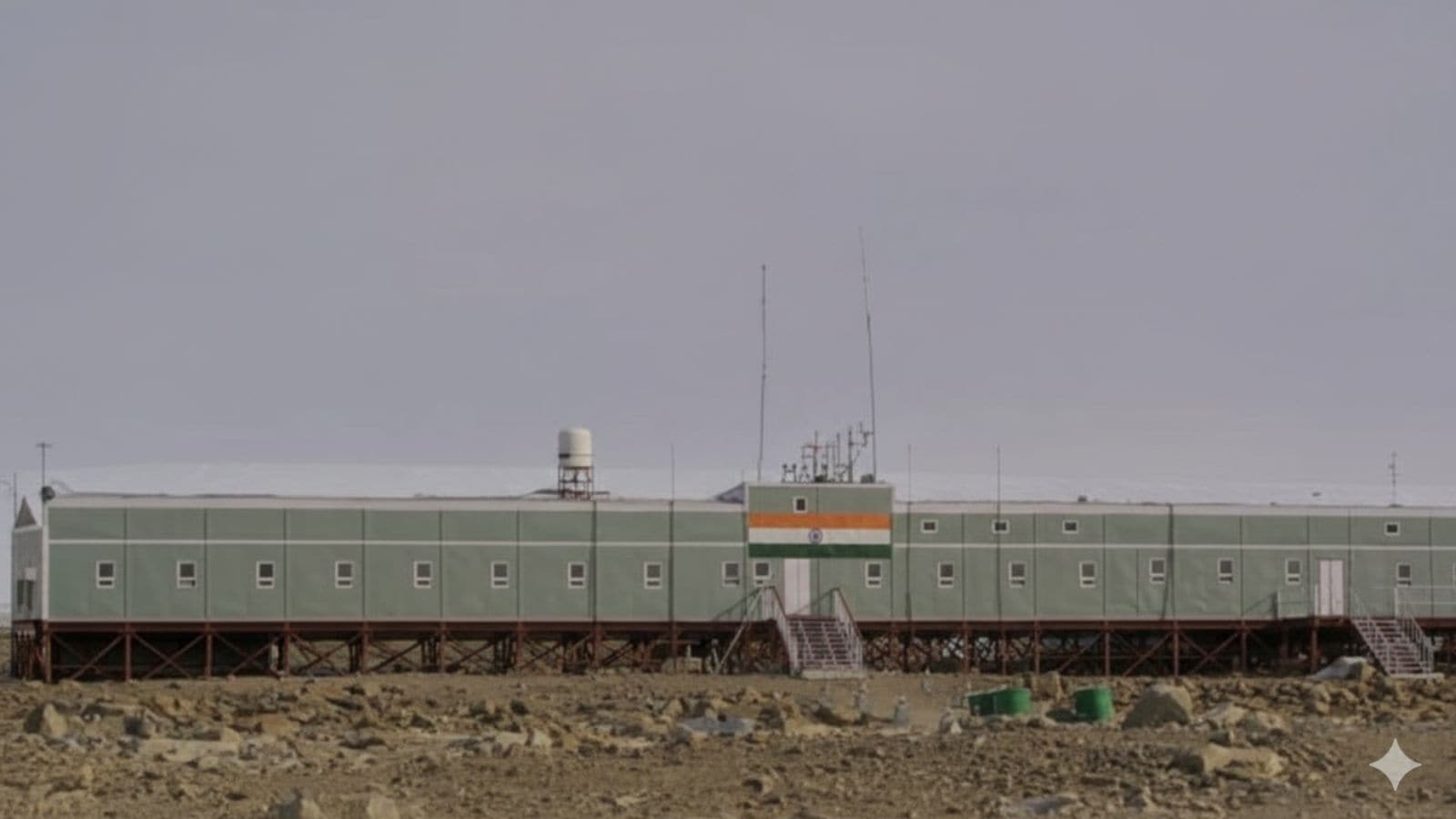
The completion of the Maitri II, India’s next-generation research station in East Antarctica, has been pushed back to 2032, and scientific operations are likely to commence even later, according to the government.
In December 2023, when the government first announced the need to establish Maitri II in East Antarctica, the projected construction completion timeline was January 2029. The site for the successor of Maitri I, established in 1989 in the Schirmacher Oasis, was also identified two years ago.

In his response in Parliament to a question on Maitri II posed by A Raja, a Lok Sabha MP of the Dravida Munnetra Kazhagam (DMK), Dr Jitendra Singh, Minister of State (Independent Charge) Science and Technology, and Earth Sciences, said last week, “The projected timeline for Maitri II to become operational is estimated as seven years with expected completion by 2032.”
Story continues below this ad
The estimated cost of building Maitri II over seven years is Rs 2,000 crore. Singh said the Ministry of Earth Sciences has approved Rs 29.2 crore for pre-investment activities, including architectural design and preparation of the Detailed Project Report (DPR).
The minister further said that Maitri II will enhance India’s ability to conduct multidisciplinary scientific research in Antarctica.
Story continues below this ad
He added, “It will significantly elevate India’s scientific capability in biology, earth sciences, glaciology, atmospheric sciences, climate studies and long-term environmental monitoring.”
In a report dated October 15, The Indian Express said that Maitri II had received the ‘in-principle’ approval from the Centre. (https://indianexpress.com/article/long-reads/decks-cleared-for-maitri-ii-india-set-to-chart-new-frontiers-in-antarcticas-icy-wilderness-10303286/) India is building its fourth research station in Antarctica, with the newest proposed station replacing Maitri I, which has been operational since 1989.
India’s research in Antarctica over the years
Since 1981, the National Centre for Polar and Ocean Research (NCPOR) in Goa, operating under the MoES, has actively conducted research in Antarctica.
Story continues below this ad
India’s first research station, Dakshin Gangotri, actively conducted expeditions to Antarctica but ceased operations around 1989. Since then, Indian researchers have been regularly camping at Maitri and Bharati stations.
Both stations support winter and summer expeditions for Indian meteorologists, atmospheric scientists, geologists, glaciologists, botanists, zoologists, and seismologists, among other branches of specialists.
Maitri, located in the Schirmacher Oasis in East Antarctica, has hosted researchers since 1989. An inland station located around 100 km from the shore and at an elevation of about 50 metres above sea level, Maitri has the capacity to house 25 people in its main building. These numbers can reach 40 during summer, facilitated by containerised living modules.
Story continues below this ad
The upgraded station will feature modern laboratories, advanced ice-core storage and processing systems, a dedicated biological and microbial research suite and expanded atmospheric observation facilities. A stronger and more dependable logistic backbone will ensure uninterrupted scientific operations throughout the year.
These enhancements will greatly expand the scope, precision, continuity and international relevance of India’s Antarctic research, enabling the country to contribute high-quality data and cutting-edge findings to global polar science for decades to come, said minister Singh.