
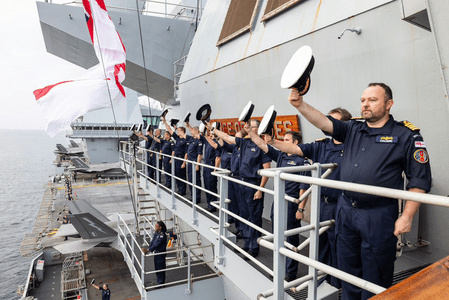

New Delhi, Oct 19 (IANS) Amid rising turbulence in the Indian Ocean and shifting alliances in the Indo-Pacific, the Indian Navy is expanding its maritime reach. India’s naval diplomacy comes at a time when external powers are increasing activity in India’s maritime neighbourhood, a report has stated.
India’s naval outreach in recent months has been more than just traditional exercises, Colonel B.P. Katju (retd) wrote in a report in India Narrative. The warships of India and the Philippines carried out their first-ever joint patrol in the South China Sea in August, signalling solidarity with Southeast Asian partners amid rising tensions in contested waters.
Soon after, the indigenous vessel INS Nistar participated in Singapore’s multinational submarine rescue exercise involving 12 navies, including China and Japan. In the eastern waters, INS Sahyadri called at Kemaman in Malaysia as part of an ongoing Indo-Pacific deployment.
In the west, India held its first joint naval exercise with Greece after Prime Minister Narendra Modi’s visit to the country. India’s engagement with Greece comes amid increasing cooperation between Turkey and Pakistan, including Ankara’s reported support for Pakistan during Operation Sindoor.
In an opinion piece in India Narrative, Col Katju (retd) wrote: “Amid growing turbulence in the Indian Ocean and shifting alliances across the wider Indo-Pacific, the Indian Navy is visibly expanding its maritime reach — from the Mediterranean Sea in the west to the South China Sea in the east. This assertive naval diplomacy comes at a time when external powers are stepping up activity in India’s maritime neighbourhood, testing New Delhi’s balance between engagement and vigilance.”
The UK’s aircraft carrier HMS Prince of Wales joined the Indian Navy in the Konkan exercise in the western Indian Ocean. The participation demonstrates India’s increasing network of defence partnerships — but also revives debates regarding the AUKUS alliance, which some Indian analysts consider as a military bloc functioning outside India’s own strategic frameworks.
The report said: “The Indian Ocean is becoming a theatre of competing influences. China’s ‘research vessels’ continue to dock in Sri Lanka and the Maldives, often suspected of surveillance. Recently, even the US, Japan, and Australia have sent similar ships, ostensibly for hydrographic studies. India, which has previously raised alarms over Chinese activity, now faces a delicate question: how to respond when the intruders are partners rather than adversaries.”
Complicating matters further, Turkey has been providing drones and warships to Pakistan and the Maldives. Against this backdrop, India is moving ahead with Project 77, a Rs 40,000-crore initiative to make nuclear-powered submarines domestically. The Indian Navy aims to field two submarines armed with 800-km range missiles by 2036-37.
In the opinion piece, Katju wrote: “India’s defence establishment appears clear-eyed about the challenges ahead. From the Mediterranean to the South China Sea, New Delhi’s naval engagements are not just demonstrations of reach — they are statements of intent. Yet, as Operation Sindoor’s legacy lingers and new global alliances form, India must guard against being drawn into others’ rivalries. For a nation long seen as the anchor of the Indian Ocean, the message is unmistakable: India is no longer just watching the tides — it is steering them.”
–IANS
int/akl/vd
Disclaimer
The information contained in this website is for general information purposes only. The information is provided by BhaskarLive.in and while we endeavour to keep the information up to date and correct, we make no representations or warranties of any kind, express or implied, about the completeness, accuracy, reliability, suitability or availability with respect to the website or the information, products, services, or related graphics contained on the website for any purpose. Any reliance you place on such information is therefore strictly at your own risk.
In no event will we be liable for any loss or damage including without limitation, indirect or consequential loss or damage, or any loss or damage whatsoever arising from loss of data or profits arising out of, or in connection with, the use of this website.
Through this website you are able to link to other websites which are not under the control of BhaskarLive.in We have no control over the nature, content and availability of those sites. The inclusion of any links does not necessarily imply a recommendation or endorse the views expressed within them.
Every effort is made to keep the website up and running smoothly. However, BhaskarLive.in takes no responsibility for, and will not be liable for, the website being temporarily unavailable due to technical issues beyond our control.
For any legal details or query please visit original source link given with news or click on Go to Source.
Our translation service aims to offer the most accurate translation possible and we rarely experience any issues with news post. However, as the translation is carried out by third part tool there is a possibility for error to cause the occasional inaccuracy. We therefore require you to accept this disclaimer before confirming any translation news with us.
If you are not willing to accept this disclaimer then we recommend reading news post in its original language.