
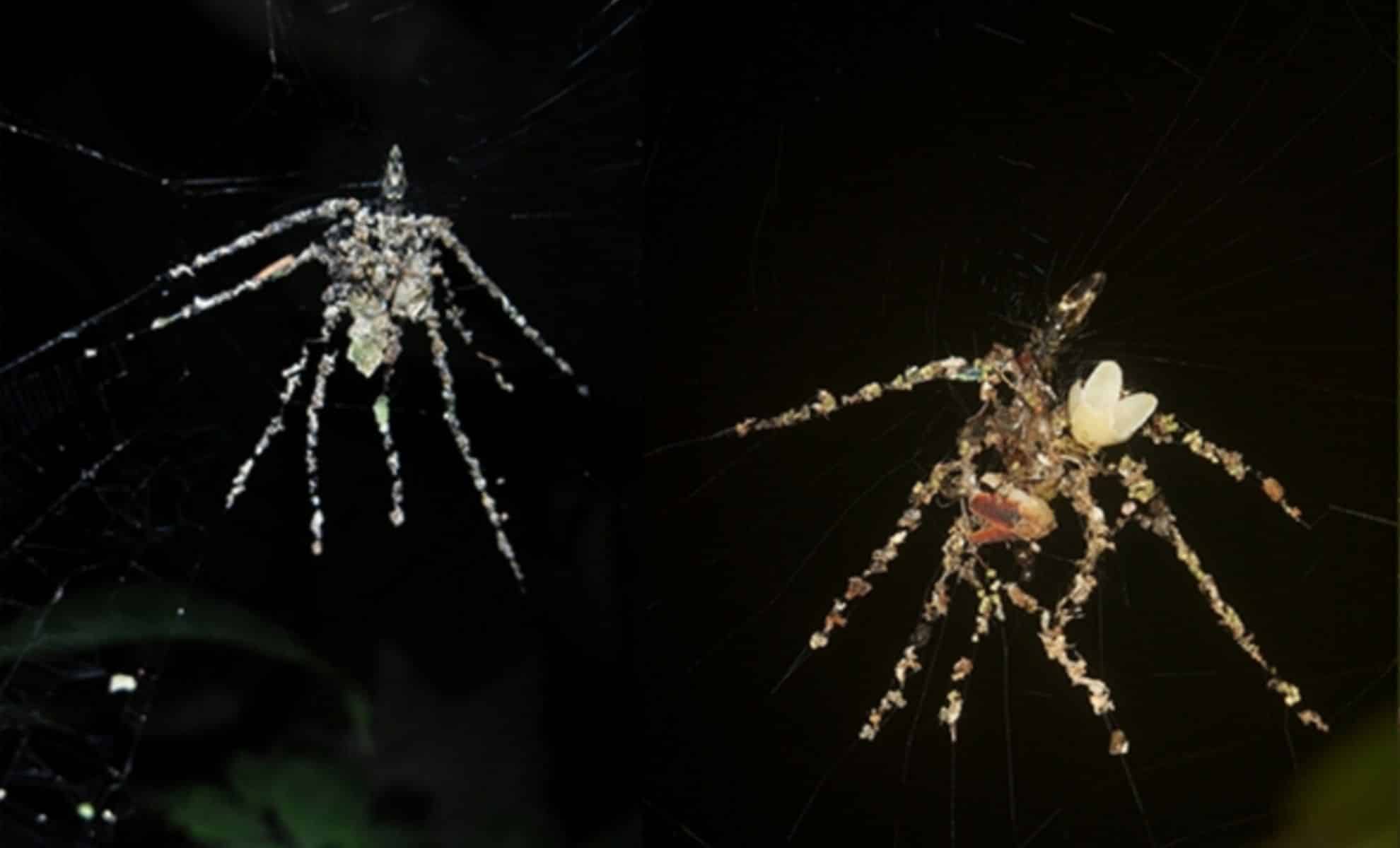
While many spiders use webs for catching prey, Cyclosa spiders are going a step further by turning their webs into a theater of deception. These spiders don’t just create decorative web structures; they craft decoys that are convincing enough to confuse predators. This unusual behavior has fascinated researchers and provided new insights into the complex world of spider survival strategies.
A Web of Deception
Cyclosa spiders are known for their ability to construct stabilimenta, web decorations made from silk and organic materials like leaf fragments and insect carcasses. However, a few species have taken this concept to the next level, building decoys that resemble a larger spider, far bigger than the actual creature hiding behind it. According to a study published in Ecology and Evolution, these decoys are often more than three times the size of the spider’s body, cleverly mimicking a bigger, potentially more dangerous arachnid. The spiders meticulously arrange debris into these larger-than-life forms, often near the center of their webs, while the real spider positions itself nearby, hidden from view.
This behavior has been observed in Cyclosa species in both the Peruvian Amazon and the Philippines. In these regions, scientists have documented how the spiders carefully select materials like dead insects, leaves, and soil to form convincing replicas of themselves. The finished decoys mimic not only the size but the shape of the spiders’ body and legs, fooling predators into thinking they are looking at a much larger and more threatening creature.
Why the Decoys Work: A Defense Mechanism
The ultimate purpose of these decoys is survival. Cyclosa spiders face a variety of predators, including birds, lizards, and damselflies, all of which hunt by sight. According to Dr. George Olah, a lead author of the study, the decoy spider strategy may help the real spider avoid detection or attack. Larger predators, such as birds or lizards, may be deterred by the presence of what appears to be a bigger, more formidable opponent. In contrast, smaller predators like damselflies that hover in front of webs may target the decoy instead of the spider itself.

The behavior is an example of evolutionary adaptation, where Cyclosa spiders have evolved to use visual cues to their advantage. This tactic helps the spider mislead visual predators, creating a diversion and increasing its chances of survival. The study found that predation attempts were often directed at the decoy, leaving the real spider unscathed and able to continue its life undisturbed.
A Widespread Evolutionary Strategy
Interestingly, the decoy-building behavior is not limited to a single species or location. Researchers have documented similar tactics in multiple Cyclosa species across tropical regions in South America and Southeast Asia. This suggests that the decoy spider strategy is not a rare quirk but rather a widespread evolutionary solution to predation. In fact, this behavior has now been observed in Cyclosa spiders from Peru, the Philippines, and Madagascar.
The strategy is also indicative of the spiders’ adaptive ingenuity, as these creatures are able to alter their environment to confuse predators without physically changing their own body. By creating a decoy that is larger and more threatening, Cyclosa spiders can effectively misdirect predators, gaining protection through the illusion of size. This behavioral flexibility challenges earlier assumptions that invertebrates rely on rigid, instinctual responses for survival.
The decoy-building Cyclosa spiders are masters of deception, using their webs not only as traps for prey but as shields against predators. The discovery of this behavior offers a fascinating glimpse into the hidden lives of spiders and the unexpected ways they navigate the challenges of survival. With their ability to deceive and confuse, these tiny arachnids are rewriting the rules of spider defense.