
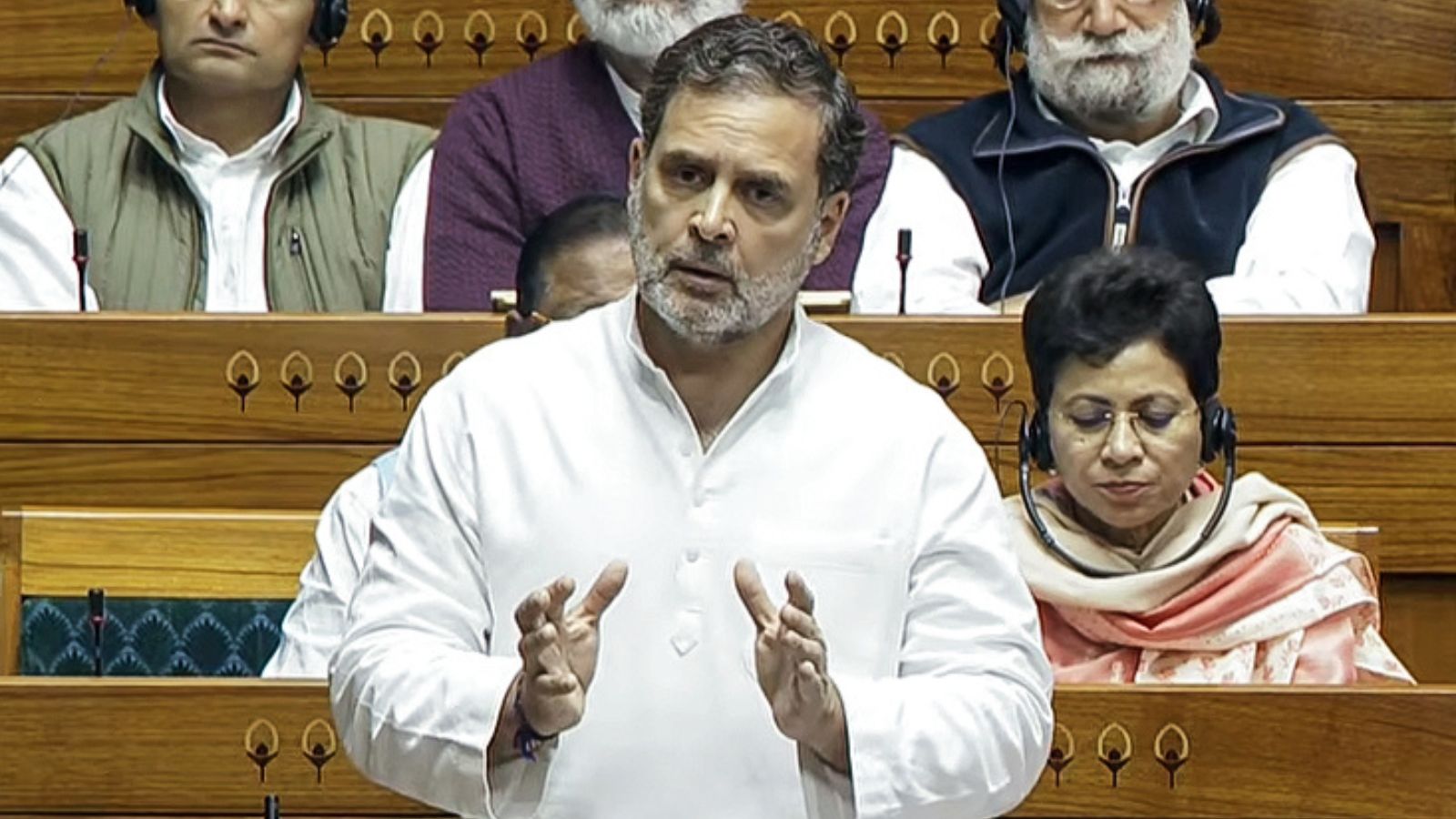
Seizing the Parliament grand stage to raise questions on the “impartiality” of the Election Commission, the Opposition Tuesday demanded a return to paper ballot and an amendment in the law that deals with the appointment of the Chief Election Commissioner and ECs, and picked holes in the special intensive revision of voter rolls underway in several states.
The Lok Sabha discussion on electoral reforms was less about suggestions of meaningful reforms and more about scoring political points with Opposition and Treasury benches hurling charges at each other.
The Opposition, which wanted a discussion on the SIR but agreed tactically to the broader topic of electoral reforms, alleged that the EC was working at the behest of the BJP government and that there was huge mistrust and lack of transparency in the election process itself.
Divergences and tactical silences
Incidentally, there were some divergences and tactical silences. While most Opposition parties demanded a return to paper ballot, the TMC and the NCP (SP) were silent on that aspect. In fact, NCP(SP)’s Supriya Sule said she was not speaking against EVMs as she had been elected MP four times through the machine. While Congress MP Manish Tewari, who opened the debate, demanded either mandating a 100 per cent counting of VVPAT slips or reverting to paper ballots, Leader of the Opposition Rahul Gandhi confined himself to seeking Opposition access to the “EVM architecture”. The YSRCP, which is not part of the Opposition bloc, too demanded a return to paper ballot.
Gandhi largely reiterated his vote-theft allegations – he described it as an anti-national act – and what he called the capture of institutions by the RSS. And perhaps for the first time, he said the Opposition, whenever it returns to power, would change the 2023 law which said “no Court shall entertain or continue any civil or criminal proceedings against any person who is or was a Chief Election Commissioner or an Election Commissioner for any act, thing or word, committed, done or spoken by him when, or in the course of acting or purporting to act in the discharge of his official duty or function”.
Alleging that the RSS wants “wholesale capture of India’s institutional framework” – from the EC to education to intelligence agencies, CBI, ED and Income Tax department – Gandhi said he has already “put forth adequate proof of how the Election Commission is colluding with those in power to shape the elections”.
Rahul’s questions
He asked three questions: on the 2023 law which “removed” the CJI from the Prime Minister-headed selection panel which picks the CEC and the ECs, which gives “immunity” to the CEC and ECs and the change of a rule earlier this year which allowed the EC to destroy all CCTV footage of all poll processes 45 days after declaration of results.
“Why is it that the CJI was removed from the selection panel of the EC? What motivation could there be to remove the CJI? Do we not believe in the CJI? Of course, we believe the CJI… I sit in that room. It is a so-called a democratic decision. On one side, PM Modi and Amit Shah and on the other side the LoP. I have no voice in that room. What they decide is what happens. Why is the PM and Amit Shah so keen on choosing exactly who the EC is going to be,” he said.
“No PM has done this in the history of India. In December 2023, this government changed the law. They changed the law to make sure that no EC could be punished for any action they take while they are ECs. Why would the PM and Home Minister give this tremendous gift of immunity to the EC? Finally, why was the law with regard to CCTVs and the data they contain changed? Why was the law put in place that allows the EC to destroy CCTV footage 45 days after the election? What is the need? The answer given is that it is a question of data. It is not a question of data. It is a question of stealing the election,” he said.
Accusing the EC of “colluding with those in power to shape the elections”, Gandhi claimed that election campaigns were being tailored as per the requirements of the Prime Minister, and were sometimes months long. He also repeated his earlier charge that the election of Haryana was “stolen” and the “theft was ensured by the ECI”.
“Even after the SIR in Bihar, 1.2 lakh duplicate photos exist in the voter list… We have proven this in Karnataka, we have proven this in Maharashtra and I am absolutely certain that this is how you are winning elections in Madhya Pradesh, in UP, Bihar, across the country,” he said.
“Give machine-readable voter lists to all political parties one month before election, take back the law that allows the destruction of CCTV footage. And while you are doing that, also tell us what is the architecture of the EVM. Give us access to the EVM. Let our experts go and see what is inside the EVM. Until today, we have not had access to the EVM. Change the law that allows the EC to get away with whatever he wants to do. That is all the electoral reforms you need,” he said.
“I want to assure the Election Commissioners that they might be under the impression that this law lets them get away with it. Let me remind them. Don’t worry. We are going to change the law. And we are going to change it retrospectively and we are going to come and find you,” he said.
The common theme that ran through the speeches of the Opposition MPs was mistrust in the impartial role of the EC and lack of faith in EVMs.
Tewari and TMC’s Kalyan Banerjee maintained that the EC does not have the powers to conduct a nationwide SIR and that the intention behind the SIR exercise was to “delete” electors, not authenticate them. Tewari said the three-member selection panel that picks the CEC and EC should be expanded to include the Leader of the Opposition in Rajya Sabha and the CJI to ensure balance and fair play. He also called for disallowing direct cash transfers to people by governments before elections.
From SP’s Akhilesh Yadav to DMK’s Dayanidhi Maran and Shiv Sena (UBT)’s Anil Desai, many Opposition members demanded a return to paper ballot. Most Opposition members also mentioned the deaths linked to the SIR exercise. “Why are we debating this? It is because a perception has taken shape that the Election Commission is not fair. The EC has allowed its political neutrality to come under serious question,” Sule said.