
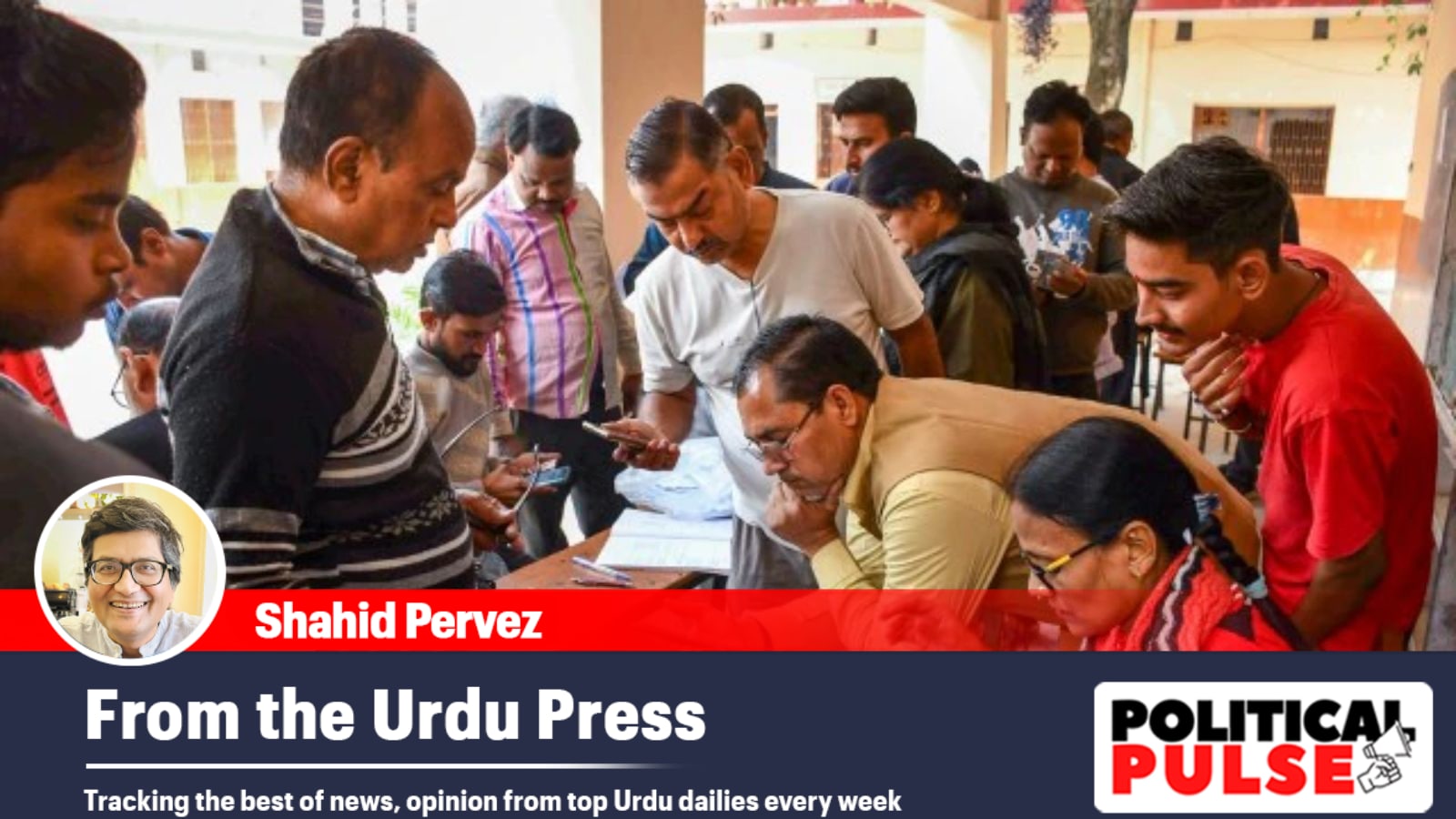
As the storm set off by the Election Commission (EC)’s Special Intensive Revision (SIR) roils national politics, it has also cast a shadow on the Winter Session of Parliament which got underway Monday. The row dominated the coverage of the Urdu dailies through the week, even as there appeared to be signs that both the Houses may debate the fraught issue in the coming days.
Flagging the turmoil caused by the EC’s ongoing SIR of electoral rolls in nine states and three UTs, the Hyderabad-based Siasat, in its December 2 editorial, points out that the Opposition parties have continued to be up in arms against the exercise, but the poll body has remained unfazed. “The preparation of new voter lists after intensive revision of existing rolls is a formidable exercise, which concerns crores of electors. The EC has put the onus of this massive task on the BLOs comprising a small section of government staff like teachers, setting a tight deadline for completion of the process,” the editorial says. “This has resulted in work overload and extreme pressure for the BLOs, which has led to deaths and alleged suicides of many of them across the country.”
“A key question arising from the SIR affair is, who would take the responsibility for the BLOs’ deaths linked to the hasty SIR exercise, which have devastated so many families? The EC and the Centre have continued to remain silent on this matter”, says the edit, adding that “even a proper rationale for the pan-India SIR has still not been clearly spelt out by the poll body”.
The daily asserts that voter lists must be regularly revised, corrected and updated. “The electoral rolls must be cleansed of any discrepancies and errors, listing only genuine voters and deleting any bogus names. But this entire exercise involving hundreds of millions of people could not be rushed through in a matter of a few weeks, which would only prove counter-productive,” it says, questioning the SIR’s methodology.
“The manner in which the EC has sought to ram through the SIR has also triggered suspicions about its motives,” the edit notes. “As a constitutional body, the EC is entitled to chart its own course to discharge its mandate. But it cannot ride roughshod, ignoring the impact of its moves on people’s lives. It is time the EC should do some introspection and take necessary action to facilitate the BLOs’ work amid a conducive atmosphere and timeline.”
URDU TIMES
Highlighting the offer of a Hindu neighbour of a Muslim journalist in Jammu, to gift his land to the latter’s family whose house was demolished by the Jammu Development Authority (JDA) during an anti-encroachment drive, the Mumbai-based Urdu Times, in its November 29 leader, points out that India has always been lauded as a country of peace and love, unity and harmony. “While designs have been made in recent times to create a Hindu-Muslim divide, erect a wall of mistrust between communities, and fuel hatred and discord, the idea of India is reflected by the humanity and generosity of a Jammu-based Muslim journalist Arfaz Daing’s Hindu neighbour Kuldeep Sharma,” it says. “All attempts to vitiate the atmosphere and damage our social fabric seem to be falling flat as they face various shining instances of communal amity, which define the Indian ethos.”
The daily notes that the JDA rolled out bulldozers to raze the house of Arfaz’s father Ghulam Qadir Daing, which he had built 40 years ago, leaving the 72-year-old man sitting amid its rubble in the open. “His neighbour Kuldeep Sharma then reached there to offer the Daing family his land. His gesture would deal a blow to bigoted forces. Sharma has upheld India’s singularly pluralistic culture marked with the essence of unity in diversity,” it says.
The edit points out that people from diverse communities and religious groups or castes have been living together in India from time immemorial. “Our country’s soil is imbued with love, not hate, which should be credited to our many saints and sufis who dedicated themselves entirely for this great cause.”
SIASAT
Commenting on the truce reached by Karnataka Chief Minister Siddaramaiah and Deputy CM D K Shivakumar following a breakfast meeting, held at the CM’s house after a nudge from the Congress leadership, Siasat, in its November 30 editorial, says that the two leaders seem to have hit the pause button in their power struggle, helping their party to defuse a crisis for now. It points out that while the Congress has officially never confirmed any agreement between them for sharing of power for 2.5 years each, this is widely believed in political circles that a “rotational CM” deal was struck after the party formed its government in the state in May 2023. Their tussle came to a head recently when the Siddaramaiah government marked 2.5 years of its tenure, which led to renewed lobbying and fresh disquiet within the party, it says. “Finally, the Congress high command stepped in, asking both leaders to have their one-on-one meeting to resolve the impasse. After the breakfast meeting, they jointly signalled a truce, reaffirming their commitment to the party’s interest.”
While Siddaramaiah and his deputy said they would abide by whatever decisions the Congress high command takes, it is getting increasingly clear that Shivakumar may take charge as the CM by “the end of March or early April next year”, the daily states. “The Congress leadership would now work out a roadmap for this transition of power. It has asked both leaders to focus on governance and avoid comments over the issue,” it says.
Siddaramaiah is a Congress heavyweight and a mass leader. “However, the point remains that as the state Congress chief, Shivakumar played a pivotal role in steering the party to a resounding win in the 2023 polls,” the edit notes. “The Congress is also eyeing the 2028 polls. For the party’s future, its governments in Karnataka and Telangana are critical, even as it is trying to return to power in Kerala in the 2026 elections.”