
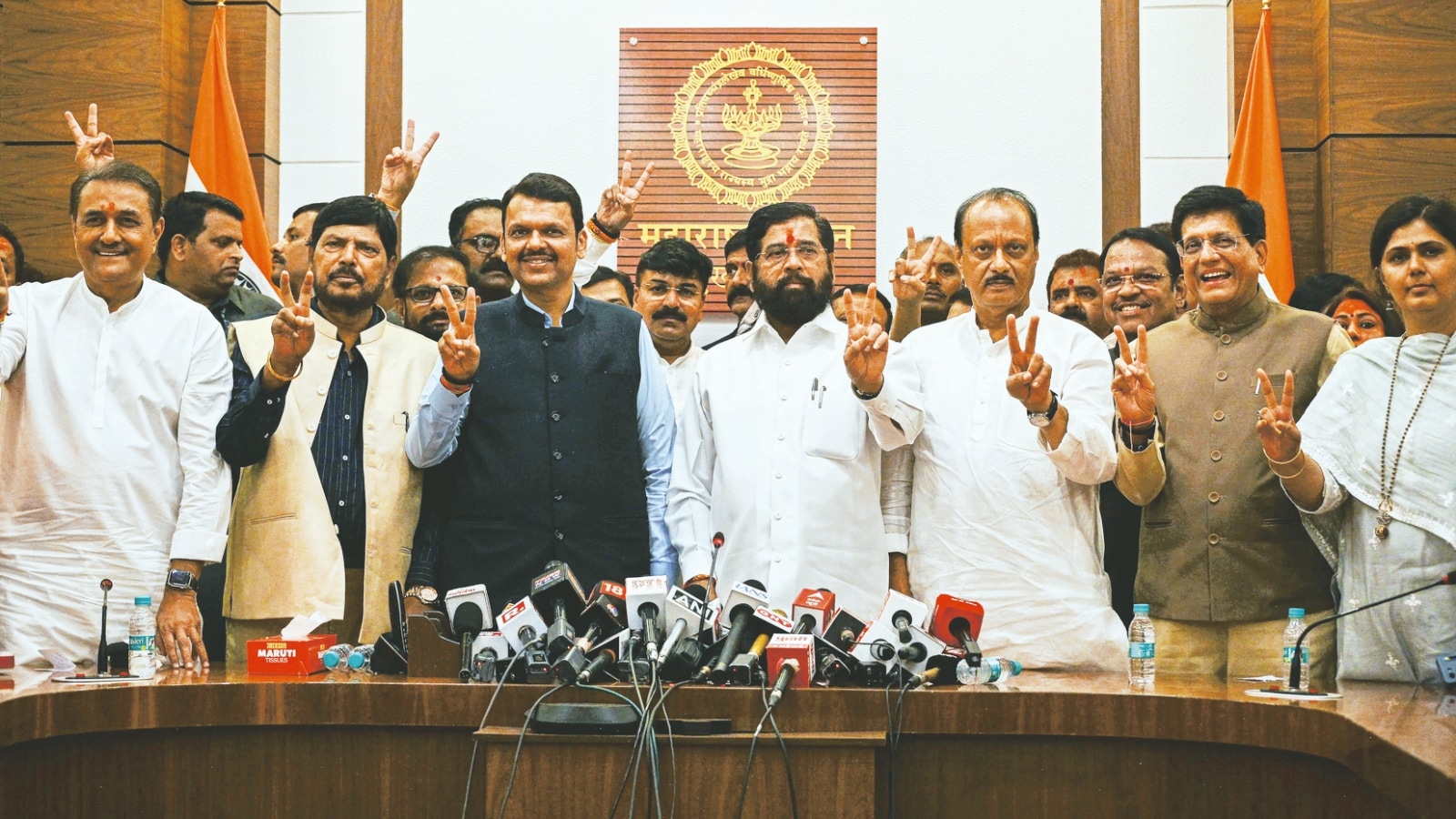
Set to complete a year in power on December 5, the Devendra Fadnavis-led Maharashtra government stormed to power riding on its “good governance” plank, but has seen conflicts within the Mahayuti alliance overshadow its work.
With its focus on infrastructure and industrial development, the government, soon after assuming power, reiterated its commitment to fixing economic faultlines in the state, which has seen sharp polarisation on caste lines due to the Maratha quota agitation and counter-protests by the Other Backward Classes (OBCs). It also indicated a clear shift towards “development politics” aimed at long-term structural change, rather than short-term populism.
“We cannot be rigid in coalition politics. After the local body elections are done by early next year, the focus will shift entirely to governance. There will be some harsh decisions taken to streamline the system as well as political arrangements,” said a senior BJP minister.
Fadnavis took charge of the state on December 5, 2024, for the third time, following a sweeping victory in which the Mahayuti — comprising the BJP, the Eknath Shinde-led Shiv Sena and Ajit Pawar’s NCP — won 235 of 288 Assembly seats. The BJP on its own won 132 constituencies. Unlike his first term, when he was reliant on the undivided Sena’s 63 seats, this time the CM’s dependence on Eknath Shinde and Ajit Pawar was vastly reduced and he set out on pushing through his development agenda. However, a lack of coordination among ruling partners has not only hampered governance but also left the bureaucracy divided.
Controversies and challenges
Days after taking over, the Mahayuti was rocked by the murder of sarpanch Santosh Deskhmukh, a case in which former NCP minister Dhananjay Munde’s aide was named. While it eventually led to Munde’s resignation as minister, the government faced flak over the incident from Opposition quarters and from within.
More recently, Ajit Pawar found himself in the dock over a Pune land deal involving his son Parth Pawar, forcing Fadnavis to give the Deputy CM a “clean chit” after he came under attack from the Opposition.
The Shiv Sena too has contributed to problems for Fadnavis over the last year, with several ministers such as Sanjay Shirsat and Yogesh Kadam named in cases of corruption and misconduct.
Even as the unease among the coalition partners spilled into the open in the run-up to the local body polls over allegations of poaching each other’s leaders, with Shinde frequently travelling to Delhi to meet the central leadership as things between the allies heated up in the state, BJP minister Chandrashekhar Bawankule said the government was “prompt” in taking action whenever there was any wrongdoing.
“There was no cover-up. On the governance front, decisions have been taken at a brisk pace in all key sectors which are seen to be contributors to the development of rural as well as urban parts of the state,” he said.
The year also saw the government face a stiff challenge in the form of Maratha quota activist Manoj Jarange-Patil, whose agitation brought Mumbai to a standstill for five days in September. The agitation proved to be a litmus test for Fadnavis, who hails from the Brahmin community and also serves as the state Home Minister. His Deputy CMs — both from the Maratha community — made the situation tricky as they distanced themselves from the crisis. While Shinde retreated to his native village in Satara, Pawar restricted himself to Pune. Eventually, the crisis was defused by BJP minister Radhakrishna Vikhe-Patil after partially conceding Jarange-Patil’s demand.
The Fadnavis government has also been faced with farmer distress and concerns regarding the agricultural sector.
Even as Pawar, who holds the Finance portfolio, said the government has granted a Rs 31,268-crore relief package to farmers hit by floods and unseasonal rain, the state has seen over 800 farmer suicides since Fadnavis took over. Ministers, too, have repeatedly expressed concerns about the disbursement of the package and the lack of access to loans for farmers.
Farmer leaders, too, have been up in arms against the government. “The Mahayuti has not been able to address administrative challenges as well as those arising due to natural calamities. You cannot resolve complex agricultural issues by dishing out a one-time relief package,” said Raju Shetti, former Hatkanangale MP and president of the Swabhimani Shetkari Sanghatana.
Admitting there was “no one-fix solution” to the problem, an agricultural department official said, “The government is sensitive towards farmers’ concerns. The solution is a continuous process and needs to be pursued consistently,” he added.
Development strategy
However, amid all the turbulence, the CM has attempted to keep the focus on the government’s legislative agenda. “Be it governance or politics, we have ensured that development has remained an integral aspect, necessary for the empowerment and well-being of people,” he said on Wednesday.
Shinde has claimed that all pre-election promises are being “implemented honestly”. “A case in point is the Ladki Bahin Yojana, under which over two crore women get a monthly aid of Rs 1,500,” he said.
The government has emphasised economic growth with social welfare and regional development through large infrastructure projects, industrial development, and improved connectivity. As part of this strategy, the government has set its sights on governance reforms, setting up educational hubs and completing the 802 km Shaktipeeth Highway connecting Vidarbha and Sindhudurg in the Konkan region. Apart from this, the government has also signed multiple MoUs to set up industrial parks with an aim to boost industrial infrastructure and investments.
In line with Union Home Minister Amit Shah’s call to end Naxalism in the country by March 2026, the government has cracked down on Maoists in Gadchiroli district. Fadnavis has also announced that the Maoist-hit district will be developed as a “steel hub” and will serve as the “gateway to South India”.