
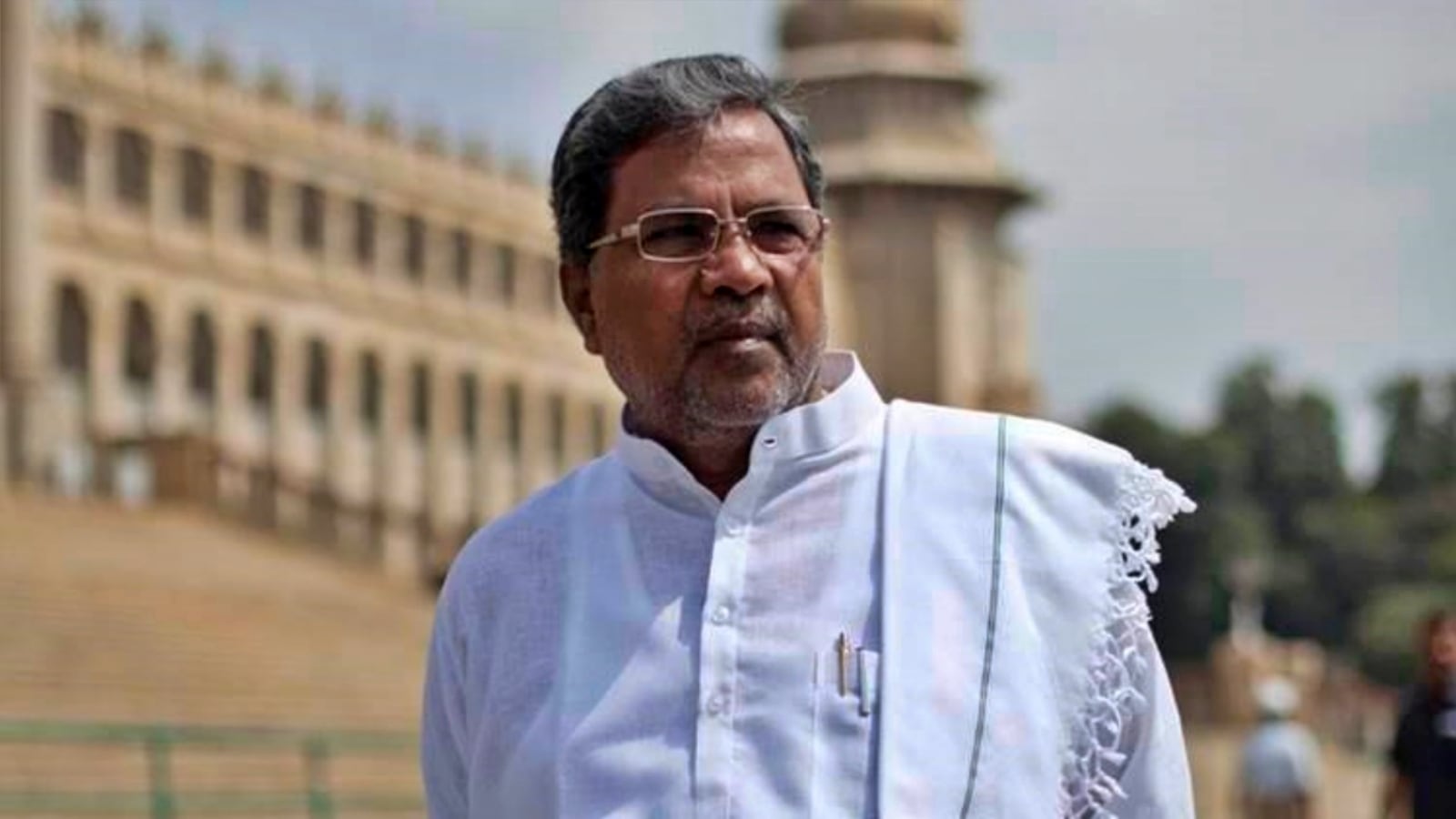
Only education can help people gain self-respect in India, where a slavery mindset is still prevalent 75 years after Independence, Karnataka Chief Minister Siddaramaiah said at an event in Mangaluru on Wednesday to mark the centenary of a historic dialogue on caste and religion between Kerala spiritual leader Narayana Guru and Mahatma Gandhi.
“Only education helps people gain self-respect. Self-respect is very important. Even 75 years after Independence, we have not come out of the slavery mindset,” Siddaramaiah said at an event seen in political circles as a show of strength by backward communities amid a power tussle in the Congress between Siddaramaiah, an OBC leader, and his deputy D K Shivakumar.
“For example, an upper caste person, even if he is poor, is called respectable names. At the same time, when a man is from a lower caste, even if he is wealthy and educated, he is addressed in a derogatory way. This is an example of the slavery mindset. As long as we do not confront this and eradicate it, we cannot get rid of this mindset,” Siddaramaiah said.
The event was held at Mangalore University’s Mangalagangothri campus to mark the centenary of a historic dialogue held by Gandhi and Narayana Guru in March 1925 in Kerala.
Siddaramaiah said that Narayana Guru, Mahatma Gandhi and Dr Babasaheb Ambedkar emphasised the values of independence, equality and fraternity.
“I instantly accepted the invitation to participate in this event because Narayana Guru was a secular person. We have many castes and many religions. He tried to teach the lesson of one caste, one religion, and one God through the course of his life,” Siddaramaiah said.
“Nobody is born low or high, Narayana Guru said. What we have to understand is that the dialogue between Gandhiji and Narayana Guru involved Narayana Guru trying to place his beliefs before Gandhi,” he said.
Story continues below this ad
“In their dialogue, Gandhiji points to a mango tree and says the leaves of the tree have many different colours and are in different stages. He says that the caste system in India is similar. However, Narayana Guru says that the essence of all the leaves is the same. The leaves may appear different, but their taste is the same, he observed,” the Karnataka chief minister said.
“We have to realise that caste does not make people big or small. There is a misplaced emphasis on identity on the basis of caste in society, and Narayana Guru attempted to dispel some of the mistaken notions about caste that were held by Gandhi,” Siddaramaiah said.
“He never identified himself with any caste or religion—not even to the Billava community to which he was born. In Kerala, he worked to create a secular society. In Kerala, the Ezhava people were treated as untouchables, and Narayana Guru worked to change the situation for the Ezhava people,” he said.
Siddaramaiah said that Narayana Guru established a Shiva temple in Kerala, but some people said a lower caste man should not build a temple for Shiva. At the time, Narayana Guru told his critics that he had not established a temple “for your Shiva but for our Shiva”, the Karnataka CM added.
Story continues below this ad
“This is the reason he told people not to go to temples if they are not allowed into the temples due to the caste factor. He told them to build their own temples for Shiva. He told them to become priests. He travelled along coastal Karnataka and helped build temples. He created history as a result of his philosophy,” Siddaramaiah said.
‘Historical dialogues’
“The beliefs that Gandhi held regarding religion and caste changed after the meeting with Narayana Guru. This dialogue was a historical discussion. We have to understand from this dialogue that caste and religion should go, and we should all live as humans who are equals,” Siddaramaiah said.
“In 1925, Narayana Guru met Mahatma Gandhi, and in 1931, he met Babasaheb Ambedkar. These two dialogues are historical dialogues. Babasaheb Ambedkar incorporated religious tolerance and fraternity as constitutional values. Only when these values are cultivated can there be an equal society. The social inequalities must be removed,” he added.
“All religions preach the lesson of loving one another and not hate. The division of people on the basis of caste and religion should not happen,” he stressed in a reference to the divisive religion-based politics prevalent in coastal Karnataka.
Story continues below this ad
“The extent of our selfishness can be seen in the fact that if we need a surgery and blood is required, we do not discriminate on the basis of caste or religion, but as soon as we recover, we ask about the caste and religion of everyone we meet. This is selfishness. People must live with humane values in Dakshina Kannada. There must be unity in diversity,” the Karnataka CM said.
The event assumed political significance in the context of an ongoing power tussle between Siddaramaiah and Shivakumar. Shivakumar’s absence was conspicuous at the event that was also attended by Congress national general secretary K C Venugopal.
Narayana Guru is revered by key backward class communities like the Billavas/Idigas in the Dakshina Kannada region bordering Kerala. The event on Wednesday was organised by All India Congress Committee secretary and Karnataka MLC B K Hariprasad, who hails from the Dakshina Kannada region.