
As the curtain comes down on a turbulent 2025, the Urdu dailies turned their gaze to some significant rulings given by various courts that sent ripples across the country. From a UP court rejecting the state government’s plea to withdraw all charges against the Akhlaq lynching accused to the Supreme Court staying the Delhi High Court’s order suspending the life sentence given to ex-BJP MLA Kuldeep Sengar in the Unnao rape case, to the apex court staying its own order that accepted a 100-metre elevation rule for the Aravallis – these stories defined the front pages of the dailies over the week.
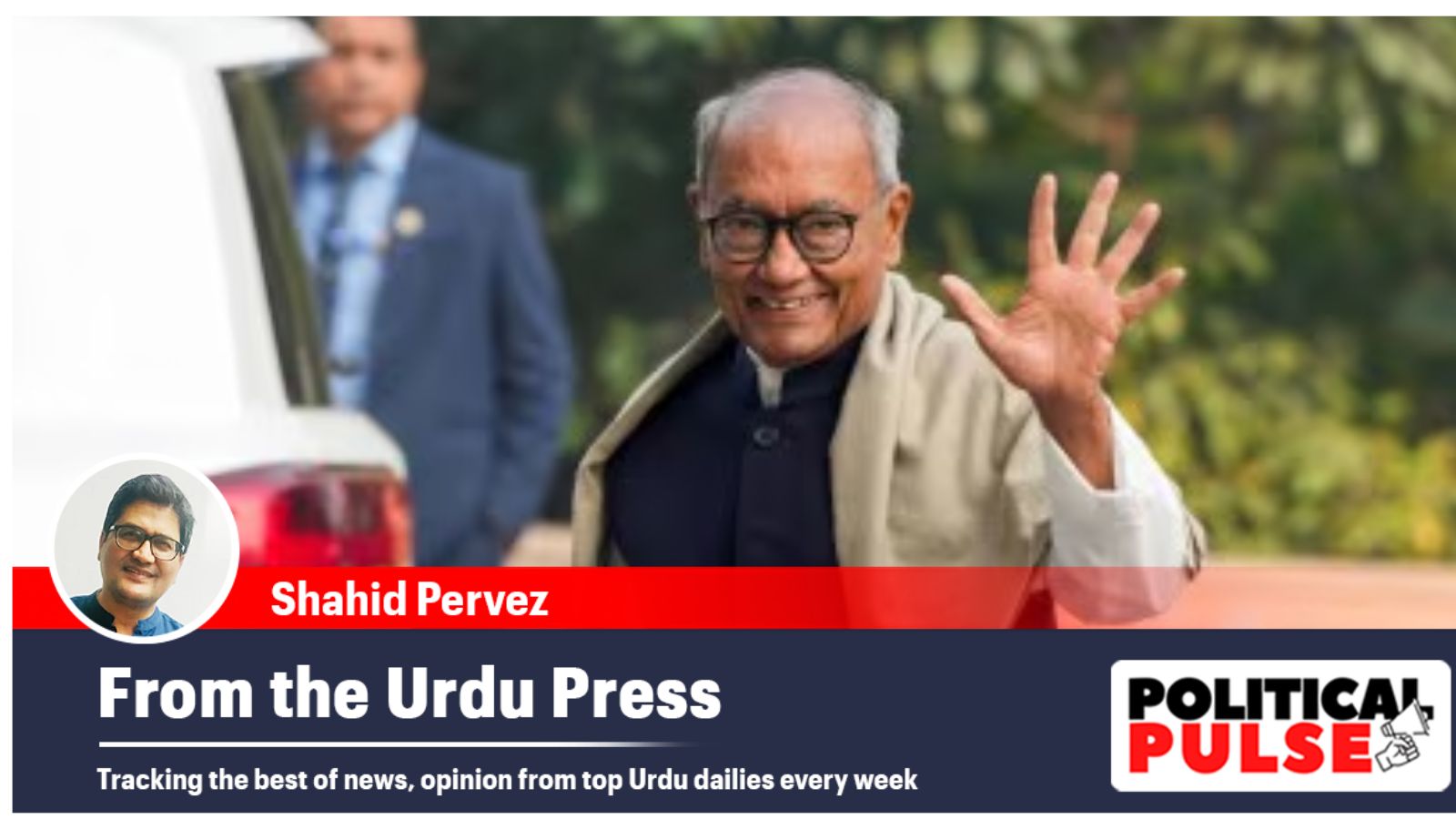
Referring to the row sparked by veteran Congress leader Digvijaya Singh’s remarks lauding the organisational structure of the BJP-RSS while calling for “decentralisation” in the Congress, the Hyderabad-based Siasat, in its editorial on December 30, says that Digvijaya has been known for his sharp attacks on the Sangh Parivar. “Digvijaya has been one of the Congress leaders, who has always taken on the RSS openly and campaigned against it, due to which he has also been dogged by controversies. Ironically, this time, he has landed in a row due to his praise for the RSS’ organisational strength,” it says.
Amid the Congress Working Committee (CWC) meeting held to discuss the party’s course of action against the Narendra Modi government’s move to replace the UPA’s landmark MGNREGA with the G Ram G Act, 2025, Digvijaya put out a post on X with an old photograph that showed BJP stalwart L K Advani attending an event and a younger Narendra Modi sitting on the floor near him. Digvijaya remarked that “The way grassroots workers of the RSS and Jan Sangh/BJP sit on the floor at the feet of leaders and go on to become the Chief Minister of a state and the Prime Minister of the country shows the power of the organisation”, the daily notes.
Earlier, Digvijaya had also pitched for reforms and “decentralisation” of power in the Congress, the editorial says. “While the Congress has prudently chosen not to react to this entire row, the BJP has raked it up in an attempt to sharpen the divide within the grand old party,” it says. “Digvijaya could not be accused of indulging in anti-party activity. His move to highlight the Congress’s organisational deficiencies reflects his intent to seek corrective measures for its revival. While the Congress leaders should flag these issues within the party fora and Digvijaya’s bid to cite the example of the Sangh may not be appropriate, he could not be accused of malevolence or rebellion against his party,” the edit states. “It could be argued that Digvijaya went public with these comments because he cares about the Congress’s future and wants the party to get its act together. He has reiterated that he is a fierce critics of the Sangh Parivar.”
MUNSIF
Highlighting a Surajpur court’s order rejecting the UP government’s plea to withdraw all charges against the accused in the 2015 lynching of Mohammad Akhlaq, the Hyderabad-based Munsif, in its December 25 editorial, says that the court’s ruling has upheld justice and sent a clear message to the government. The editorial points out that Akhlaq was beaten to death by a mob in his village in Greater Noida near Delhi over rumours that he had killed a cow and stored the meat in his home, which his family members denied. It says that Akhlaq’s cold-blooded murder had caused widespread outrage in the country and abroad, which also ignited a debate over communal violence and cow vigilantism. “There have demands from several quarters that the Akhlaq lynching accused must be given exemplary punishment.”
The daily says that the BJP dispensation, both in UP and at the Centre, have “failed” Akhlaq’s family as the case has continued to hang fire in the courts for a decade. “And then the UP government moved the court to withdraw prosecution in the matter,” it notes, adding that the reasons cited by the government for its action included its claims that no firearms or sharp weapons were recovered from the accused and that there was no previous enmity between the accused and the victim.
“The government’s plea was disgraceful, which the court has rejected. The court has also ordered that the case be heard on a daily basis, directing the prosecution to fast-track the matter. It has posted January 6 as the next date of hearing too,” the editorial says. “It is to be seen how the case progresses in the coming days, but the court’s ruling has given a new hope for justice to Akhlaq’s family. What however remains disturbing is that the row has betrayed the bias of a state, which has a constitutional responsibility to secure justice for every citizen regardless of religion, caste or creed.”
SIASAT
Commenting on the homecoming of Bangladesh Nationalist Party (BNP) acting chairman Tarique Rahman after 17 years in self-exile in the UK, Siasat, in its December 27 leader, states that the son of ex-Bangladesh prime minister Khaleda Zia (who passed away Tuesday) returned to Dhaka to a rousing welcome by tens of thousands of his supporters. Addressing them, Rahman called for maintaining peace, unity and stability in the strife-torn country. The BNP is a leading contender in the February 12 Bangladesh parliamentary elections and Rahman is a frontrunner for the PM’s post.
“Rahman has sought to show hope to the people of Bangladesh. Invoking Martin Luther King Jr’s ‘I have a dream’ remark, he said he has a plan for rebuilding his country,” the editorial says. “The people of Bangladesh has pinned their hopes on Rahman’s leadership. They are looking up to him to steer the country out of its prevailing chaos and unrest, and to put it back on track towards peace and development,” it says. “After grappling with acute poverty and backwardness for decades, Bangladesh had started its development journey which seems to have got derailed now,” the edit says, adding that a grave crisis has gripped the neighbouring country.
Referring to the student uprising and violence in July-August 2024 that led to the ouster of then PM Sheikh Hasina after her 15-year rule, the daily notes that the upheaval forced her to escape to India. “Hasina had ruled with an iron hand, virtually eliminating the Opposition from Bangladesh politics. However, even the interim government, led by Muhammad Yunus, has not been able to improve the situation of that country, which has fuelled the forces of anarchy,” it states. Rahman has said he has a plan for an inclusive and safe Bangladesh, the edit says. “He should spell out the details of his plan before the people to enable them to take informed decision in the upcoming elections that would determine their future.”