
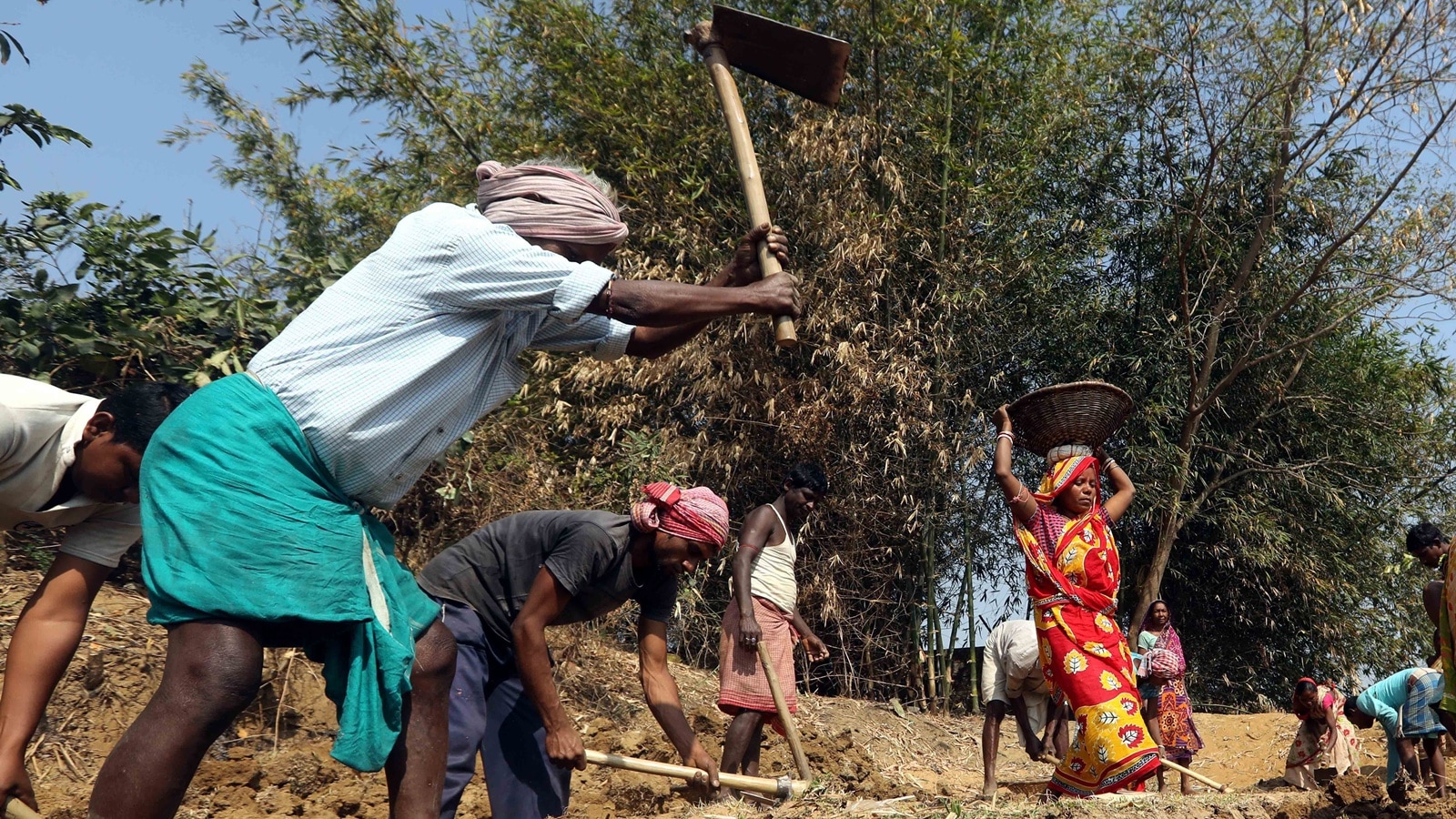
Repealing the two-decade-old Mahatma Gandhi National Rural Employment Guarantee Act or MGNREGA, the BJP-led NDA government has enacted the Viksit Bharat-Guarantee for Rozgar and Ajeevika Mission (Gramin) or VB-G RAM G Act, 2025, which introduces a new Centrally Sponsored Scheme to provide unskilled jobs in rural areas across the country.
The legislation was passed by voice vote in both the Lok Sabha and the Rajya Sabha during the recently concluded Winter Session amid vociferous protests from the Opposition members, which accused the government of “ramming it through” Parliament.
The G Ram G law fundamentally alters the statutory wage guarantee framework by introducing a 60-day pause on work period. It may also face various hurdles during implementation given its other contentious provisions, which include fund sharing pattern (Section 22) and normative allocation (Sub-section 5 of Section 4).
These provisions may have a bearing on the the performance of the new scheme besides having significant fiscal implications for several cash-strapped states.
What is the new scheme’s funding pattern?
In contrast to the landmark MGNREGA, G RAM G Act proposes a higher share of states in the funding of this guaranteed rural employment programme. As per Section 22(1) of the Act, the fund-sharing pattern between the Centre and the state governments will be 90:10 for the 11 Northeastern or hilly states / Union Territories (UTs), which are Arunachal Pradesh, Assam, Himachal Pradesh, Jammu & Kashmir, Manipur, Meghalaya, Mizoram, Nagaland, Sikkim, Tripura and Uttarakhand.
It will be 60:40 for all other states / UTs with legislature, which include Andhra Pradesh, Bihar, Chhattisgarh, Goa, Gujarat, Haryana, Jharkhand, Karnataka, Kerala, Madhya Pradesh, Maharashtra, Odisha, Punjab, Rajasthan, Tamil Nadu, Telangana, Uttar Pradesh, West Bengal and Puducherry.
For four UTs without legislature – Ladakh, Andaman and Nicobar, Dadra Nagar Haveli and Daman and Diu, and Lakshadweep – the Centre will bear the scheme’s entire expenses.
Under the MGNREGA, the Centre was required to make 100% payment for wages and share 75% of material and administrative costs with states.
In the last financial year 2024-25, the total expenditure on the MGNREGA stood at Rs 1.04 lakh crore, of which Rs 85,640.55 crore was borne by the Centre. Of the total spending, Rs 73,337 crore was the wage bill paid entirely by the Centre. On an average, the Centre funded 90% of the scheme’s overall fiscal burden, with the states paying for the remaining 10%. However, a majority of the states would have to pay much more now, with the new scheme proposing 60:40 funding ratio.
The Union Ministry of Rural Development estimates that the annual expenditure on the new scheme would be around Rs 1,51,282 crore, of which the estimated Central share would be Rs 95,692.31 crore, with the remaining amount of Rs 55,589.69 crore to be released by the states.
While there are no official estimates about the additional fiscal burden on the states due to the new scheme, a calculation of the last financial year’s expenditure data shows that the additional fiscal impact on states may be over Rs 30,000 crore annually. This would have a significant impact on states’ finances, which would have to make provision for it in their budgets.
Why transition may face challenges?
The Centre is set to face various challenges in the course of transition to the new scheme from the MGNREGA. It will have to clear all the existing liabilities pending under the old scheme. As the G RAM G Act provides a six-month’s time to states for implementing the scheme, they are likely to roll it out in different timeframes. The Central government believes that its estimated annual share of Rs 95,692.31 crore for the new scheme would cover liabilities too.
What is ‘normative allocation’ row?
The G RAM G Act’s new “normative” formula transforms its allocation into a top-down process. The Act defines this as “the allocation of the fund made by the Central Government to the State”.
Section 4(5) of the Act states: “The Central Government shall determine the state-wise normative allocation for each financial year, based on objective parameters as may be prescribed by the Central Government.”
Under the MGNREGA, all states were required to present their annual work plan and labour budget to the Union Ministry of Rural Development before the beginning of each financial year (on or before January 31) to execute the demand-driven scheme. The labour budget was prepared at the district level on the basis of anticipated demand for unskilled manual work. It was aggregated by the state government, which then approached the Centre for finalising the allocation.
The new provision is likely to affect states which have seen a higher demand under the MGNREGA. In 2024-25, 5.78 crore families (excluding West Bengal) availed the rural job scheme. The top five states that saw the highest demand for it were Tamil Nadu, Uttar Pradesh, Rajasthan, Bihar and Andhra Pradesh.
When would the scheme have a pause?
Unlike the MGNREGA, the G Ram G Act introduces provisions for pausing the scheme for 60 days during sowing and harvesting to ensure “adequate agricultural labour availability” then.
States will notify the 60-day period in advance. They may issue distinct notifications for different areas based on agro-climatic zones, local patterns of agricultural activities or other factors.
While the provision for pause may address the concerns over non-availability of labour for farm work during the peak agricultural season, it would effectively result in a shorter window to avail of the new scheme, which provides for 125 days of work compared to the MGNREGA’s 100 workdays in a year.
India has a diverse agriculture calendar with crops varying from one region to another. For instance, the sowing period of paddy during Kharif season starts in May and continues till August. The harvesting takes place from September to January.
The sowing of wheat, which is the principal Rabi crop, starts in October and continues till January. Its harvesting takes place from February to June.
What will be administrative expenditure?
Union Rural Development Minister Shivraj Singh Chouhan has said that the new scheme will have a higher administrative expenditure – 9% – against the MGNREGA’s 6%. This may be the highest in any government schemes, whose administrative expenses are usually about 2.5% of their total outlay on an average.