
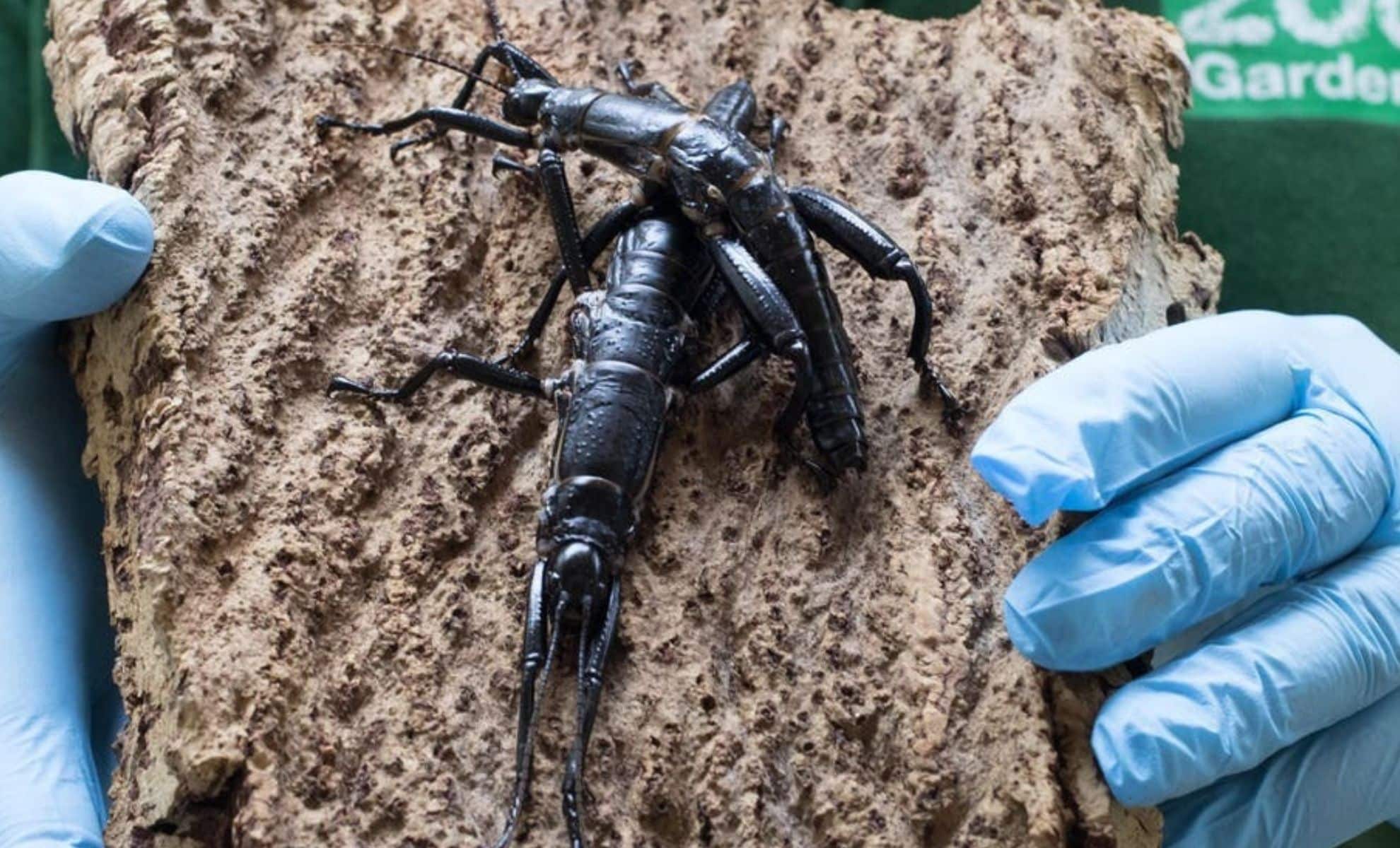
For nearly a century, it was thought to be gone forever. The Lord Howe Island stick insect (Dryococelus australis), once one of the most common insects on its native island in the Tasman Sea, vanished from scientific records in the early 20th century after an ecological disaster introduced invasive rats to its habitat. Declared extinct by the 1930s, the species became a textbook example of how quickly island ecosystems can collapse.
Then in 2001, an unlikely discovery stunned the scientific community. On Ball’s Pyramid—a near-vertical sea stack rising from the Pacific Ocean 23 kilometers southeast of Lord Howe Island—scientists found live specimens under a wind-exposed shrub growing in a cliffside crevice. The insects were large, wingless, and bore resemblance to the missing D. australis, but their slightly darker, stockier build cast doubt.
Only in 2017 did a study published in Current Biology confirm the truth: the insects matched historical museum specimens of D. australis with less than 1% genetic divergence. After 80 years, the species had not vanished—it had survived, hidden in isolation, on a volcanic rock in the middle of the ocean.
the rediscovery that rewrote extinction
Ball’s Pyramid isn’t a place where most life survives. Nearly 550 meters tall and shaped like a giant spear rising from the sea, the rock is largely barren. But a single shrub—Melaleuca howeana—growing in a sheltered crevice harbored what may have been the last natural population of the insect. That microhabitat provided both food and cover from wind, salt spray, and the harsh sun.

The rediscovery raised more than symbolic questions. It challenged assumptions in conservation biology about extinction, population resilience, and the potential for so-called “Lazarus species” to re-emerge. Scientists began calling D. australis a case of “de-extinction by survival.”
In 2003, researchers removed two breeding pairs from Ball’s Pyramid to launch captive breeding programs. One pair went to Melbourne Zoo, and the other to a private facility. By 2016, those efforts had produced over 13,000 hatchlings, turning a critically endangered species into one of the most monitored insects on the planet.
inside the fragile recovery of the lord howe stick insect
Captive breeding was only the first step. Keeping a rare species alive in controlled conditions doesn’t guarantee long-term success. Between 2013 and 2019, researchers at Melbourne Zoo and Lord Howe Island observed multiple cases of sudden insect mortality in the breeding colonies.
A 2018 study in Veterinary Pathology documented two major mortality events. In one, dead insects showed minimal signs of illness before death. In another, they displayed motor issues, gut discoloration, and internal lesions. Lab cultures revealed the presence of Serratia marcescens and Pseudomonas aeruginosa, both bacterial pathogens known to cause disease in insects.
A 2024 study in the Journal of Wildlife Diseases took the analysis further. Scientists collected environmental and insect samples across Lord Howe Island and detected diverse strains of Serratia bacteria, some of which had never been genetically characterized before. These pathogens weren’t necessarily lethal in all cases but posed a threat to the biosecurity of rewilding efforts.
The researchers concluded that the risk of reintroducing captive-bred insects infected with novel pathogens to Lord Howe Island was low but not negligible. That finding underscored the importance of ongoing microbial surveillance and pathogen screening in future conservation plans.
evolutionary adaptations written in isolation
Despite being reduced to a tiny, cliff-bound population, D. australis endured thanks to a combination of ecological isolation and unique biological traits. A 2023 paper in Genome Biology and Evolution revealed key features that helped the species survive: a long adult lifespan, slow reproductive rate, and the ability to mate in low-density environments.
These traits—known to benefit species under demographic stress—likely allowed a small number of individuals to persist for decades in a microhabitat the size of a closet. Researchers also examined the potential for parthenogenesis, a form of asexual reproduction common in other phasmids, but genomic evidence showed that D. australis reproduces sexually.
The study emphasized how these evolutionary advantages could serve as a model for conserving other island invertebrates under similar stress.
reintroducing a species, with caution
The final piece of this decades-long story is unfolding now. Since the successful rat eradication program on Lord Howe Island in 2019, conditions have steadily improved for native species once thought to be lost. With predators removed, the landscape is being prepared for a possible reintroduction of D. australis to its historical habitat.
But rewilding a species like this isn’t just about returning it to where it once thrived. Conservation teams are evaluating everything from bacterial pathogen control to restoration of host plants, especially M. howeana, the shrub that sheltered the surviving insects on Ball’s Pyramid.
The approach integrates genetic diversity analysis, ecological modeling, and biosecurity risk assessments—an unusually thorough effort for an insect species. These steps are aimed at ensuring long-term success without triggering unintended ecological consequences.