
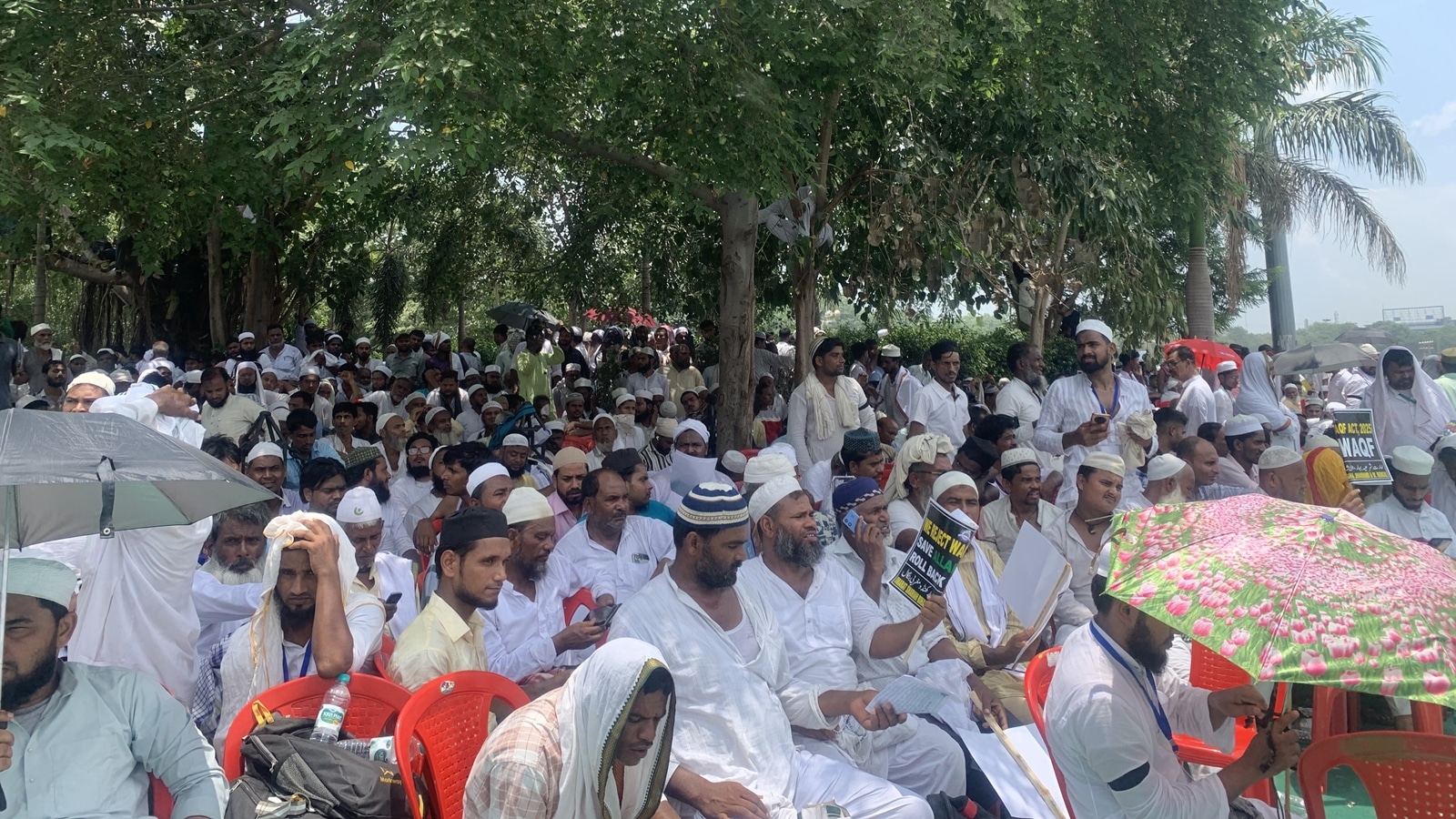
A day ahead of the deadline to register Waqf properties on a portal launched by the Centre on June 6, details of about a third to around tenth of the properties have been uploaded in four of the five states with the largest volume of Waqf land under their boards across the country.
Waqf boards and mutawallis (caretakers) of the properties are facing issues such as the portal – UMEED or ‘Unified Waqf Management, Empowerment, Efficiency and Development’ – crashing, the difficulty in finding documents and papers regarding centuries-old properties, as well as different measurements used for land in different states, among others.
The UMMED portal was launched by the Centre under provisions of the contested Waqf (Amendment) Act, with the objective of bringing all Waqf properties under a centralised digital database, with geo‑tagging and documentation. The government has said this will ensure that the properties are managed and protected better and in a transparent manner.
There are an estimated 8.8 lakh Waqf assets spread across the country.
At 1.4 lakh, Uttar Pradesh has by far the most Waqf assets across its Sunni and Shia boards. After UP, West Bengal (80,480), Punjab (75,511), Tamil Nadu (66,092), and Karnataka (65,242) have the most Waqf properties. Bihar is the only state besides UP that has separate Sunni and Shia boards; all other states have unified Waqf boards.
In Uttar Pradesh, around 35% of the properties had been registered on UMMEED till Thursday. In West Bengal, where the Trinamool Congress government has faced protests from Muslim organisations for instructing district magistrates to register Waqf properties, details of around 12% had been uploaded till Monday night. In Karnataka and Tamil Nadu, the figure was 10% (till Tuesday and Wednesday, respectively).
Punjab, which ranks third in terms of size of Waqf properties, is an exception, with registration of around 80% of the properties till Wednesday evening. But the reason for this, officials said, was that the Punjab Waqf Board is not registering Waqf properties but ‘Waqf estates (which could include any number of properties)’, making it a more manageable process. Punjab also has a different administrative set-up as it doesn’t have mutawallis (caretaker) for Waqf estates, and the Board manages them directly.
If the Waqf properties are not registered on UMEED by Friday, their respective Waqf boards or mutawallis can approach Waqf tribunals in their states and explain the reasons for the same. The tribunals have the power to grant an extension.
However, Waqf Boards and mutawallis apprehend the tribunals would get overwhelmed with requests at this rate. “How will tribunals deal with thousands of applications for extending the deadline?” said the CEO of a Waqf board.
The Indian Express spoke to officials and CEOs of Waqf boards in the five states with the largest volume of Waqf properties, and they urged the government to extend the deadline for registration on the portal. They also said that without a land survey, such an exercise is very difficult because some of the Waqf properties are historic.
In an Idea Exchange session with The Indian Express last week, Union Minister for Minority Affairs Kiren Rijiju admitted receiving complaints about the portal but said the deadline could not be extended as “the date is in the (Waqf) Act”. “I can’t change the Act unless Parliament itself changes the provisions… My request is that everybody should get on the portal without any delay. If there are reasons which are understandable, or special circumstances preventing them from getting registered, tribunals can give them more time,” said Rijiju.
Several Muslim MPs cutting across parties are among those who have written to Rijiju seeking an extension of the deadline.
On Wednesday, Samajwadi Party Rampur MP Mohibullah Nadvi said in the Lok Sabha: “The server has been down… Seventy per cent of the Waqf properties have not been registered (in UP)… It seems Articles 25 and 26 (freedom to practise religion and manage religious affairs) have been done away with, and the life of Muslims has been made difficult in our own country.”
In a similar appeal in the Lok Sabha Thursday, Congress Saharanpur MP Imran Masood said: “There are complaints from across India that there are technical problems with the UMEED portal… Muslims are worried.”
The All India Muslim Personal Law Board (AIMPLB) has also called for extending the deadline. AIMPLB spokesperson S Q R Ilyas said: “Reports have been pouring in from everywhere that the portal is crashing, slowing down and at times stopping entirely. Evidently, it is almost impossible to upload lakhs of properties within such a short period.”
On Monday, while hearing a plea regarding the UMEED portal, the Supreme Court refused to grant an extension for registering Waqf properties, instead asking the parties to approach tribunals concerned for relief.
Uttar Pradesh
The state has two separate Waqf boards, for Shia and Sunni communities. Till Monday night, the Sunni Waqf Board had managed to upload documents for 45,574 Waqf properties, of the total 1.26 lakh under its control (36%); while the Shia Waqf Board done so for 2,909 of the 15,386 Waqf properties (18.9%) under it.
A senior official in the UP Sunni Central Waqf Board said that the documents and details being sought on the UMEED portal are difficult to get as some Waqf properties are historic, and their papers are impossible to find. “For example, a property was declared Waqf in the early 20th century and its mutation was done then. Where will we find the papers for such properties? These properties are mentioned in the revenue records as Waqf. Then why does the government want us to furnish details of the mutation or registration of a property as Waqf?”
UP Sunni Central Waqf Board Chairman Zufar Farooqui told The Indian Express that mutawallis and Waqf board officials are trying their best to ensure uploading of documents and complete registration of properties. “We are working round-the-clock, but… we will not be able to complete this process before the deadline,” he said.
West Bengal
An official in the Board of Auqaf West Bengal informed that till Monday night, approximately 10,000 of the total 80,480 Waqf properties in the state were registered successfully on the UMEED portal.
The official flagged the fact that the mutawallis were not tech-savvy and educated, for the slow pace. “You are asking them to use a portal on a computer in English. In rural Bengal, most mutawallis don’t know English,” said the official.
The TMC government had refused to implement the Waqf (Amendment) Act for months before last week issuing directions to upload information regarding Waqf properties on the UMEED portal.
Another West Bengal official flagged the issue of different yardsticks for measuring land in different states. “One bigha in Bengal is different from that in Bihar, UP and other states. The Centre has created a unified system on the portal for measurement of land. How is it practical?”
Karnataka
A senior Karnataka State Board of Auqaf official said details regarding only 6,000-odd Waqf properties of the total 65,242 had been uploaded till Wednesday. “The server does not work most of the time… The government should do something… It takes 10-15 minutes per property even when the portal is functioning,” the official said.
Punjab
Out of 25,000 Waqf estates in the state, around 20,000 have been registered on the UMEED portal.
Explaining the high number for the state, a senior Punjab Waqf Board official said: “This is because we have not registered Waqf properties, but Waqf estates, which is easier and less complicated. One Waqf estate may have any number of properties.”
The official also flagged the fact that the state didn’t have mutawallis but the Board directly manages Waqf estates. “Hence, the process is almost complete for us… Our Waqf board staff has been working day and night for the last two weeks.”
Tamil Nadu
K Navas Kani, Chairman, Tamil Nadu Waqf Board, told The Indian Express that out of 66,092 Waqf properties, registration for only around 6,000 had been done till Tuesday. “The process is moving slowly and will take considerable time before we reach full compliance,” said Kani on Tuesday.
On the challenges, he said: “Most of the caretakers and mutawallis do not have the technical awareness or support required to update on the platform, and there is no government assistance. In many cases, property documents and ownership details are ambiguous, and without completing the mandatory survey, uploading accurate records is very difficult.”
With inputs from Arun Janardanan in Chennai, and Raakhi Jagga in Ludhiana.