
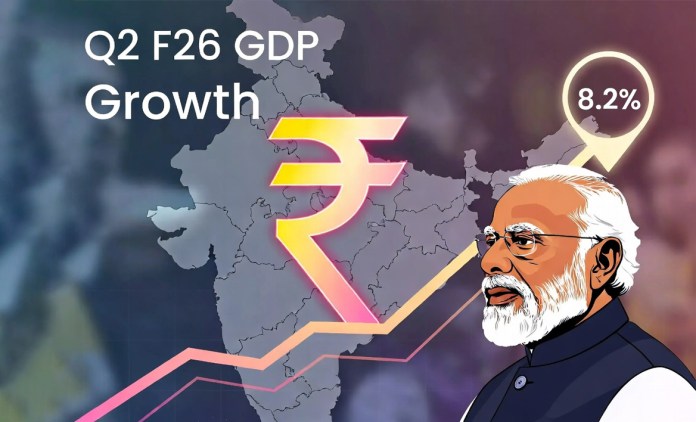
India’s second-quarter real GDP growth for FY (Fiscal Year) 2025-2026 reached a strong high of 8.2%, significantly exceeding projections of 7.3% growth as the real GDP has expanded at its fastest rate in six quarters. Additionally, India has maintained its reputation as the world’s fastest-growing major economy. The robust growth, up from 5.6% last year in the same period and 7.8% in the last quarter, underscores the strength of India’s economy despite the U.S. tariffs under the Trump administration.
A real GDP increase of 7.3% was predicted by the majority of economists for Q2 FY growth. According to the RBI’s own projections, the GDP was pegged to grow by 7% in the second quarter.
Official data released by the Ministry of Statistics and Programme Implementation (MoSPI) on Friday revealed that real GDP reached ₹48.63 lakh crore in Q2, a sharp rise from ₹44.94 lakh crore a year earlier. Nominal GDP at Current Prices, which includes inflation, climbed 8.7% to ₹85.25 lakh crore from ₹78.40 lakh crore last year.
Real Gross Value Added (GVA) grew by 8.1%, up from 5.8% YoY and 7.6% QoQ, signalling broad-based gains across key sectors. The GVA was estimated at ₹44.77 lakh crore, against ₹41.41 lakh crore last year. On the other hand, the nominal GVA rose 8.7% to ₹77.69 lakh crore.
Prime Minister Narendra Modi took to social media to laud the development. “The 8.2% GDP growth in Q2 of 2025-26 is very encouraging. It reflects the impact of our pro-growth policies and reforms. It also reflects the hard work and enterprise of our people. Our government will continue to advance reforms and strengthen Ease of Living for every citizen,” he remarked.
The 8.2% GDP growth in Q2 of 2025-26 is very encouraging. It reflects the impact of our pro-growth policies and reforms. It also reflects the hard work and enterprise of our people. Our government will continue to advance reforms and strengthen Ease of Living for every citizen.
— Narendra Modi (@narendramodi) November 28, 2025
Strong results in the Secondary (8.1%) and Tertiary (9.2%) sectors were the main drivers of the overall real GDP increase of 8.2%. With growth rates of 9.1% and 7.2%, respectively, at constant prices, the manufacturing and construction industries within the secondary sector saw notable advancements.
The tertiary sector continued to expand at a healthy rate, especially in Financial, Real Estate & Professional Services, which had a significant 10.2% increase at Constant Prices. However, the sector of Electricity, Gas, Water Supply, and Other Utility Services grew by 4.4%, while Agriculture and Allied Activities grew by 3.5%.
Real Private Final Consumption Expenditure performed better, growing by 7.9% as opposed to 6.4% during the same period in the prior fiscal year. Real GDP grew at 8.0% in the first half of FY 2025–2026 (April–September), a notable improvement over the 6.1% growth in H1 of FY 2024–2025.
Despite the impact of the GST implementation on consumption, private final consumption expenditure (PFCE), a proxy for household consumption increased 7.9 percent year over year in Q2FY26 up from 6.4 percent in Q2FY25. The reduction went into effect on 22nd September but the prime minister had proposed GST revisions on 15th August.
Investment in fixed assets is measured by gross fixed capital formation (GFCF) which increased by 7.3 percent. This growth was little slower than the 7.8 percent reported a quarter prior but it continues to indicate strong investment momentum.
Government final consumption expenditure (GFCE) decreased by 2.7 percent in Q2FY26 after increasing by 4.3 percent the previous year. Overall GDP growth increased in spite of this public sector drag, highlighting the importance of private investment and consumption. On the other hand, imports increased by 12.8 percent while exports of goods and services increased by 5.6 percent.
The real GDP (at Constant Prices) increased by 8.2% from ₹44.94 lakh crore in Q2 of FY 2024-25 to ₹48.63 lakh crore in Q2 of FY 2025-26. In Q2 of FY 2025-26, the Nominal GDP (at Current Prices) was ₹85.25 lakh crore, rising 8.7% from ₹78.40 lakh crore in Q2 of FY 2024-25.
From ₹41.41 lakh crore in Q2 of FY 2024-25 to ₹44.77 lakh crore in Q2 of FY 2025-26, the real GVA projections showed an 8.1% increase.
Likewise, nominal GVA was expected to be ₹77.69 lakh crore in Q2 of FY 2025-26, an 8.7% growth from ₹71.45 lakh crore in Q2 of FY 2024–25. Real GDP forecasts for H1 2025–2026 were ₹96.52 lakh crore, up 8.0% from ₹89.35 lakh crore in H1 2024–2025. From ₹157.48 lakh crore in H1 2024-25 to ₹171.30 lakh crore in H1 2025-26, the nominal GDP increased by 8.8%.
The real GVA for H1 2025–26 was ₹89.41 lakh crore, up 7.9% from ₹82.88 lakh crore in H1 2024–25. The nominal GVA for the first half of 2025–2026 was predicted to be ₹155.94 lakh crore, an increase of 8.8% from ₹143.39 lakh crore in the same period the previous year.
Notably, IMF already estimated that despite global uncertainty and new US tariffs on Indian exports, India’s “very strong economic performance and resilience” has been supported by strong domestic demand.
The Indian economy expanded by 6.5% in real terms in 2024–2025. For the fiscal year 2024–2025, the Reserve Bank of India had predicted GDP growth of 6.5%. India’s GDP increased by an astounding 9.2% in 2023–2024, maintaining its position as the fastest-growing major country. Official figures show that the economy expanded by 8.7% in 2021–2022 and 7.2% in 2022–2023.
The World Bank stated earlier this year that in order for India to fulfil its goals of becoming a developed nation by 2047, it must expand by an average of 7.8% over the next 22 years. But the World Bank claimed that in order to get there, reforms would need to be implemented with the same level of ambition as the goal itself.
Interestingly, the latest numbers transpired few months after the United Stated slapped 50% tariffs on India, including 25% additional tariffs for purchasing Russian oil because President Donald Trump claimed that the Modi government’s move fuelled the war in Ukraine.