
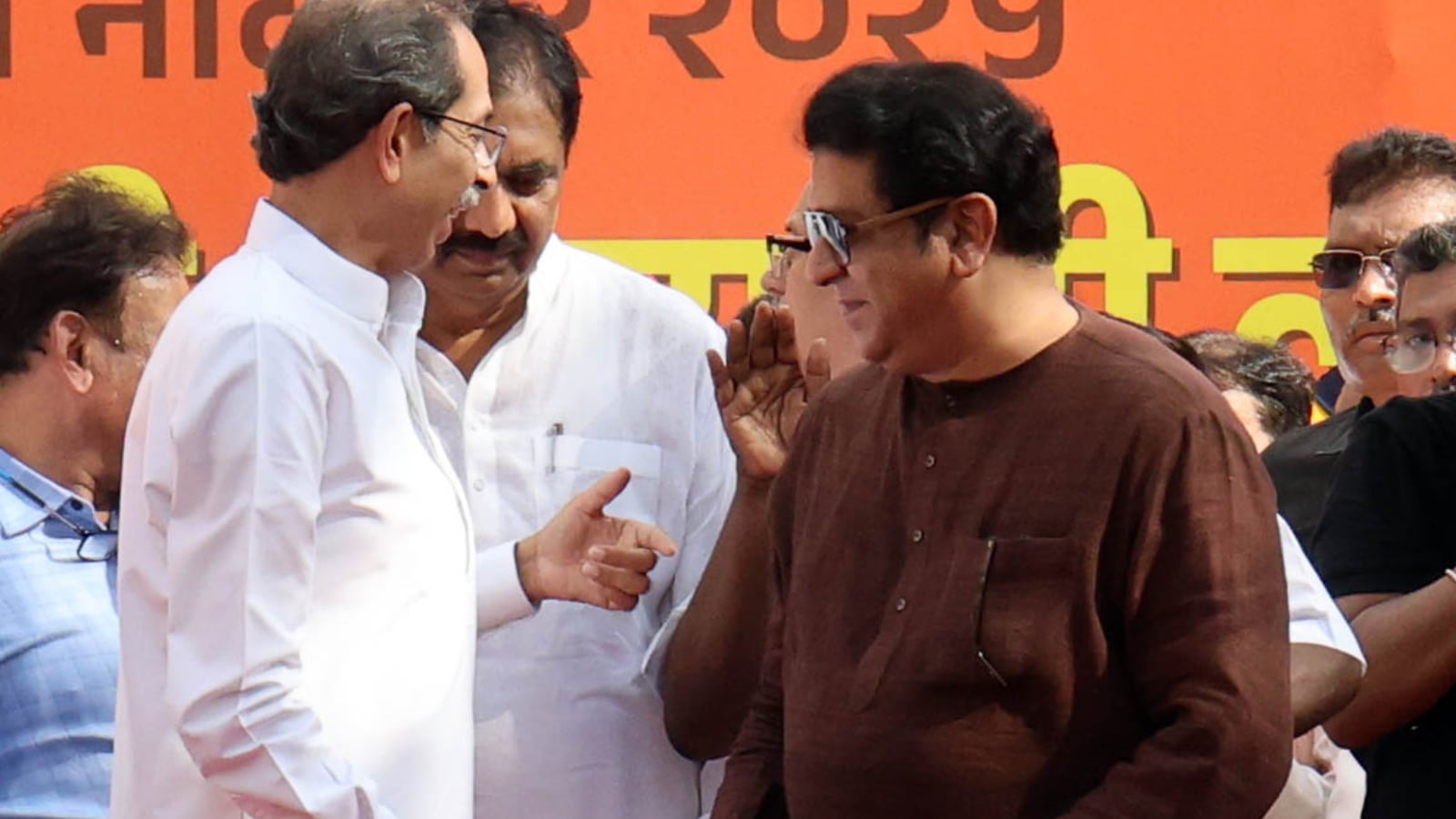
While looking to end the Sena’s almost three-decade old rule in the Brihanmumbai Municipal Corporation (BMC), the BJP has been forced to change its strategy weeks ahead of the January 15 civic body elections in Maharashtra. Reason: coming together of the once-estranged Thackeray cousins – Shiv Sena (UBT) chief Uddhav Thackeray and Maharashtra Navnirman Sena (MNS) president Raj Thackeray.
“The Sena (UBT)-MNS alliance will be announced on Wednesday by Uddhav and Raj in Mumbai,” Sena (UBT) MP Sanjay Raut said Tuesday, adding that discussions between both sides have progressed smoothly, setting the stage for the formal announcement.
Even as Chief Minister Devendra Fadnavis has publicly downplayed the impact of the Thackerays joining forces, some BJP insiders said that “counter strategies” were being worked out by the party’s core committee to tackle the Sena(UBT)-MNS combine.
With the Thackeray cousins having pledged to champion the cause of the Marathi manoos, the BJP insiders admitted that the BMC polls would not be a “cakewalk” despite the party’s strong performance in the recent local body polls, in which the BJP-led Mahayuti bagged 207 of the 288 local bodies, while the Congress and the Sena (UBT) won 28 and nine respectively.
“Whenever new alliances take shape, it is bound to make some impact. The Thackeray reunion is likely to create some euphoria, especially with their focus on wooing the Marathi and Muslim vote banks,” a BJP source said.
Story continues below this ad
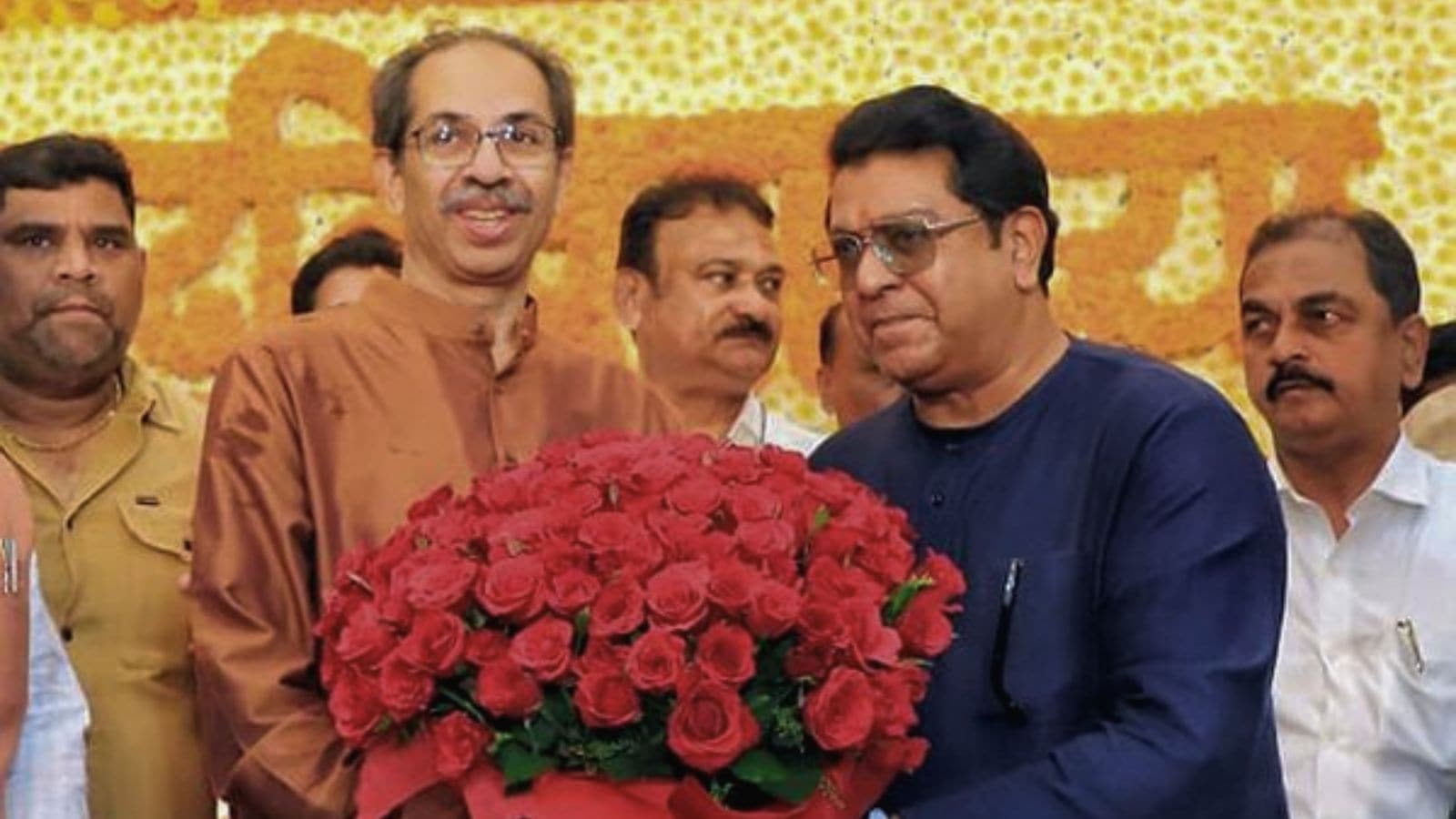 Former Maharashtra CM Uddhav Thackeray with MNS chief Raj Thackeray (Express File Photo)
Marathi speakers, who are seen as the Thackerays’ core support base, make up around 26% of Mumbai’s population. And with Muslims, who constitute around 11% of the city’s population, also likely to align with non-BJP forces, the BJP seems to have reasons to worry. A section of the nearly 11% Dalit population is also not seen as part of the BJP’s vote base.
Going by data, Uddhav and Raj together make up a political force to reckon with despite their dismal performances in the November 2024 state Assembly polls, which left the Sena (UBT) battered and the MNS fighting for its survival.
A ward-wise breakup of the Assembly elections, collated and analysed by The Indian Express, shows that in 67 of the 227 BMC wards in the city, or 30% wards, the MNS polled more votes than the winning margin. While the Opposition alliance Maha Vikas Aghadi (MVA), which comprises the Congress, NCP(SP) besides the Sena (UBT), led in 39 of these wards, the Mahayuti was ahead in 28 wards.

If the Sena (UBT) allies with the MNS, it may not only consolidate its position in these 39 wards but also flip the wards where the ruling coalition was ahead.
A closer look at the geography of these wards shows that the MNS’s strength lies in the Marathi belt stretching across Worli, Dadar, Mahim, Ghatkopar, Vikhroli, and Dindoshi-Malad, where its candidates polled one-third to half of the votes secured by the MVA candidates.
The MNS was seen to have influenced 123 wards. This reveals its influence across Mumbai’s political geography despite a small vote share (4% from 25 seats in the 2024 Assembly polls).
For Uddhav, this arithmetic translates into strategy in an election where even a few hundred votes can decide a ward, even though the MNS is not that big a factor in the Assembly and the Lok Sabha polls. Given that their bases overlap, a tie-up with the MNS can ensure a transfer of votes, leading to a consolidation of the fragmented Marathi electorate.
The alliance of Thackerays is likely to force the BJP to rely more on its ally, the Eknath Shinde-led Shiv Sena, especially in the municipal corporations with a significant Marathi-speaking population like the BMC, Thane, Kalyan-Dombivali, Nashik, Pune and Navi Mumbai.
Both Uddhav and Raj, despite leading different parties and attempting to reach out to non-Marathi speakers, have kept the Marathi manoos central to their politics – an issue used by Bal Thackeray to establish the Shiv Sena in 1966.
The Uddhav-Raj reunion, however, does not come without its share of opposition, especially from the Congress which was not keen to have the “hardline” MNS on board the MVA. Cracks began to emerge in the Opposition alliance after the Mahayuti’s big win in the Assembly polls with AICC in-charge for Maharashtra, Ramesh Chennithala, announcing that the Congress would contest the BMC polls alone.
On the other hand, state Congress chief Harshvardhan Sapkal said that the party’s politics “is inclusive and accommodating”. “Therefore, any outfit that bases its politics on caste, community or religion cannot be acceptable to us ideologically. We do not want to comment on the Thackerays’ reunion but our main rival in the corporation polls is the BJP. The Congress will emerge as the rallying point for all parties which do not subscribe to the BJP’s divisive and communal agenda,” he said.
MNS’s journey
Miffed over his cousin’s elevation as the undivided Sena’s working president, Raj walked out of the party and floated the MNS in 2006.
In its first Assembly election three years later, the MNS won 13 of the 143 seats it contested with a 5.71% vote share. In 2014, the MNS’s tally was down to one with its vote share dropping to 3.15%. Five years later, the MNS tally remained at one with its vote share dipping further to 2.25%. The party drew a blank in last year’s Assembly polls with a 1.55% vote share, even as Raj’s son Amit Thackeray also lost the election from Mahim.
The MNS’s high point came in the 2012 civic body polls where it won 27 seats in the 227-member BMC but five years later, its tally dropped to just seven.
Despite its dwindling electoral graph, Raj’s charisma as a leader and his ability to pick the right alliance seemingly helped his party stay relevant, although it was perceived by his rivals as a “vote-cutter”.