
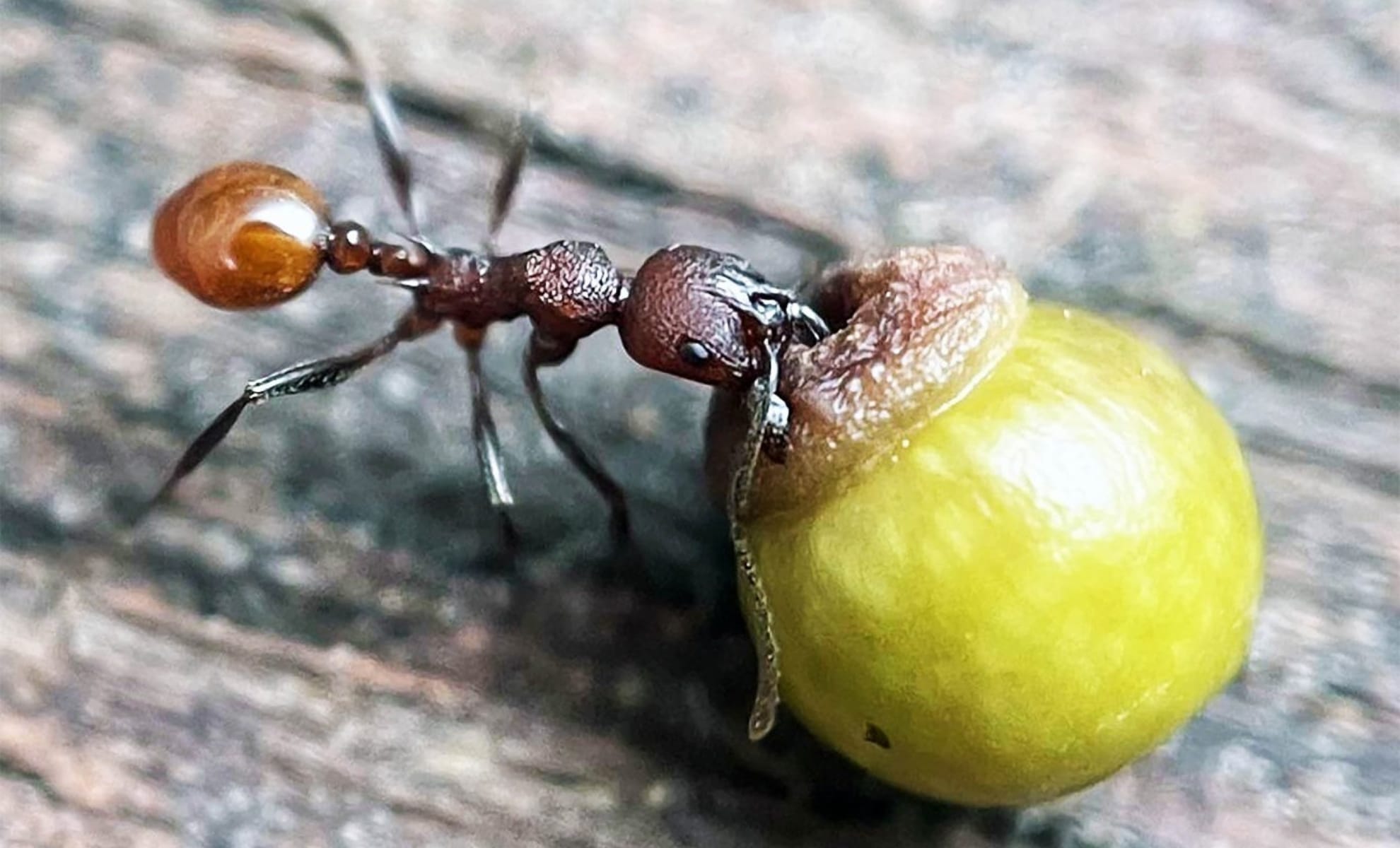
Hugo Deans, while playing outside, noticed a cluster of small spheres near an ant nest. What he thought were seeds turned out to be oak galls, leading his father—an entomologist—to uncover a complex relationship between the ants and these plant growths that has since changed scientific thinking.
This breakthrough challenges long-held assumptions about how plants and insects interact. What began as a simple curiosity about ants’ behavior became a revelation, forcing scientists to rethink the role ants play in dispersing not just seeds, but also the larvae of wasps living inside galls on oak trees. The discovery has brought a new perspective on how animals and plants communicate and collaborate through evolutionary processes.
A New Look at Seed Dispersal
For over a century, the biological phenomenon of myrmecochory—the process by which ants disperse seeds—has been widely studied and understood. In this mutualistic relationship, ants collect seeds, eat the fatty attachments (called elaiosomes), and leave the seeds in safe, protected areas where they can grow. This interaction benefits both the plants, which get their seeds dispersed, and the ants, which receive a small nutritional reward, reports Earth.com.
However, Hugo’s discovery shifted this understanding. According to researchers at Penn State University, ants were not only collecting seeds but also gathering oak galls, which are plant growths caused by wasp larvae.
The galls resemble seeds, but what makes them different is that they contain a developing wasp. The ants were unknowingly transporting these galls into their nests, much like they would a seed. This finding suggests that ants have evolved to respond to chemical cues on the galls, much like the fatty acids found in seeds, which attracted the ants to carry them to their nests.

The Role of the Kapéllo
Further research revealed that the galls were not just random objects for the ants. They were specifically designed by nature to attract ants. A part of the gall, called the kapéllo, is a small cap that sits on top of the gall and mimics the appearance of a seed’s elaiosome. This cap is rich in fatty acids, similar to those found in seed attachments, which explains why ants are drawn to them.
In laboratory experiments, researchers placed both seeds and oak galls in front of ants and observed their behavior. The ants were just as interested in carrying the galls as they were in seeds. The key factor seemed to be the kapéllo, which the ants would often grasp and carry back to their nests. This behavior supports the idea that ants have evolved to recognize and respond to specific chemical signals, which guide them to transport not only seeds but also galls that provide protection for the larvae inside.
Rewriting Ecological Relationships
This discovery has profound implications for how scientists understand ecological relationships. Traditionally, the role of ants in seed dispersal was well-documented, but the role of ants in transporting galls was not.
According to Professor Andrew Deans, Hugo’s father and an expert in entomology, this new finding opens up the possibility that ants are part of a broader ecological network than previously realized. They may help spread more than just seeds—protecting and dispersing other species, like the wasps inside galls, that rely on the ants for transportation.
This interaction also highlights the intricate ways in which species have evolved together. The galls and the wasps that create them have adapted to the oak trees, and the oak tree, in turn, has adapted to the needs of the wasps. Meanwhile, ants have evolved to take advantage of both the seeds and the galls, making this a complex web of interspecies cooperation.