
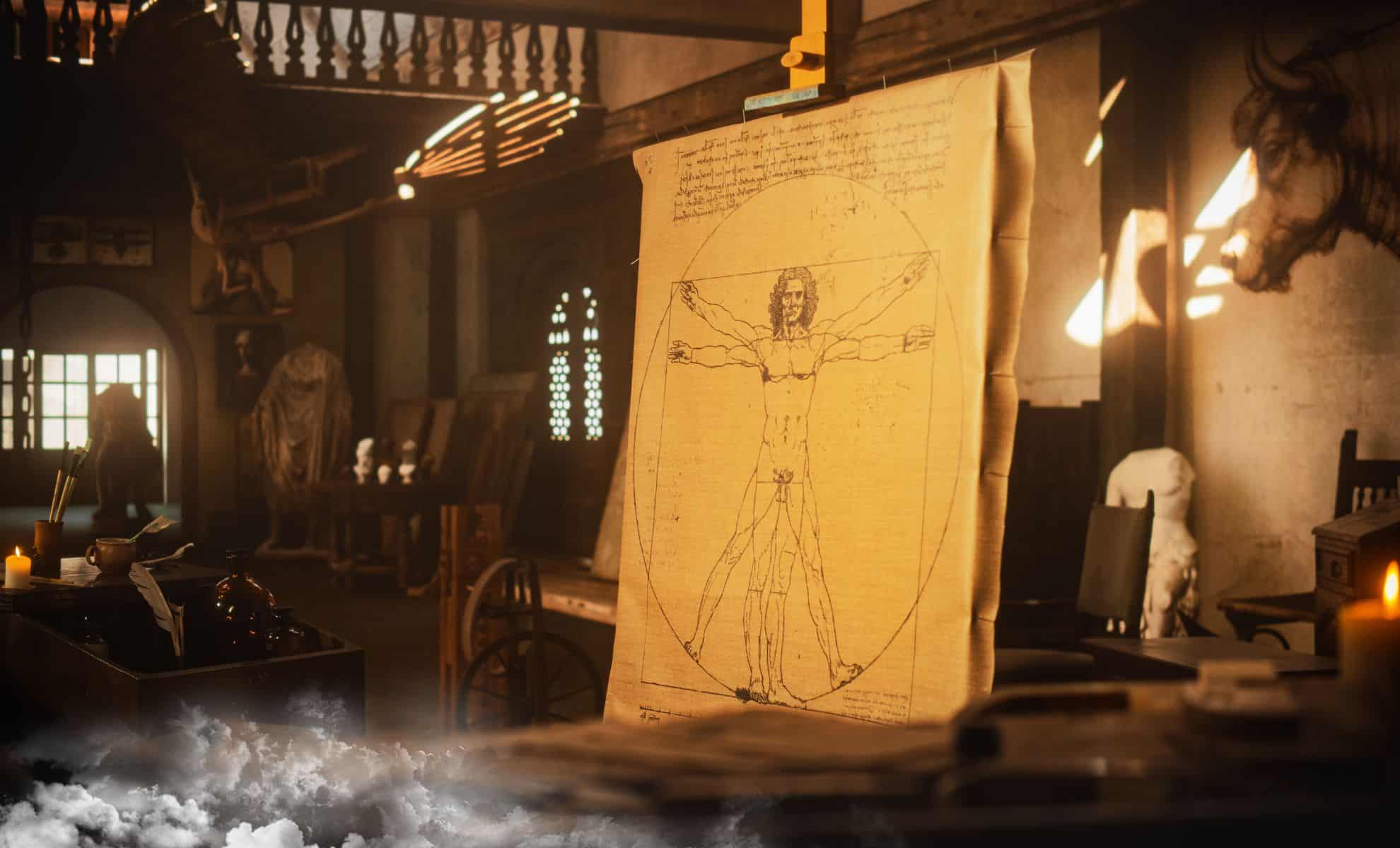
The Vitruvian Man has long been celebrated as a masterpiece that demonstrates the ideal proportions of the human body, originally theorized by the Roman architect Vitruvius. Da Vinci’s 1490 drawing illustrates the concept that the human form could fit within both a square and a circle. While this iconic work has been dissected by scholars for centuries, Dr. Mac Sweeney’s findings offer a surprising new dimension to Leonardo’s genius, proposing that the artist might have also anticipated later discoveries in anatomy and geometric design.
Hidden Geometry in Plain Sight
For centuries, the Vitruvian Man has been studied not only for its artistic brilliance but also for the mathematical ideas it conveys. Leonardo’s drawing was inspired by Vitruvius’s notion that the human body should fit into both a circle and a square. But as Dr. Mac Sweeney notes in his study, a third shape is embedded within this framework, a triangle hidden between the figure’s legs. The discovery of this equilateral triangle is notable because it closely resembles Bonwill’s triangle, a dental principle developed in the 19th century by Dr. William Bonwill, who defined the optimal alignment of the human jaw based on an equilateral triangle.

According to Mac Sweeney, this hidden triangle isn’t just an artistic flourish, it points to an understanding of human anatomy and geometry that wasn’t fully recognized until centuries later. The placement of the triangle in the drawing suggests that Leonardo may have grasped fundamental concepts of human skeletal and jaw function long before the medical field could articulate them.
A Triangular Connection to Modern Dentistry
The significance of the equilateral triangle between the figure’s legs lies in its direct connection to modern dental science. Bonwill’s triangle describes the optimal relationship between the central incisors of the lower jaw and the two mandibular condyles, the joints that connect the jaw to the skull. This geometric model for ideal jaw alignment wasn’t formally established until the 19th century, yet Dr. Mac Sweeney argues that Leonardo’s Vitruvian Man demonstrates a similar geometric understanding.
By recognizing this triangle in the drawing, Mac Sweeney links Leonardo’s work to Bonwill’s triangle, which is foundational in the study of how the human jaw functions and moves. The dentist’s analysis of this hidden shape underscores how deeply Leonardo’s drawing intertwined art with an understanding of functional human anatomy, anticipating principles that would later be confirmed by modern dentistry.
Leonardo’s Mathematical Precision
Dr. Mac Sweeney’s research also highlights the mathematical precision embedded in Leonardo’s Vitruvian Man. The triangle hidden in the figure’s posture is not only anatomically significant but also mathematically profound. When replicated six times around the navel, this equilateral triangle creates a hexagonal pattern that results in a ratio of approximately 1.64, a number that appears in various natural and mathematical systems. This ratio is remarkably close to the tetrahedral ratio, a constant found in optimal biological arrangements, including human craniofacial proportions.
This ratio, often associated with the packing of spheres and other geometrically efficient forms in nature, mirrors measurements found in human anatomy, suggesting that Leonardo may have used his artistic practice to encode these geometric relationships. By linking art, anatomy, and geometry, Leonardo’s Vitruvian Man offers more than just a visual representation of ideal human proportions, it embodies a sophisticated understanding of human form that aligns with principles discovered by modern science centuries later.
Dr. Mac Sweeney’s discovery provides a fresh lens through which to view Leonardo da Vinci’s work, revealing how the artist’s genius may have bridged the gap between art and the scientific knowledge that emerged much later. What was once viewed as a masterpiece of artistic idealization may now be understood as a prescient exploration of human anatomy, geometry, and biology.