
With officials in West Bengal flagging what they said were possible large-scale “system-driven” deletion of electors during the ongoing Special Intensive Revision (SIR), the office of the state’s Chief Electoral Officer (CEO) has directed that all personal hearings for voters marked as “unmapped”, or not found in the 2002 electoral roll, by the Election Commission’s software be put on hold until further verification.
The pause applies only to electors flagged as not found by the EC’s central software but were found present on the hard copies of the 2002 rolls.
Explaining the reason for the pause, state officials said that when authorities on the ground checked the hard copies of the 2002 rolls, they found that electors or their children shown as “unmapped” on the EC’s software were present. They also said that the local Electoral Registration Officer (ERO) could be blamed for centrally generated notices they had nothing to do with.
The pause does not apply to “unmapped” cases flagged by EROs after on-ground verification.
According to the EC’s instructions issued on October 27 for the intensive revision, all existing electors were required to fill forms and trace themselves or a family member to the electoral roll of the last intensive revision in the state, which was conducted in 2002. In other words, they had to be “mapped” to the 2002 electoral roll, either through their own presence or that of a relative on that roll, to continue as electors.
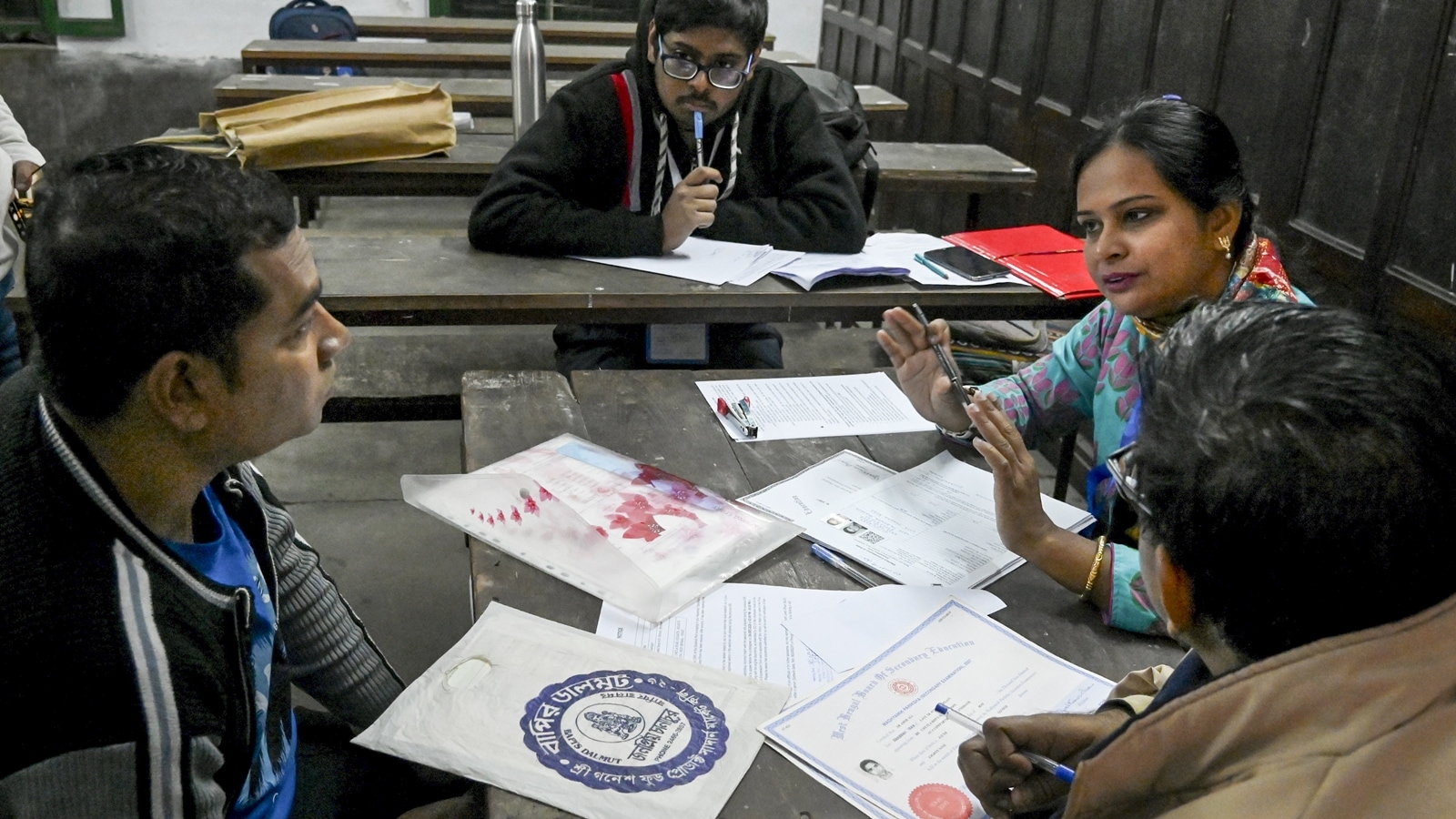
After the draft electoral roll was published in West Bengal on December 16, following the submission of forms, 58 lakh electors were deleted after being found as dead, shifted or absent. In addition, the EC software flagged roughly another 31 lakh electors for not being found on the 2002 rolls — “unmapped” — and generated notices requiring them to prove their eligibility through a personal appearance in order to remain voters.
The process of personal hearings based on these centrally generated notices began on December 27.
Since these notices were issued centrally, an association of state service officers, including officials currently discharging duties as EROs, wrote to the state CEO and the Election Commission on December 24, expressing concern over large-scale “system-driven” deletion of electors, bypassing the statutory role of EROs.
Under the Representation of the People Act, 1950, it is only the ERO of the Assembly constituency, who is empowered to doubt an elector’s eligibility and issue a notice calling for a hearing.
On December 27, the ruling TMC submitted a memorandum objecting to the “system-generated” notices.
On Saturday evening, the Additional CEO of the state stepped in and asked all District Election Officers to stop calling electors for hearings if their names were flagged as “unmapped” with the 2002 rolls, despite the system having generated notices for the SIR.
The Additional CEO’s letter said that many voters were marked as “unmapped” because the PDF file of the 2002 electoral roll (and the last SIR in West Bengal) had not been fully converted to CSV, or plain text format.
Key question
The West Bengal notices on unmapped voters flag a procedural issue at the heart of electoral integrity: when the law assigns responsibility to a local statutory authority, central interventions can unsettle the chain of accountability.
As a result, the BLO App — the application meant for the use of EC’s Booth Level Officers — could not fetch linkage for many electors, even though they or their children could be traced on the hard-copy of the 2002 rolls authenticated by the DEOs and published on the CEO’s website.
The letter stated that the CEO’s office has requested the Election Commission to allow Booth Level Officers, EROs and Additional EROs to upload the relevant portions of the 2002 roll hard copy directly, so that these electors can be mapped properly.
The letter stated that although hearing notices may have been generated from the system for such cases, “these electors may not be called for hearing,” and the personal hearing notices should be kept by the ERO/ AERO and not served.
The extract of the 2002 roll is to be sent to the concerned DEO for verification, after which the ERO/AERO “may take a call and upload the document for disposing the cases”, it stated. “BLOs may be sent to the field and take a photo with such elector and the same may be uploaded,” it said.
“In cases where discrepancies are detected later on with the hard copy of the 2002 electoral roll by the ERO/AERO, or on complaints, the concerned electors may be called for hearing after serving notices,” it said.
Meanwhile, the hearing process continued Sunday. A senior ECI official said, “The hearing process will not stop. It will continue as it has been. For those who have already received notices, their hearings will be disposed of once they appear. For those who have not received notices, they will not get them now.”
The Indian Express has learnt that a relaxation from appearing in person would be extended to those marked as “not mapped” by the system, but found to be on the hard copy of the electoral roll — a number that is expected to be in lakhs.
The Indian Express first reported on December 16 that the SIR in Bihar had also seen pre-filled notices appear on the individual log-ins of EROs on the ECI’s centralised portal. Although the notices were issued in the name of the ERO, they were not generated by them which is a departure from norm.
However, many of those EROs did not act on or pursue the notices. According to official data, of the 68.66 lakh deletions recorded during the Bihar revision, only 9,968 remain unexplained — the rest were attributed to death, migration, duplication or absence.
In West Bengal, however, the officers have raised questions about jurisdiction at a sensitive stage of the revision process over the issue of who is authorised to initiate scrutiny once enumeration forms have been submitted.
In the case of the ongoing SIR in 12 states and Union Territories, sources said two kinds of notices have been generated using the EC’s portal: one for those not mapped with the last intensive revision electoral roll and two, for those who have been marked for “logical discrepancies”, including in spellings of names. For now, the CEO’s office has put personal hearings on hold for the first category until further verification. The hearings for logical discrepancy cases have not started yet.