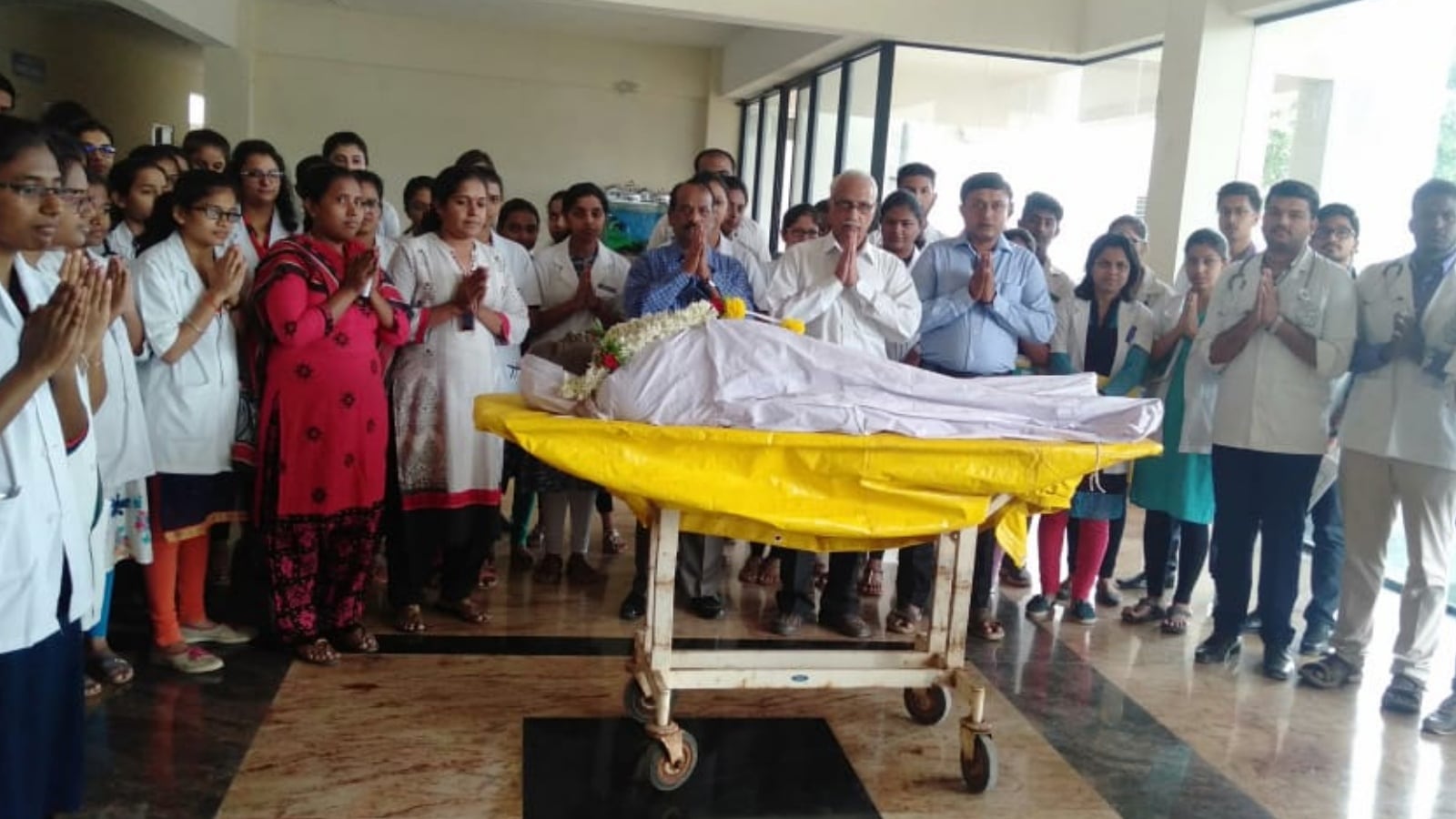
On November 13, 2010, the small town of Belagavi in Karnataka drew the attention of the world when an anatomy professor dissected his father’s body as per the will of the deceased.
Ever since, the anatomy professor, Dr Mahantesh B Ramannavar, who is also the departmental head at BM Kankanwadi Ayurveda Mahavidyalaya under KLE University (Belagavi), has been a crusader for body donation awareness in Karnataka.
“Following my father’s death and his wish, I found my purpose in life – which is to create awareness about body donation,” Ramannavar told The Indian Express.
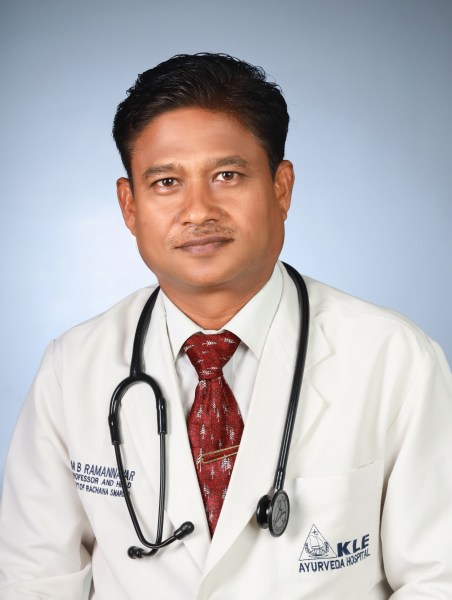 Dr Mahantesh B Ramannavar
As of today, the Dr Ramannavar Charitable Trust, headed by him, has been able to register more than 5,000 body donations and facilitate the transfer of over 200 bodies to medical colleges across the state for teaching and research purposes.
Ramannavar realised the importance of body donation when he was a medical student. While pursuing the Bachelor of Ayurveda, Medicine and Surgery (BAMS), he struggled during practical classes as there were hardly any bodies to dissect. “During those days, we were forced to conduct dissections of those bodies that had already been dissected by seniors. There was little awareness among the public about body donation,” Ramannavar said.
Referring to the then ‘flourishing’ grey market for bodies, he said, “There were some handlers who used to supply dead bodies to medical colleges. There was a government fee, but the handlers used to demand Rs 1.5-2 lakh for a dead body over and above that amount. The bodies were sent from either Hyderabad or Mumbai, and almost all of them were unclaimed dead bodies.”
Talking about the ‘lack of awareness’ among people regarding body donation, he also flagged “cultural and religious beliefs, systemic challenges, fear and mistrust” as reasons for the apparent low rate of body donations in the country.
Story continues below this ad
“The body of the deceased person must be handed over within six hours of the death, and there is no guidance from anyone. However, even those who are willing to donate their bodies don’t know whom to approach. There is no bridge between them and the hospitals,” Ramannavar added.
Ramannavar also recounted the opposition he had faced after he decided to dissect the body of his father: “Other than my mother and me, no one was in a situation to digest the fact that a son would be dissecting the body of his father. There were religious beliefs and social stigma around it. I was ready to do it as per his will, and my mother supported me… Besides the will of my father, I was inspired by English physician William Harvey, who had dissected the body of his sister.” He added that “the moment I entered the dissection room, it was just another dead body and I didn’t have any feelings.”
Help from spiritual gurus
To encourage body donations, Ramannavar contacted heads of several mutts. “As body donation has a cultural and religious baggage, I sought the help of the mutts, and during a discourse, they provided me the opportunity to speak about body donation. Thereafter, the registrations for body donations increased in the state,” he said.
In a remarkable development, 108 people from Shegunasi village in Athani Taluk of Belagavi district registered for the body donation program with Ramannavar’s Trust in 2017.
Story continues below this ad
“Among those registered, about 20 people have died, and their bodies were donated promptly to the medical college,” the anatomy professor said.
Ramannavar added that he makes sure that the donated bodies are treated with respect and dignity. According to the rules of the Dr Ramannavar Charitable Trust, medical students must garland and hold a special prayer session before taking a body to the dissection hall.
Appeal to government
“We want the government to be involved on a larger scale to encourage body donation. If there are excess bodies in a medical college, it refuses to take more bodies, but there might be a shortage in some other medical colleges. The government needs to bridge the gap, and this is where my charitable Trust comes in. We help the kin of those who have registered with us to reach out to medical colleges that require body donation for research and teaching,” Ramannavar said.