
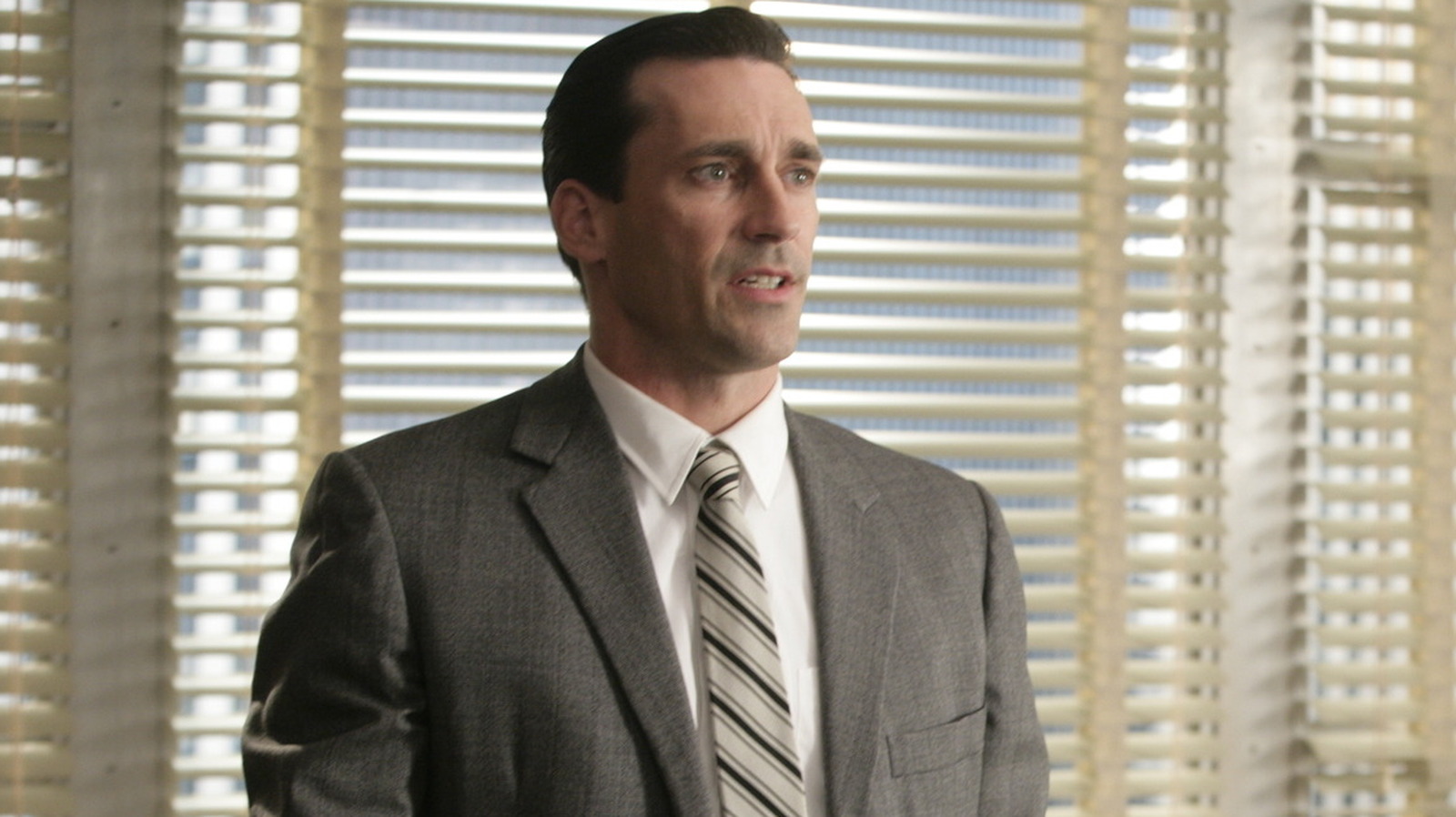
On its surface, AMC’s “Mad Men” is about the formative years of modern advertising agencies in 1960s New York City. But it doesn’t take long before the show’s many layers begin to peel back, revealing an incredibly complex character drama that was not only one of the the best shows of the 2010s, but is often considered among the best TV dramas of all time. Successful and charismatic ad executive Don Draper (Jon Hamm) is the de facto main character of “Mad Men.” But there are roughly 20 other characters who are considered main characters at various points, to say nothing of the literally dozens of recurring and side characters. All of them have something to offer the narrative.
It may have taken a while before we finally understood the ending, but the finale of “Mad Men” frequently ranks among the best in television history. That’s impressive, given how many shows either slightly disappoint or outright enrage with their final episodes. Remarkably, for as great as “Person to Person” is, we don’t even think it’s one of the show’s best episodes. To put a finer point on it, limiting the best “Mad Men” episodes to a mere top 10 was a much more difficult task than it would be for most other shows. But we still took a stab at it, and we feel pretty good about where we landed with these picks.
10. Guy Walks Into An Advertising Agency (Season 6, Episode 3)
“Mad Men” rarely goes for laugh out loud funny. When it does, the humor is usually of the darkest variety. Case in point: “Guy Walks Into An Advertising Agency,” where someone gets their foot severed with a lawn mower and it sprays blood on everyone. It’s played for laughs, but to reduce the episode to that one moment is to sell short the overall greatness.
The primary plot is that Sterling Cooper is going to be visited by Puttnam, Powell, and Lowe (PPL), its British advertising agency parent company. It lays the groundwork for what would eventually become PPL ousting Sterling Cooper’s top guys, and the trio starting their own rival agency in the back half of the series. Also of note is Joan (Christina Hendricks) learning the disappointing news that her dreams of becoming a homemaker aren’t as close to being realized as she had hoped, and Don Draper’s daughter Sally (Kiernan Shipka) feeling uneasy about her new baby brother.
Both the writing and directing of “Guy Walks Into An Advertising Agency” received well-earned Primetime Emmy nominations – the former of which isn’t terribly unique among “Mad Men” episodes, but the latter is an honor only three others received. The only reason it is the lowest rated episode on this list is because it might be a bit too crowded in terms of how much is going on. Overall, it balances things well enough to set up the rest of the best.
9. Meditations in an Emergency (Season 2, Episode 13)
A small detail that only true “Mad Men” fans pick up on is how the various books Don Draper is seen reading correlate to whatever is going on in his life at the time. From major classics like “The Godfather” and “The Sound and the Fury,” to slightly lesser known works including “The Fixer” and the aptly titled “Confessions of an Advertising Man,” Don’s library, in any given episode, offers varying degrees of insight into where he is at in his personal and/or professional journey at that point.
With the Season 2 episode “Meditations in an Emergency,” making the book Don is reading at the time the actual title of the episode meant that the show didn’t want the connection to just be an Easter egg. But as is per usual with “Mad Men,” there isn’t just one specific moment intended to be referenced. The primary emergency is the Cuban Missile Crisis, which is looming large on everyone’s mind. But it’s also during this episode where it is first revealed that PPL is indeed merging with Sterling Cooper, leading to a sequence of events in which head of accounting Herman “Duck” Philips (Mark Moses) makes an ill-advised attempt at trying to flex his professional power over Don.
On top of all of that, Betty Draper (January Jones) tells Don she is pregnant with their second child — but not before cheating on him with a stranger. Elsewhere, Peggy Olsen (Elisabeth Moss) confesses to Pete Campbell (Vincent Kartheiser) that their hookup after his bachelor party resulted in her having a baby that she put up for adoption.
8. Maidenform (Season 2, Episode 6)
The 1960s saw companies like Maidenform start marketing bras more as sexy lingerie and less as a purely functional undergarment. Playtex wants to follow Maidenform’s lead, and turns to Sterling Cooper for help. Peggy sees this as an opportunity to assert her creative voice, but Joan scoffs at the notion that Peggy knows what it takes to look attractive to men. In response, Peggy shows up at the strip club where members of Sterling Cooper are treating Playtex executives to a night out in an attempt to prove that she can be fun and flirty.
Meanwhile, Don is made to realize that his womanizing is becoming legendary. He doesn’t take this as a point of pride, and in fact we see one of the first examples of him actually being a bit disgusted with himself. This comes to a head when he’s at home shaving and his daughter comes in to watch — and when her promise to keep quiet reminds him of telling his most recent sexual conquest the same thing, he is further sickened by his careless treatment of women.
“Maidenform” also provides a glimpse into the sad personal life of Duck, who comes to view the dog he shared with his ex wife as a constant reminder of his failed marriage. In response, he abandons the dog in the streets of New York City. Writer Matthew Weiner would later sum up why “Maidenform” is such a great episode, telling the New York Times, “‘Maidenform’ … is the first episode of the show where I was like, ‘This cannot be done on any other show.’ Because it’s so psychological.”
7. The Hobo Code (Season 1, Episode 8)
Don’s affair with Midge Daniels (Rosemarie DeWitt) began before the start of “Mad Men” and would continue across Season 1. She was integral in introducing audiences to the real Don — that is to say, Dick Whitman, his real name before he claimed the life of the actual Don Draper, who had been his commanding officer in the army. Don tried as hard as he could to leave his chaotic upbringing in the past and truly “become” Don Draper, but it was a battle he sometimes lost. More to the point, it was a battle he sometimes seemed to want to lose, and that was evident in maintaining a relationship with the free spirit Midge.
In “The Hobo Code,” Midge finally convinces Don to not only smoke pot for the first time, but actually hang out with her boho pals. In the process, we see flashbacks to his childhood, where he was taught by an unhoused man the titular hobo’s code. That is to say, how to read people in order to learn how to manipulate them for your own gain. It’s there that he learns the skills that would eventually make him not only able to be an incredible pitchman, but someone who could make everyone in his life only see the version of him he wanted them to see.
Flashback episodes like this often feel more functional than actually entertaining, but “The Hobo Code” does an excellent job at presenting Don’s origin story, as it were, in a way that doesn’t feel lazy or uninteresting. Still, it very much is a flashback episode at the end of the day, hence it finding itself falling just short of the better half of this list.
6. Smoke Gets In Your Eyes (Season 1, Episode 1)
Typically, TV shows don’t hit their stride until halfway through Season 1. It’s difficult to introduce all those characters and commit to world building in a way that doesn’t feel a bit like reading the prologue before the actual book starts. But it’s not surprising that “Mad Men” was firing on all cylinders from its very first episode. In fact, it’s only because of that aforementioned first episode set-up that “Smoke Gets In Your Eyes” barely misses out on the top five.
Other than seeing Don a bit anxious about pitching to Lucky Strike, which would retroactively feel out of character for him, he comes fully formed right out of the gate in a way that few other complex character drama protagonists are. The first episode of “Mad Men” also happens to be Peggy’s first day at Sterling Cooper, foreshadowing just how much of her professional journey would be part of the show. She would become something of a surrogate for an audience also learning about these people and this world.
Despite Midge already being in the picture as one of Don’s extramarital paramours, it’s in this episode where we also meet department store heiress Rachel Menken (Maggie Siff), with whom he’d also have a brief affair. Some fans even believe Rachel was the only woman Don ever developed genuine feelings for.
If given the chance to remaster the episode a bit and smooth out its rough edges, “Smoke Gets In Your Eyes” could be a contender for the best episode of “Mad Men.” It’s that good. As it stands, it’s held back only by all it needs to establish and introduce in under an hour.
5. The Other Woman (Season 5, Episode 10)
A surprising truth about “Mad Men” is that Christina Hendricks took some time to fall in love with playing Joan, feeling that the character was unrealistically mean in the beginning. But Hendricks grew to love Joan, learning that what she misread as coldness and cruelty was instead Joan doing what she needed to do to command respect during an era where professional women got almost none.
After five seasons of watching Joan hold her own among some of the worst kinds of men, “The Other Woman” was heartbreaking to watch. While it’s true that Joan is well aware of the power that her attractiveness has over men, and is more than willing to wield that power when needed, it was always on her terms. So when someone from the Jaguar company explained in no uncertain terms that Joan had to have sex with him in order for Sterling Cooper to land the account, Joan rightfully balked. Unfortunately, most of the men in the room chided her for her unwillingness to do what they saw as no big deal in order to land a lucrative client.
The twist? Don is the only one who was as equally disgusted by the proposal as Joan herself, and was vehemently opposed to it. It’s not that Don was shown to be something other than a heartless robot, but his care for Joan in this situation felt different than previous cracks in his facade. Both Jon Hamm and Christina Hendricks submitted “The Other Woman” to the Emmy nomination board that year as examples of their best work of the season, and rightfully so. It’s because it’s an episode focused primarily on one character that it “only” finds itself in fifth place here.
4. The Wheel (Season 1, Episode 13)
There’s an idea that nostalgia is a recent phenomenon, but in fact, people have always been wistful for whatever they deem the “good ol’ days.” In the Season 1 finale “The Wheel,” we see that on full display as Don uses the power of nostalgia with Kodak’s new Carousel slideshow projector. There isn’t a dry eye in the house as Don plays on the room’s longing for a simpler time — a time Don never actually experienced, and probably never existed the way everyone wants to believe it did. But nostalgia is like that; a dreamy fib.
The pictures that Don shows are of his life with Betty and their daughter, from a time before we joined them as viewers at the start of “Mad Men.” It’s already clear by this point that the emotions Don displays as he shows those family photos is an act. He’s almost as much a passive viewer of his own personal life as we are. Still, like the Kodak executives and his Sterling Cooper colleagues, we are nonetheless touched by his performance. Such is the power of Don’s (and Jon Hamm’s) abilities to sell a fiction.
The weird creative decision of giving Peggy a cryptic pregnancy does bring “The Wheel” down a peg; essentially the only reason it fails to land in the top three “Mad Men” episodes. But for what it’s worth, Peggy does get the chance to exert some power, firing a commercial narrator who isn’t up to snuff, so it’s not all bad for her.
3. The Good News (Season 4, Episode 3)
Though Anna Draper (Melinda Page Hamilton) lost her husband — the real Don Draper — in the war, she gets the consolation prize of a close friendship with her dead husband’s replacement. Don spends time with Anna any chance he gets, and, perhaps owing to her unique connection to and knowledge of his secret, he confides in her in ways he doesn’t with anyone else. We see one of these meetings in the episode “The Good News,” during which time Don finds out that Anna has cancer. He decides to spend a few days with her, helping her with various tasks and chores. It would be the last time they saw each other, and her subsequent loss would be a huge blow to Don.
All of that could’ve been its own episode, and it would have been a good one. But “Mad Men” rarely rolls like that. Instead, “The Good News” goes from being a good episode to becoming the third best in the history of the show by also showing yet another rarely seen side of Don.
It’s the side that knows how to have fun when he and Lane Pryce (Jared Harris) end up having a wild, drunken night on the town. Between that and a hilarious comedy of errors involving a misunderstanding between Lane, Joan, and Lane’s secretary, “The Good News” brings home some of the show’s funniest moments. In fact, despite the bittersweet nature of it being Don and Anna’s last time together, “The Good News” is a delightful and warm episode overall. That’s something “Mad Men” rarely allows.
2. Shut the Door, Have a Seat (Season 3, Episode 13)
Season 3 of “Mad Men” ends with one of those major plot shake ups that most shows only get to try once. It’s also the kind of creative turn that could either make the show even more interesting, or it could disrupt the status quo too much and ruin a good thing. In this case, it’s the long-in-the-works departure of Don, Roger Sterling (Roger Slattery) and Bert Cooper (Robert Morse) from Sterling Cooper, as PPL continues to exert an increasing amount of creative and executive control. The trio take a few key employees and the lion’s share of the clients, and start their own rival firm instead.
Thankfully, the creative gamble worked. “Shut the Door, Have a Seat” not only ushered in what would come to encompass the entire second half of the series’ overarching narrative, but it is very nearly the best episode in the series. It also contains one of Don Draper’s best scenes, as getting fired ends up becoming a revelation for him, giving him the opportunity to build something of his own. This is particularly important for someone who has been living a life that another man created.
In another masterstroke, despite it being a season finale, “Shut the Door” ends on an upbeat tone rather than a fraught cliffhanger. Viewers are left waiting for Season 4 because they are excited to see what’s next, not because they are worried about how the characters are going to get out of some hackneyed predicament.
1. The Suitcase (Season 4, Episode 7)
One of the rare TV episodes that is practically flawless, Season 4’s “The Suitcase” is not only everything that’s great about “Mad Men” but about television in general. It’s fitting that it’s an episode focused almost entirely on Don and Peggy, arguably the two most important characters in the series. It’s also the show’s best episode because it’s one of the few that has the confidence to focus on a single plot and its minimal character needs, rather than including multiple subplots and a full chorus.
Not that “Mad Men” isn’t skilled at doing that type of juggling, and rarely does a “Mad Men” episode feel overstuffed or too busy. But “The Suitcase” is all the better because it bucks expectations and offers that streamlined story, yet still managing to feel as compelling as an episode full of twists and talent.
While everyone else is distracted by a big boxing match, Don and Peggy decide to double down and work all night on the important Samsonite campaign. Don knows Peggy is his equal and has the potential to be better than him at the job someday, even if he doesn’t say it. But never once during “The Suitcase” does he treat her as anything but an equal partner here. That’s a huge milestone for both of them.