
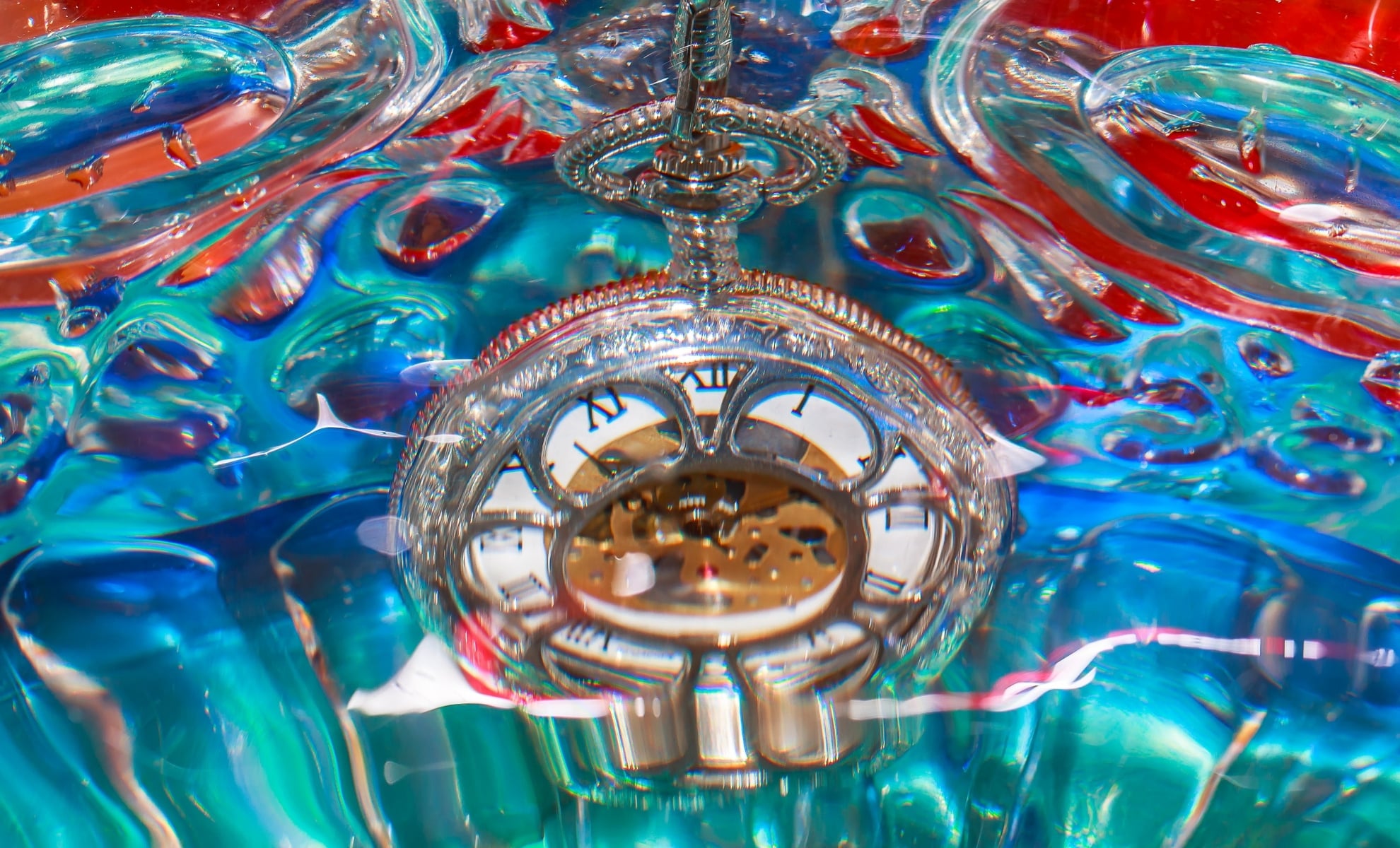
Using a custom-built metamaterial, scientists in New York managed to reverse electromagnetic waves in time, not just direction. The research team, working at the CUNY Advanced Science Research Center, achieved what was once thought nearly impossible. Their findings, published in Nature Physics, demonstrate that manipulating electromagnetic fields fast enough and uniformly enough to reverse time-based wave behavior is no longer just a theoretical goal; it’s now a documented reality.
For decades, scientists accepted that waves, whether sound or light, could reflect off objects in space. This is how we hear echoes or see our reflections in mirrors. But the idea of a time reflection, where waves bounce backward through time, seemed like science fiction.
This phenomenon involves a sudden and uniform change in the medium carrying the wave, causing part of the wave to reverse its direction in time and transform into a different frequency. The challenge has always been the amount of energy needed to shift the medium fast enough to make that happen.
Flipping Time Through Engineered Materials
The breakthrough came when researchers turned to metamaterials, materials engineered to exhibit properties not found in nature. Instead of trying to alter an entire material’s properties at once, a task requiring massive energy, the CUNY team created a strip of metal embedded with electronic switches linked to reservoir capacitors.

This setup allowed them to activate the switches at will, effectively doubling the impedance along the strip in a split second. According to the team, this sharp, rapid change created the precise conditions for time reflections to occur. “Our idea was to avoid changing the properties of the host material, and instead create a metamaterial in which additional elements can be abruptly added or subtracted through fast switches,” explained Gengyu Xu, a postdoctoral researcher involved in the project, reports Popular Mechanics.
The Strange Mirror of Time
Time reflections behave in a completely different way than their spatial counterparts. When a wave hits a mirror, the front of the wave bounces back first. In time reflection, it’s the end of the wave that reflects first. According to researchers, this means that if you were to look in a time mirror, you wouldn’t see your face; you’d see your back.
Translated into sound, it would resemble a recording being played in reverse: fast, sharp, and high-pitched. Visually, the shift in wave frequency might appear as an abrupt color change, like red turning to green. As explained by Andrea Alù, lead author of the study and director of the Photonics Initiative at CUNY ASRC, “This has been really exciting to see, because of how long ago this counterintuitive phenomenon was predicted, and how different time-reflected waves behave compared to space-reflected ones.”
The team wasn’t just chasing an abstract idea. Time reflections could eventually enable new forms of wave control that dramatically enhance technologies dependent on electromagnetic signals. Better mastery of wave behavior, both forward and backward, could lead to improvements in wireless communication systems or pave the way for low-energy wave-based computing.