
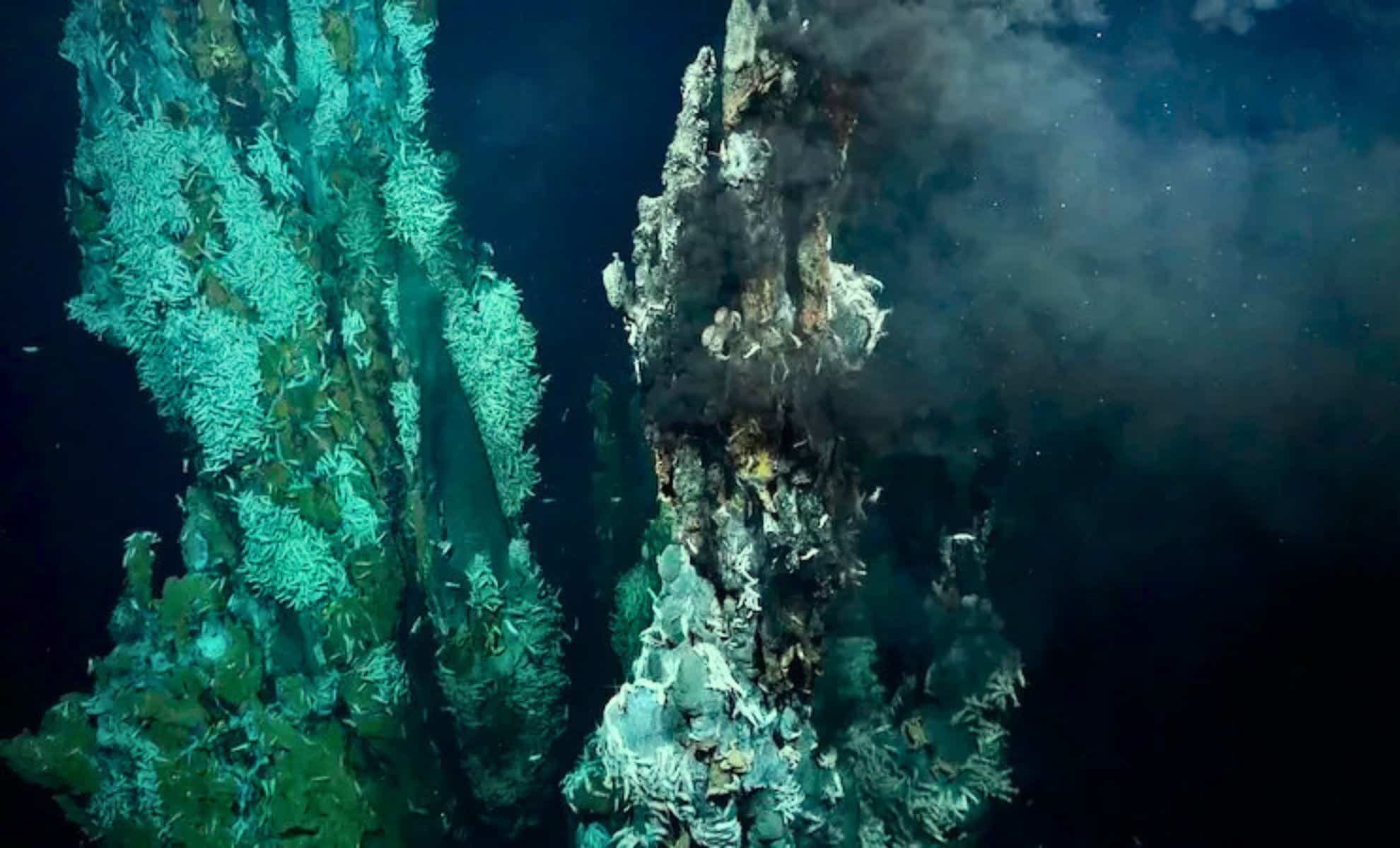
More than 1,300 meters beneath the Pacific Ocean, near the volcanic slopes off Papua New Guinea’s Lihir Island, researchers have uncovered a geological anomaly that could reshape current understanding of Earth’s ocean floor systems.
During a deep-sea expedition in mid-2023, scientists operating a robotic submersible discovered a seafloor site where two incompatible geological processes, hydrothermal venting and hydrocarbon seepage, occur side by side within centimeters of each other. This convergence creates an unusual natural chemical environment never observed before in the deep ocean.
The site, later named Karambusel, features scalding fluids erupting from the seafloor alongside cooler, methane-rich gases. The discovery was formally published in Scientific Reports by researchers from the GEOMAR Helmholtz Centre for Ocean Research Kiel in December 2025. Their study, available here, identifies the field as the world’s first confirmed hybrid hydrothermal and seep system.

With its metal-rich fluids, unusual chemistry, and thriving biological communities, Karambusel presents not only a scientific breakthrough but also a new conservation challenge. It sits within a mineral-rich region already marked for industrial exploration, including potential seabed mining operations.
Hot Vents, Cold Seeps, and a Chemical Puzzle
Karambusel is located on the western flank of Conical Seamount, part of the Tabar-Lihir-Tanga-Feni island chain. The region is geologically active and economically significant due to nearby deposits, including the Ladolam gold mine, which ranks among the largest of its kind globally.
During the expedition aboard the RV Sonne, the team deployed the ROV Kiel 6000 to investigate suspected venting zones. Unexpectedly, they observed shimmering fluids reaching 51°C erupting just half a meter from colder, methane-dominated seeps. This tight spatial configuration had never been documented at any known seafloor vent field.

According to the published study, the site marks the first time both systems have been observed operating together, forming a unique ecological and geochemical environment. Hydrothermal vents are typically powered by magma, which heats seawater that dissolves metals as it rises through the crust.
Cold seeps, by contrast, release gases like methane from decomposing organic matter buried deep within sediment layers. Their coexistence at Karambusel challenges conventional models of seafloor fluid systems.
Chemical Extremes and Deep-Ocean Life
The fluids expelled at Karambusel are unusually rich in arsenic, thallium, antimony, and mercury, elements commonly associated with epithermal mineral deposits. These also occur on land in gold-rich mining zones. The team’s gas analysis showed that methane comprised over 80 percent of the dry gas phase at several vent sites, a concentration not reported at any other known hydrothermal system.
This methane, they determined, is thermogenic. It is produced from heat-driven decomposition of buried organic material, similar to how natural gas forms. The coexistence of such high methane levels with active metal-rich fluid flow suggests the vent system taps into both magmatic and sedimentary sources deep within the Earth’s crust.

At the seafloor, this unusual chemistry supports dense communities of chemosynthetic organisms, which survive not on sunlight but on chemical reactions. The team documented 23 distinct megafaunal species, including mussel beds (Bathymodiolus edisonensis), bamboo-like tubeworms (Paraescarpia echinospica), vent crabs, and microbial mats.
These life forms appear to depend on both methane and sulfide-rich fluids, occupying a rare dual-energy habitat. The species count and biomass density rival long-established vent systems, suggesting that Karambusel may have been active for thousands of years, although it had gone unrecorded until now.
A Fragile System Under Industrial Pressure
The discovery comes at a time of growing commercial interest in deep-sea resource extraction. Karambusel lies near the coast of Lihir Island, which is already home to large-scale mining. The surrounding seafloor falls within licensed exploration blocks for potential mineral recovery, raising concerns about the site’s vulnerability.
The researchers warn that seabed mining or mine tailings disposal near the site could irreversibly damage this ecosystem before it is fully understood. In their publication, they note that Karambusel’s vent communities, including possibly undescribed species, remain undocumented in environmental assessments of the region.
The site’s unusual mineralogy, containing elevated levels of gold, silver, and sulfide minerals, adds to its industrial appeal. Yet its unique chemistry and biology also make it a natural laboratory for studying the interactions of magmatic activity, fluid dynamics, and life in one of Earth’s most extreme environments.