
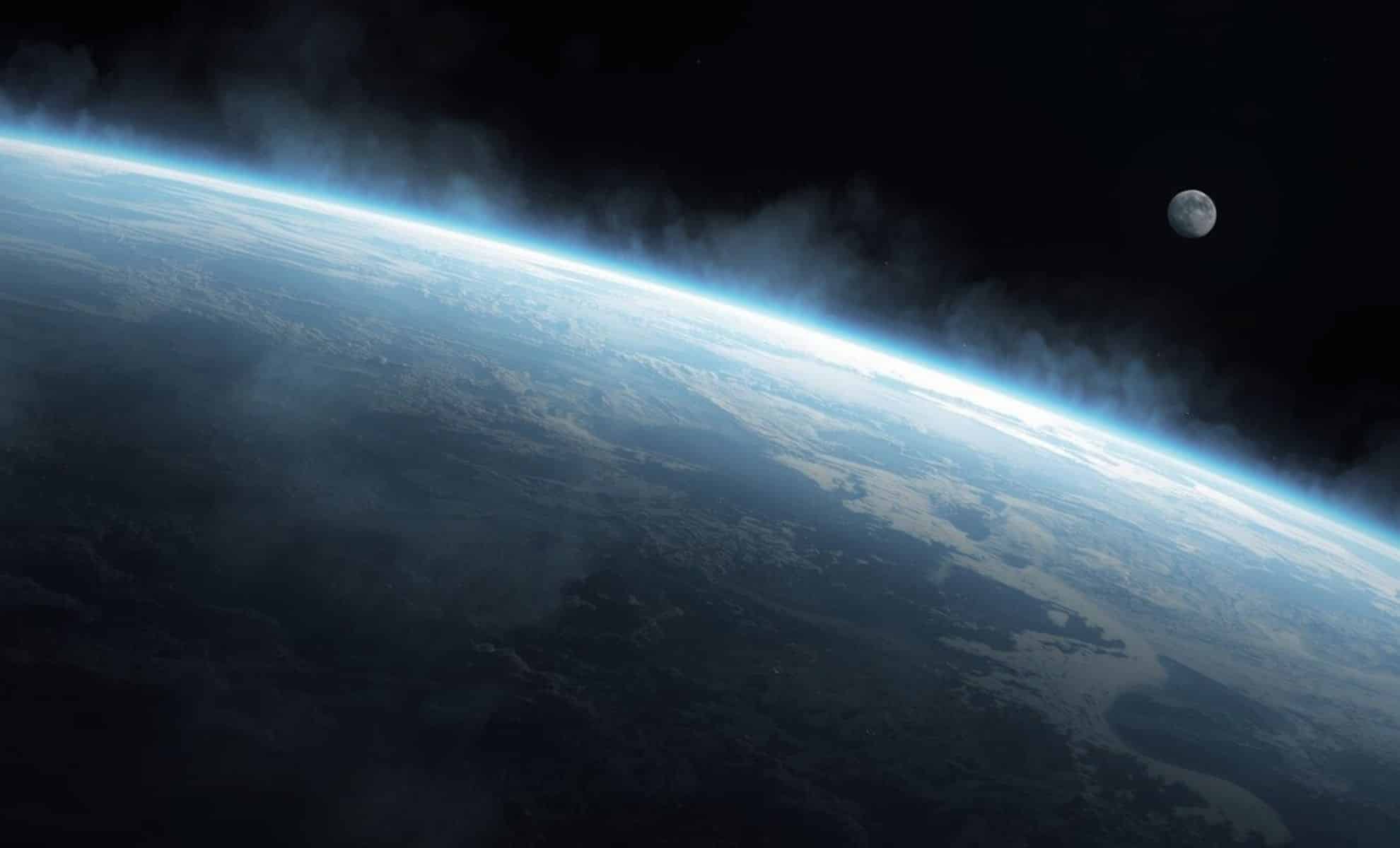
For decades, Earth’s magnetic field was seen as a protective barrier, sealing the planet’s atmosphere off from the vacuum of space. Now, scientists are uncovering evidence that challenges that idea. Instead of containing Earth’s air, the planet’s magnetic shield is letting it escape, and the Moon has been quietly collecting it.
Every month, the Moon sweeps through Earth’s magnetic tail. In that window, charged particles from Earth’s upper atmosphere are guided along magnetic field lines and deposited onto the Moon’s surface. Traces of oxygen, nitrogen, and noble gases embed themselves in the lunar dust and remain there, unchanged for billions of years.
This subtle process has transformed the Moon into an unexpected archivist. Lunar soil is holding snapshots of Earth’s ancient atmosphere that are no longer preserved here, where erosion, weather, and tectonic shifts have erased much of the past.
A study published in Nature Communications Earth & Environment used advanced magnetohydrodynamic simulations to confirm that Earth’s magnetosphere doesn’t block particle escape entirely, but instead helps direct atmospheric ions to the Moon, particularly during magnetotail crossings.
Solar Wind Alone Doesn’t Explain Lunar Volatiles
Since the Apollo missions, scientists have noted unusual concentrations of volatile elements in lunar soil. Samples contained more nitrogen and argon than expected, and the isotope ratios did not match those produced by the solar wind. For years, the anomaly lacked a solid explanation.

Early theories pointed to micrometeorite impacts or ancient volcanic outgassing from within the Moon. But those processes could not account for the consistent, Earth-like isotopic signatures found in several Apollo samples, including the well-known “Rusty Rock” (sample 66095) collected during Apollo 16.
To better understand the source of these volatiles, researchers developed comparative atmospheric models simulating early and modern Earth conditions. Findings published in PNAS revealed that the isotopic patterns found in lunar soil align more closely with particles originating from Earth’s atmosphere than those delivered by the Sun.
Evidence for this connection had been hinted at as far back as 2005, when a Nature study proposed that terrestrial nitrogen and noble gases could have been transported from Earth to the Moon before the planet’s magnetic field fully developed. These new simulations suggest the opposite—that an active magnetic field can actually enhance this particle transfer.
Lunar Dust Is an Atmospheric Archive
The Moon is a static, airless world with no plate tectonics, no erosion, and no weather. What lands there, stays. That makes it the perfect storage medium for particles escaping Earth’s atmosphere.
Some of the strongest evidence comes from Apollo-era samples. A 2019 NASA Astrobiology analysis reviewed the oxidation levels and volatile signatures of lunar rocks and found patterns consistent with Earth-derived materials. These results reinforce the idea that the Moon has been slowly recording Earth’s atmospheric history across geological time.
As the Moon moves through the magnetotail, particles from Earth’s ionosphere are swept toward its surface. This process is repeated every orbit and leaves behind a slow, consistent buildup of atmospheric signatures in the Moon’s nearside regolith.
The Magnetosphere Is More than a Shield
Earth’s magnetic field is often described as a defense system against cosmic radiation. That’s accurate, but incomplete. New research shows that the magnetosphere also shapes the movement of atmospheric escape.
Instead of acting as a perfect wall, the magnetic field stretches into a long tail under pressure from the solar wind. This tail, or magnetotail, acts like a streambed guiding atmospheric ions away from Earth and occasionally toward the Moon.

Spacecraft observations support this process. The Kaguya mission from JAXA detected terrestrial oxygen ions reaching the Moon’s surface, especially during periods when the Moon was shielded from the solar wind and instead immersed in the magnetotail. NASA’s research into magnetospheric behavior confirms that these interactions are not only real but ongoing.
A 2008 paper in Science (referenced in NASA’s Earth Science Division) confirmed that high-energy oxygen ions, likely originating from Earth’s upper atmosphere, were being detected at lunar distances. This strongly supports the idea that Earth’s own wind is influencing the Moon’s surface chemistry.
A New Frontier for Planetary Science
The idea that the Moon has preserved fragments of Earth’s atmosphere turns it into more than a celestial partner. It becomes a witness to our planet’s environmental past.
By analyzing isotopic compositions in lunar soil, researchers may gain insights into how Earth’s atmosphere has evolved—across periods of volcanic activity, climate change, and solar variability. These insights could not only inform Earth’s history, but also shed light on atmospheric dynamics on Mars, Venus, and even exoplanets orbiting distant stars.
As lunar exploration ramps up, future missions could focus on collecting comparative samples from the Moon’s farside, which has limited exposure to Earth’s magnetotail. The differences in volatile concentrations could provide conclusive evidence of Earth-origin particles on the Moon.