Last week, sitting with a senior BJP leader and Union minister, a journalist colleague and I were discussing with him why the party had not announced its national president even one-and-a-half years after the 2024 general elections.
The current BJP chief J P Nadda had been given an extension in early 2023 till the 2024 Lok Sabha polls. However, a consensus on his successor seemed to have eluded the BJP brass, even as the RSS also showed interest in the matter.
The minister indicated that “none” of the usual names which had been doing the rounds would be chosen to lead the BJP. “You will be surprised over the pick,” he said enigmatically.
“So, we will have to Google to learn more about him or her?” my colleague asked him. The BJP leader smiled. And then said, looking solemn, that the BJP was a well-oiled organisation now, one which could run on its own steam without being dependent too much on the party president. In other words, he added, the systems were well in place within the party, with Amit Shah having the authority to give it the strategic push and guidance, when required, under the overall “leadership” of Narendra Modi.
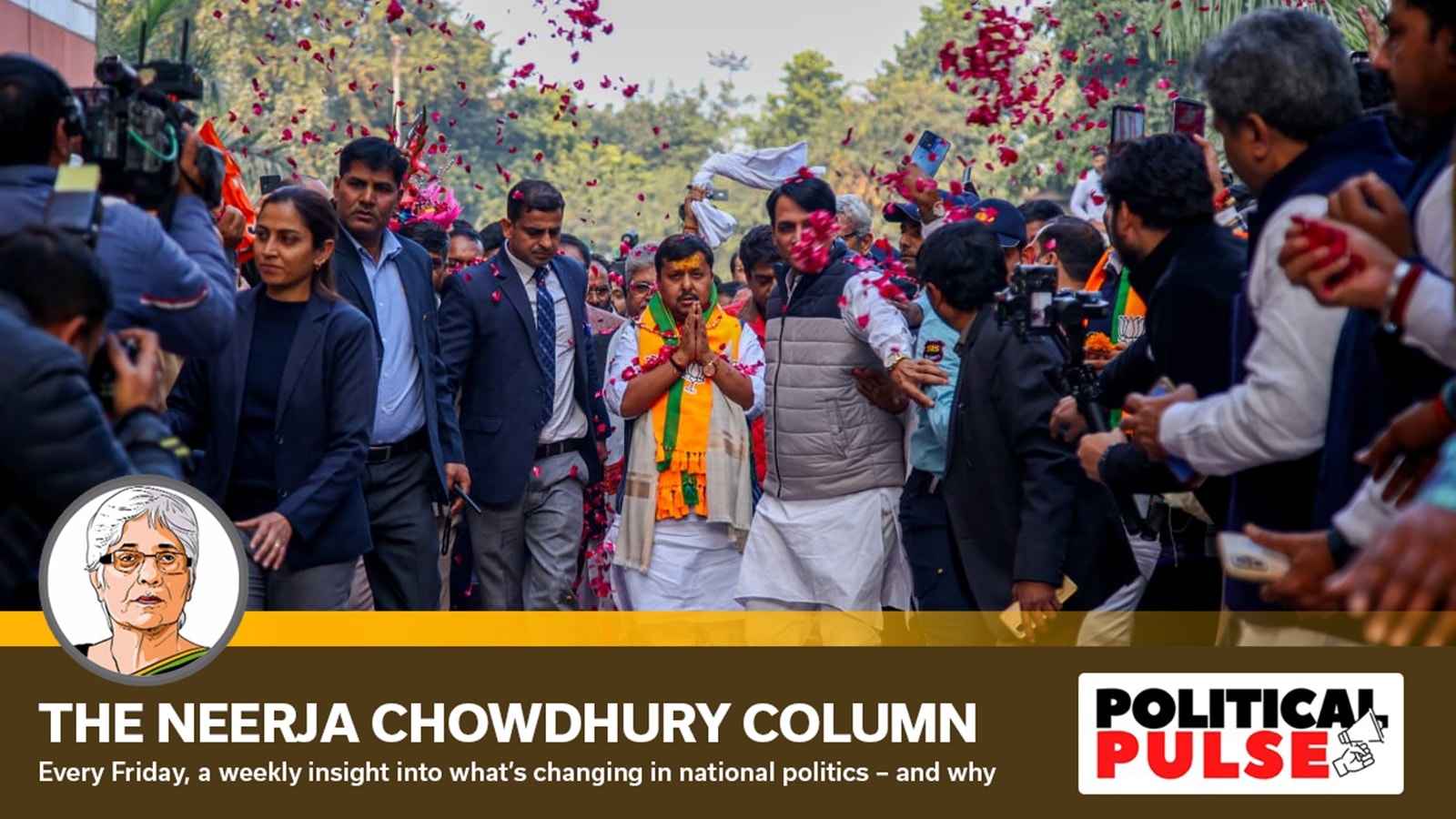
On Sunday, the BJP Parliamentary Board named five-term Bihar MLA Nitin Nabin as the party’s national working president. Nadda had also started off as a working president (in June 2019) before being made president six months later. Like Nadda, Nabin, too, is set to be eased into the job over a brief interlude.
Not many outside Bihar may have heard of Nabin, who is currently the Road Construction Minister in the Nitish Kumar-led NDA government.
Nabin was the BJP co-incharge of the November 2023 Chhattisgarh Assembly elections, when the party secured a stunning victory by getting the better of the incumbent Bhupesh Baghel-led Congress. The next year, he was appointed the BJP in-charge of the Lok Sabha elections in Chhattisgarh, which the party swept there. In July 2024, he was named the party in-charge of that state.
His elevation to the BJP’s top organisational post may reveal something about the BJP’s thinking and strategy today.
Firstly, it tells us that Modi-Shah duo is firmly at the helm, even as they faced a temporary setback in the 2024 Lok Sabha polls, which saw the party stalling well short of a majority at 240 seats. Their writ runs in the BJP in all states across the country. And this is because they are able to win election after election for the party. In the wake of the BJP’s resounding wins in Haryana, Maharashtra, Delhi and Bihar, the party has reinforced its dominant position at the national level, even as it is stepping up its bids for the impending polls in several states.
Secondly, the BJP leadership has put in motion the “karyakartaisation” of the organisation, which Nabin’s rise represents. A Patna-based professional and BJP supporter remarked: “Can you imagine a person from the ground, an ordinary karyakarta, being made the national head of the ruling party? We feel so proud and happy.”
Its optics is like a “chaiwalla” rising to head the government, or a tribal woman leader Droupadi Murmu being elevated to head the State. It signals that power is devolving in the BJP organisation, even as the party high command has become stronger, taking all key decisions related to governance and organisation.
The BJP has in the process put in place a new model of leadership – allowing relatively lesser known leaders to come to the fore and lead the states. They are expected to walk in step with the party high command, who could be groomed and moulded – and will be part of the new team of Modi-Shah.
Like Mohan Yadav chosen to steer the BJP’s government in Madhya Pradesh as the CM, Bhajan Lal Sharma in Rajasthan, Vishnu Deo Sai in Chhattisgarh, Mohan Charan Majhi in Odisha, or Rekha Gupta in Delhi – in places of more prominent party leaders such as Shivraj Singh Chouhan or Vasundhara Raje or Raman Singh – now it is Nitin Nabin at the head of its national organisation.
Clearly, one of the things that went for Nabin was his age. He is only 45 and is being compared to the 83-year-old Congress president Mallikarjun Kharge, NCP(SP) chief Sharad Pawar, 85, Mamata Banerjee, 70, or M K Stalin, 72.
While age per se does not seem to ensure a special appeal for the country’s youth, even as those under 35 years account for 65% of India’s population, Nabin has become the youngest to occupy the top BJP organisational post, which would make him a long-term player in the party.
Thirdly, the selection of Nabin shows that the BJP leadership has managed to recalibrate its relationship with the RSS, which had come under strain after the 2024 general elections, when the Sangh, unlike in the past, was seen to have held back from extending its all-out support to the BJP.
After several behind the scene parleys between the BJP and the RSS at various levels, the Sangh had left it for the BJP high command to decide the next party chief even though it has always maintained that the party should not be an extension of the government or its “handmaiden”.
Nabin is said to have the RSS’s blessings and is known as “low-key” and “non-controversial”, who is not expected to ruffle any feathers. He is also known as a hardworking BJP leader who enjoys “easy acceptability” among party workers.
The BJP’s Nabin decision is also about Bihar, as it sends a message to the people of the state. To lead a government in the eastern state has been one of the BJP’s dream projects and the party brass is believed to be working on a succession plan to have its own CM there. It is another matter that Nitish Kumar, albeit ailing, may not step aside so easily.
The elevation of Nabin, who belongs to the Kayastha community, has also gone well with the upper castes, who are among the BJP’s core support base. Several forward caste professionals in Patna were seen congratulating each other following the party’s move. Kayasthas, though small in numbers, have a large presence in bureaucracy.
Sections of the upper caste BJP supporters have not been very happy with the increasing dominance of the OBCs in national politics that the BJP has encouraged.
Nabin’s selection for the top BJP role also makes it more likely for the party to have its own OBC CM in Bihar after Nitish Kumar’s innings, whenever the change of guard takes place. It could be Deputy CM and Home Minister Samrat Choudhary, a Kushwaha, or Union Minister Nityananand Rai, a Yadav face, or even another Nabin.
(Neerja Chowdhury, Contributing Editor, The Indian Express, has covered the last 11 Lok Sabha elections. She is the author of ‘How Prime Ministers Decide’.)