
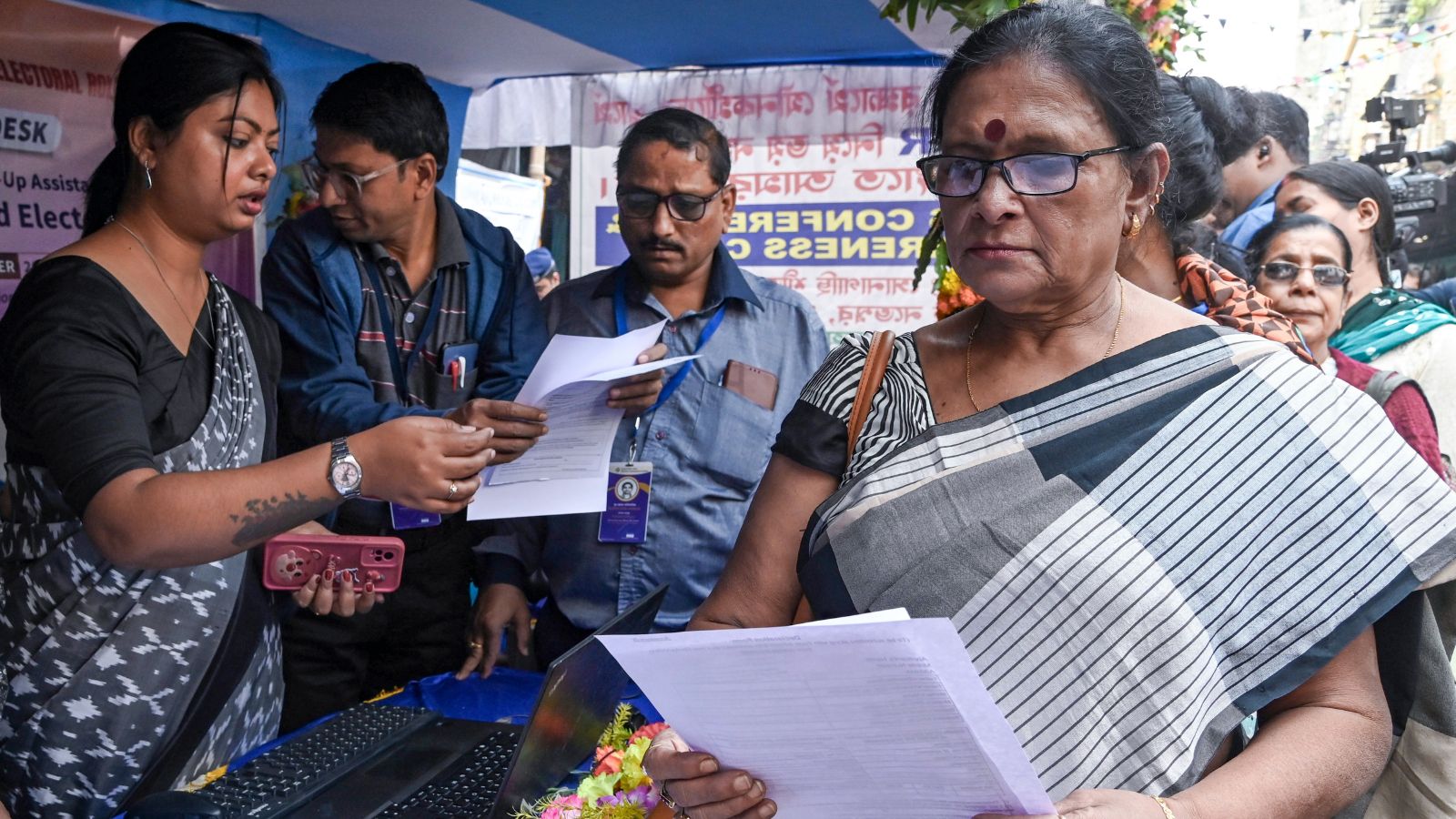
The draft electoral rolls of West Bengal published on Tuesday showed that the state’s electorate had shrunk from 7.66 crore to 7.08, with 58 lakh names struck off the voters’ list on grounds ranging from death and permanent migration to duplication and enumeration forms not being submitted.
An analysis of the draft rolls — provisional in nature and subject to change following the next phase of claims and objections — shows that Assembly seats with a sizable number of Hindi speakers are among the top 10 constituencies that saw the most deletions, ranging from 15%-36% of the electorate. In contrast, several Muslim-dominated constituencies saw a marginal number of deletions.
Assembly constituencies in and around Kolkata have also seen a large number of deletions, with the Kolkata North and Kolkata South districts registering the most deletions at 25.92% and 23.82%, respectively.
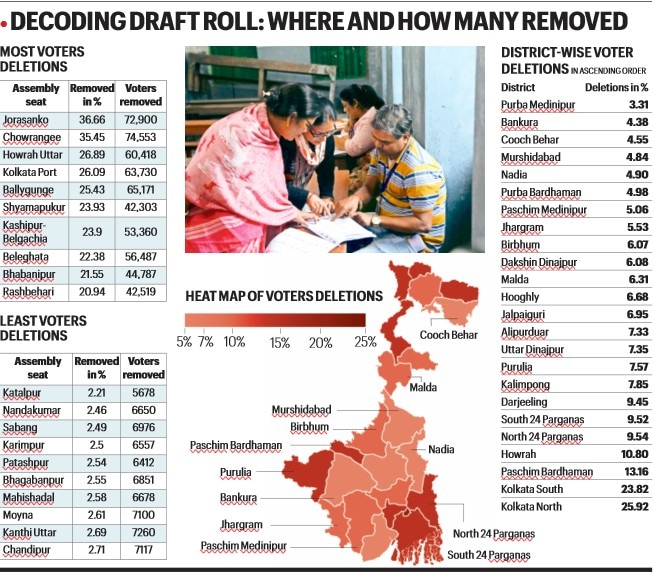
Among the 10 seats with the most deletions are Jorasanko (36.66% of the electorate removed), Chowringhee (35.45%), Kolkata Port (26.09%), which is the constituency of TMC leader and Kolkata Mayor Firhad Hakim, and Chief Minister Mamata Banerjee’s constituency Bhabanipur (21.55%). These constituencies in Kolkata have a significant Hindi-speaking population and though the TMC won all in the 2021 Assembly polls and led in the 2024 Lok Sabha polls, the BJP has been attempting to expand its base there.
Constituencies where the BJP is a strong political force have also seen high deletion rates. These include Howrah Uttar (26.89% deletion); Asansol Dakshin (13.68%) and Asansol Uttar (14.71% )in Paschim Bardhaman district; and Barrackpore (19.01%) in North 24 Parganas district. Of these seats, though the BJP has an MLA only in Asansol Dakshin, it is just behind the TMC in the rest and has a robust organisational footprint in those constituencies.
Story continues below this ad
Constituencies dominated by the electorally influential Matua community, a key BJP voter base, also recorded significant deletions in the first phase. These include Kasba (17.95%) and Sonarpur Dakshin (11.29%) in South 24 Parganas district and Bongaon Uttar (9.71%) in North 24 Parganas.
Low deletions
Muslim-dominated Assembly seats have recorded marginal or negligible deletions. In Murshidabad and Malda districts, where Muslims comprise 66.3% and 51.6% of the population as per the 2011 Census, only 4.84% and 6.31% of the electorate have been struck off the electoral rolls. In none of the Assembly seats in these districts are the deletion figures crossed 10%.
In Murshidabad, constituencies such as Domkal (3.4%), Rejinagar (5.04%), and Shamsherganj (6.86%) did not see high deletion rates, while the number was low in a Muslim-dominated constituency such as Manikchowk in Malda (6.08%). Even before the Special Intensive Revision (SIR) exercise began, people had started queueing up outside local bodies and Block offices for identity documents and other papers.

In Uttar Dinajpur, with a 49.92% Muslim population as per the 2011 Census, minority-dominated seats such as Chopra (7.44%), Goalpokhar (7.03%), Islampur (8.17%), and Chakulia (8.55%) have not seen high deletions. This pattern also holds in Muslim-dominated constituencies such as Hassan (4.95%) and Nanur (5.24%) in Birbhum district.
“The BJP’s narrative stands on lies. The Centre went for SIR before the Census. Through the Census, the real truth would have come to the limelight. The draft rolls show that people from Uttar Pradesh and Bihar are in Bengal, not infiltrators from Bangladesh,” said TMC spokesperson Arup Chakraborty.
Senior BJP leader and former state president Rahul Sinha alleged that Booth Level Officers had not been able to work impartially and independently due to pressure from the TMC. “We have already brought this to the notice of the Election Commission,” he told The Indian Express.
Former MP and CPI(M) leader Sujan Chakraborty said the high deletion rates in constituencies with sizable numbers of Hindi speakers could be because migrant workers from Bihar and Uttar Pradesh live there and they “may have chosen to keep their names in electoral rolls in their home states”. “I have been saying that the SIR will put poor Hindus into trouble much more than poor Muslims,” he added.
Kolkata-based researcher Sabir Ahamed, who is attached to the Pratichi Trust, said the preliminary data had deflated the political narrative of “infiltration”. “West Bengal has been a destination of several migrants from neighbouring states such as Bihar and UP for years. They have been living here for generations and they may have opted for their native place because that is tied to their primary identity and land. Hence, we see the higher deletions in Hindi-speaking areas,” he said.
“The analysis indicates that Muslims are less likely to be affected by voter mapping issues because most have the required documents. If the SIR leads to exclusions, it will not be Muslims who are hit the hardest. The data shows Matuas and the non-Bengali migrant labour population are likely to face the maximum exclusion, as they are disproportionately represented among unmapped voters,” said Ashin Chakraborty, a researcher at a Kolkata-based public policy research institute.