
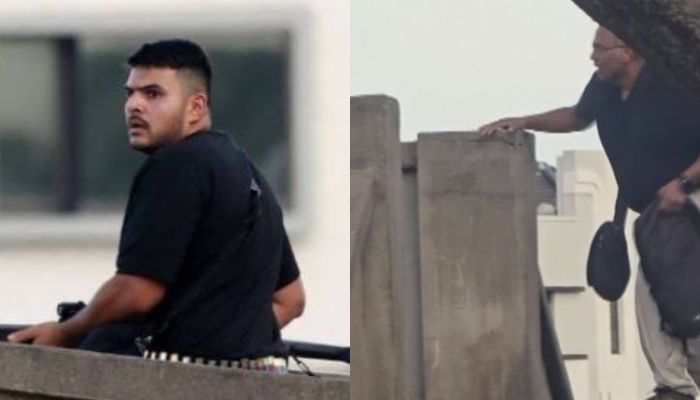
On 14th December, Pakistani origin Naveed Akram and his father Sajid Akram opened fire at a Jewish Hanukkah celebration at Bondi Beach in Sydney, Australia. This was one of the deadliest terrorist attacks Australia has witnessed in decades. The antisemitic terror attack left 15 innocent people dead, including a 10 year old girl, and injured dozens more. Australian authorities have formally declared the massacre a terrorist incident. The Prime Minister of Australia, Anthony Albanese, has described it as “evil antisemitism and terrorism on our shores”.
The incident took place during a public Hanukkah event organised by Chabad of Bondi. Around 1,000 people were present at the time of the attack. Many of them were families and children. Bondi Beach, one of Australia’s most iconic public spaces, was turned into a killing ground in a matter of minutes.
The second shooter has been identified as the 50-year-old father of Naveed Akram (the shooter who was identified earlier today). The father’s name is Sajid Akram and he was in Australia on a tourist visa. They are from Pakistan. The father had a license for 6 firearms, all of… pic.twitter.com/5w7vs39jrC
— Adam Milstein (@AdamMilstein) December 14, 2025
How the terror attack unfolded at Bondi Beach
The attack took place at around 6:47 pm local time. New South Wales Police received emergency calls reporting multiple gunshots near Archer Park, which is adjacent to Bondi Beach. The area was crowded due to the Hanukkah event titled “Chanuka by the Sea 2025”.
Within minutes, police issued public alerts urging people to take shelter and stay away from the beach. Videos of the incident showing hundreds of people screaming and fleeing across the beach and nearby streets went viral on social media.
Later, videos verified by multiple media outlets showed the terrorists firing from a small pedestrian bridge connecting the Campbell Parade car park to the beachfront. The elevated position gave them a clear line of sight over the gathered crowd.
In one widely circulated video, a bystander was seen confronting one of the terrorists, tackling him and momentarily disarming him. The terrorist retreated towards the bridge, where the second terrorist continued firing.
As soon as police arrived at the scene, they engaged the terrorists. Sajid was shot dead by police at the scene. On the other hand, Naveed sustained critical injuries and was taken into custody. He has been hospitalised under police guard.
Notably, Sajid Akram was a licensed firearms holder with a Category AB firearms licence. He legally owned six firearms, all of which police believe were used during the Bondi Beach terror attack. Four long arms, including a rifle and shotgun, were seized at the scene. Additional weapons were recovered from raids at properties linked to Sajid in Campsie and Bonnyrigg.
Civilian who ran towards gunfire and saved lives
The bystander who tackled one of the terrorists has been identified as Ahmed al Ahmed, who runs a fruit shop. He was shot during the confrontation and suffered bullet wounds to his arm and hand. New South Wales Premier Chris Minns praised his actions and called him a “genuine hero”. He stated that Ahmed’s heroic action saved many lives.
HEROIC: A civilian stopped one of the terrorists and took his gun, saving countless lives.
What a hero! pic.twitter.com/Ghtfg8HbxD
— Hen Mazzig (@HenMazzig) December 14, 2025
Death toll, injured victims, and children among casualties
According to the New South Wales Police, 15 people were killed in the terrorist attack. The victims ranged in age from 10 to 87 years old. Among the dead was a 10 year old girl, whose death sparked intense public outrage in the country.
At least 42 people were hospitalised with injuries. Several of them are critical. Four children were transferred to Sydney Children’s Hospital. Authorities have not clarified whether the deceased child was among those transferred earlier.
Two police officers were also shot while responding to the attack and were initially reported to be in serious to near critical condition.
Terrorist links, IS flags, and prior intelligence scrutiny
Investigators recovered improvised explosive devices and two Islamic State flags from a car linked to the terrorists. One flag was reportedly displayed on the vehicle’s bonnet. Prime Minister Anthony Albanese confirmed that Naveed Akram had been examined by ASIO in 2019 due to his associations with individuals linked to extremist networks. He was investigated for six months and assessed at the time as not posing an imminent threat.
According to media reports, Naveed had connections to a Sydney based Islamic State cell and was allegedly associated with Isaak El Matari, an IS operative jailed in 2019 for plotting an attack in Australia.
Naveed Akram’s background and radical trajectory
Former colleagues of Naveed told Australian media that he had worked as a bricklayer across multiple Sydney sites. He was known as a quiet but odd individual. He was described as hardworking but socially isolated. Notably, they said Naveed had an interest in hunting and firearms.
A former co worker stated that Naveed often spoke about shooting rabbits and game in rural New South Wales. Although authorities have not confirmed that Naveed held a firearms licence himself, reports suggest he had access to weapons through his father.
International condemnation and diplomatic responses
The terror attack prompted swift condemnation from global leaders. Israeli President Isaac Herzog described it as a cruel antisemitic attack on Jews.
Our hearts go out to our Jewish sisters and brothers in Sydney who have been attacked by vile terrorists as they went to light the first candle of Chanukah.
I just spoke to David Ossip, the President of the NSW Jewish Board of Deputies, who was speaking at the event as the… pic.twitter.com/9SivHY0Hep
— יצחק הרצוג Isaac Herzog (@Isaac_Herzog) December 14, 2025
while Israeli Prime Minister Benjamin Netanyahu accused Western governments of allowing antisemitism to fester through political silence.
Antisemitism is a cancer. pic.twitter.com/oz44ixjpAP
— Benjamin Netanyahu – בנימין נתניהו (@netanyahu) December 14, 2025
In a post on X, Prime Minister Narendra Modi said, “Strongly condemn the ghastly terrorist attack carried out today at Bondi Beach, Australia, targeting people celebrating the first day of the Jewish festival of Hanukkah. On behalf of the people of India, I extend my sincere condolences to the families who lost their loved ones. We stand in solidarity with the people of Australia in this hour of grief. India has zero tolerance towards terrorism and supports the fight against all forms and manifestations of terrorism.”
Strongly condemn the ghastly terrorist attack carried out today at Bondi Beach, Australia, targeting people celebrating the first day of the Jewish festival of Hanukkah. On behalf of the people of India, I extend my sincere condolences to the families who lost their loved ones.…
— Narendra Modi (@narendramodi) December 14, 2025
France’s foreign minister confirmed the death of French citizen Dan Elkayam and expressed solidarity with Australia’s Jewish community. King Charles, Australia’s head of state, said he was appalled and saddened by the antisemitic terrorist violence.
C’est avec une immense tristesse que nous avons appris que notre compatriote Dan Elkayam compterait parmi les victimes de l’attaque terroriste abjecte qui a frappé les familles juives rassemblées sur la plage de Bondi à Sydney, au premier jour de Hanouka.
Nous pleurons avec sa…
— Jean-Noël Barrot (@jnbarrot) December 14, 2025
Political fallout and calls for tougher laws
Prime Minister Albanese stated that the Australian government was prepared to deploy all available resources to combat antisemitism and terrorism. He also indicated openness to tightening gun laws if investigations reveal systemic weaknesses.
Home Affairs Minister Tony Burke confirmed that Naveed Akram was Australian born, while his father had entered Australia on a student visa in 1998, later transitioning to a partner visa and resident return visas. These disclosures have fuelled political debate over long term monitoring, radicalisation, and security vetting.
Opposition leaders have demanded parliamentary briefings on intelligence lapses, firearms licensing processes, and counter extremism frameworks, warning that the Bondi attack must not be treated as an isolated failure.
What comes next
The area has been cordoned off as police continue forensic sweeps and further investigations into the incident. Authorities are examining intelligence failures, firearms licensing processes, and whether information held by federal agencies was adequately shared with state police.
New South Wales Premier Chris Minns has signalled likely changes to gun laws, while federal authorities have vowed to deploy all available resources to combat antisemitism.
Minns acknowledged that it was too early to determine whether intelligence held by federal agencies should have been shared more extensively with state police. However, the scale and ideological nature of the attack have renewed debate over how threat assessments are conducted, closed, and revisited over time.