
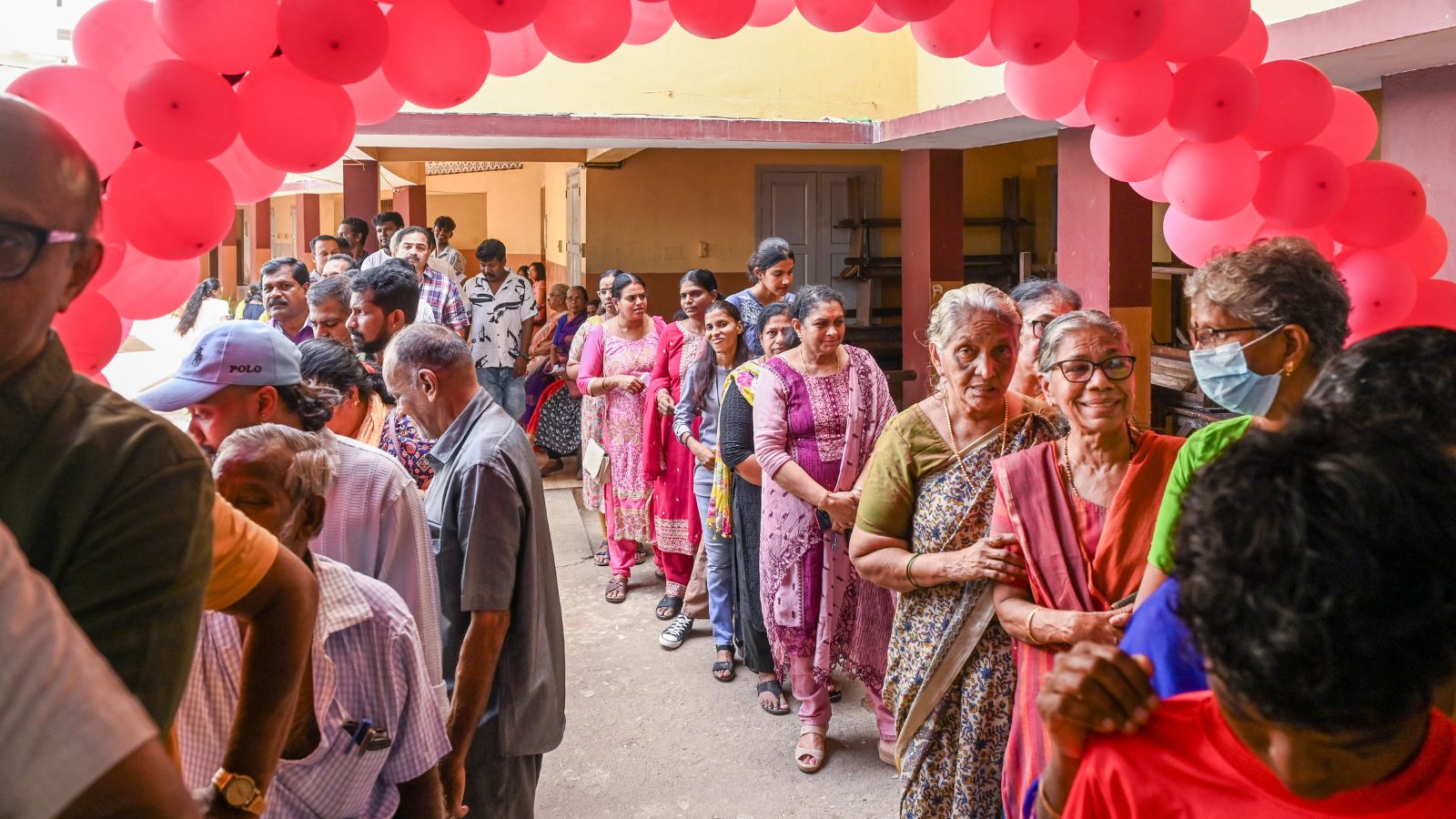
In an indicator of shifting sands in Kerala’s political landscape, the Congress-led United Democratic Front (UDF), the state’s primary Opposition, secured victory in the crucial local body elections ahead of the state Assembly elections due in April next year. Many rural and urban bodies in the incumbent CPI(M)-led Left Democratic Front (LDF)’s citadels, which had weathered repeated electoral challenges, have been captured by the UDF this time.
The LDF, which has been in power in the state since 2016 and ruled a majority of local bodies for a decade, faced a setback just as it launched its campaign to seek a third consecutive term in the forthcoming Assembly polls.
The LDF got an edge in seven of 14 district panchayats. In the 2020 local body polls, however, the ruling alliance had won 11 district panchayats.
From its traditional vote banks looking for alternatives to its failures to counter the Congress and the BJP’s narratives around scandals, the Left has found itself on the backfoot now due to various reasons. Here is a look at five such factors.
Sabarimala gold scandal
Among the issues that seemed to have worked against the Left, mainly in central and southern Kerala where the CPI(M) has had a strong Hindu vote base, is the alleged gold theft from the Sabarimala temple, a case in which one senior party leader has been arrested. Both the Congress and the BJP had played up the scandal during the local body election campaign.
Though the CPI(M) had invoked the Congress’s support from the right-wing Jamaat-e-Islami in a bid to retain its own Hindu vote bank, with Chief Minister Pinarayi Vijayan repeatedly raising this issue in his rallies and press conferences, the Congress countered it with its claims that the CPI(M) itself had got the support of the Jamaat-e-Islami for decades until 2019.
Lacklustre Left campaign
The Left mainly campaigned on its development and welfare planks, touting its achievements over the last decade in power, from increasing the monthly pensions to Rs 2,000 for 49 lakh beneficiaries to the introduction of monthly assistance of Rs 1,000 for women from below-poverty-line (BPL) families.
However, while its welfare schemes launched during the Covid-19 pandemic had helped the LDF win in the 2020 local body and 2021 Assembly elections, they failed to resonate with voters in these polls.
Many of the Vijayan government’s flagship interventions, including eradication of extreme poverty, waste management and a housing scheme for the poor, were implemented through the local bodies, but those improvements in the quality of life did not come to the Left’s rescue in these elections.
Alienation of Muslim voters
The CPI(M) suffered a blow in Muslim-dominated areas, mainly due to the impression that it had pulled back in its fight against the Hindutva agenda, which earned the Left the support of minority communities. In particular, controversies including over the PM-SHRI (Pradhan Mantri Schools for Rising India), a Central programme that the Kerala government joined after years of pushing against it, raised suspicions about the CPI(M)’s stand against the Sangh Parivar.
And when prominent Hindu leader Vellappally Natesan, general secretary of the social organisation Sree Narayana Dharma Paripalana (SNDP) Yogam, targeted Muslims in the minority community-dominated Malappuram district and claimed that “backward communities cannot breathe freely” in the district, Vijayan and the CPI(M)’s silence was seen as a stance for political gains. Natesan’s attack against UDF constituent Indian Union Muslim League (IUML) also did not sit well with Muslim voters in north Kerala.
‘Switch’ of Christian vote
The Christian vote in central Kerala, which has been divided between the Congress, CPI(M) and BJP in recent elections, seemed to rally behind Congress in these local body elections.
In the 2020 local body and 2021 Assembly elections, the UDF had lost central Kerala after regional Christian-oriented party Kerala Congress (M) joined the LDF. This time, even though the Congress had no prominent central Kerala Christian faces, the party managed to win back the community. The BJP, with 15% of its candidates coming from the community, also saw its Christian outreach fail to pay dividends.
Left ‘anti-incumbency’
After nearly 10 years in power, the Vijayan government seems to be facing “apathy” from sections of voters. The CPI(M)’s recently launched social media campaign heralding a third consecutive Vijayan regime as a “certainty” also seems to have backfired in the local body polls.
The government has also faced backlash over rising prices. Kerala has repeatedly recorded high inflation rates, which have pushed up the prices of essential items. Government aid had helped the Left to win over the public during the pandemic. But now, the government, which pushed for mega projects and investments, seemed to have overlooked the crisis prevailing among low-income working-class households engaged in traditional sectors like cashew and coir production.
Another significant issue has been the rising incidence of human-animal conflict. A quarter of the 941 village panchayats in Kerala have suffered wildlife attacks, which the Left government has been unable to resolve effectively.