
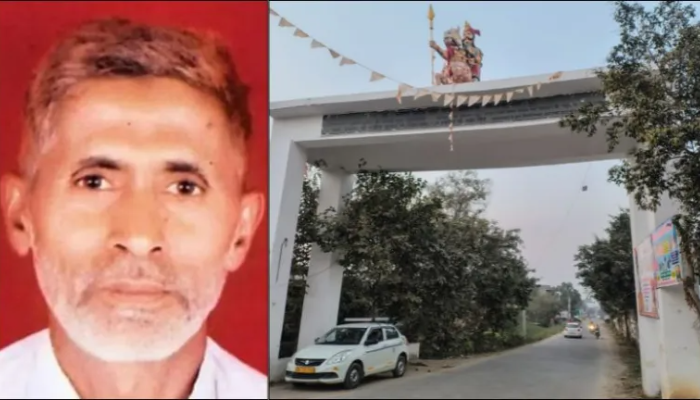
The Bisahda village in Dadri of Uttar Pradesh, has once again captured media attention after Yogi government submitted a petition to the court seeking the withdrawal of cases against all 18 individuals accused in the Akhlaq murder case. The development has instilled a sense of hope in the families of the accused for potential justice. However, the family of Akhlaq has raised concerns regarding the government’s action. On 12th December (Friday), the district court is scheduled to deliberate on the matter of whether all charges against the accused will be dismissed.
Hence, OpIndia team visited the village which is 50 kilometers from Delhi, a day earlier. Its entrance is marked by a statue of Maharana Pratap and a sign with an image of King Mihir Bhoj welcoming visitors to the “sacred area of Bisahda.” We subsequently arrived at the location where Mohammad Akhlaq had killed the cow and discarded its remnants onto a dung heap by the roadside. However, no one was willing to talk to us. We then proceeded to the residence of Arun Sisodia, a veterinarian situated 50 meters from Akhlaq’s home, who had recognised the remains as those of a cow, drawing upon his expertise.
Sisodia stated that Shivam, a resident of the village, witnessed Akhlaq discarding a polythene bag on the roadside during the night. “Upon inspecting the bag, I discovered the remains (mouth and ears) of a Friesian calf,” Sisodia highlighted. He added, “My sole offense was utilising my 21 years of experience to recognise the parts, a fact that was soon validated by two laboratories.”
Troubled families narrate their ordeal
Sisodia further clarified that the police terrorised the village, unjustly accusing innocent people for political reasons after the incident. “This was a blunder by the Akhilesh government. As a result, I was imprisoned for 23 months. Everything fell apart. I used to make 3-4 thousand rupees each day by treating animals, but my business collapsed after my incarceration. Now, we are left with only one hope: CM Yogi, who we trust can bring us justice,” he mentioned.
Afterward, OpIndia discovered that Bharatiya Janata Party leader Sanjay Rana’s son Vishal Rana, who had been identified as the primary suspect in the case, also departed from the village. The house was locked. The window grills exhibited signs of rust and the ceiling had caved in. The dilapidated place symbolised the anguish of a family in distress. Villagers voiced that Sanjay’s political aspirations effectively ended following the matter.
We then interviewed Yogendra Sharma, the father of Puneet Sharma, who is also implicated in the case. He explained that his home was situated approximately 400 meters from the location of the instance. His son was sleeping on the roof at the time and rushed downstairs after he learnt about the situation. However, bystanders prevented him from approaching the site. Nevertheless, Puneet was booked and spent nearly 17 months behind bars.
According to Yogendra, Akhlaq’s family akin to his, already knew that the young man was not part of the incident, yet he was wrongfully charged due to political rivalry. He added, “At this point, the Yogi government has acknowledged our ordeal and the court is our ultimate hope.”
Media depicted Hindus as terrorists
Former village head Rakesh Rana conveyed that the government has yet to provide any proof regarding who was responsible for Akhlaq’s death. “The accused were named by individuals due to personal oppositions. The Samajwadi Party government saw the incident from a communal viewpoint, siding against the Hindus,” he pointed out.
Rakesh recounted, “The intimidation by that government’s police was such that vegetable vendors refused to enter the hamlet and many people fled out of fear of the cops. At that time, the media portrayed us as terrorists, as if we were oppressing Muslims, while the genuine feelings of the villagers were never represented.”
“Akhlaq’s family has been part of the village for generations. The names of the accused were changed despite this which revealed a profound conspiracy. Our children suffered torture in prison. Ravi’s death in custody was a direct result of this,” he complained. Rakesh noted that the previous governments had retracted cases even against terrorists while these were just innocent individuals concerning the withdrawal of the case.
Sanjeev Rana, living about 150 meters from Akhlaq’s home, stated that the families of all the accused have lost their way. “After Akhlaq’s passing, the SP government was responsible for snuffing the life out of 20 families in the village. They are all like the living dead. The time has now arrived when ruler will battle ruler. The SP government favoured the Muslims, while the Yogi government will ensure justice for us Hindus,” he emphasised.
Akhlaq became a hardliner following his trip to Pakistan
Veterinarian Sisodia, who is also Akhlaq’s neighbour conveyed that Akhlaq’s family was exceptionally kind. He often visited their home and even recalled having a photograph of Akhlaq in his wedding album. He conveyed that Akhlaq’s behaviour transformed after returning from Pakistan and several people associated with Jamaat began visiting his house. Sisodia added that Akhlaq even provided these persons with food and his radicalisation intensified during this period.

Sanjeev mentioned that Akhlaq was a blacksmith. “He was once engaged in a conversation that raised suspicions. When a person expressed concern and asked to see his mobile phone, he refused and instead threw it into a fire furnace. Akhlaq had become more radicalised after interacting with Jamaatis and his growing affection for Pakistan was becoming clear,” Sanjeev remembered.
Hindus repeatedly demonstrated spirit of brotherhood.
Sisodia pointed out that Hindus played a crucial role in preventing the divorce of Akhlaq’s brother Mohammad Afzal’s daughter, Kamar Jahan and they united to support her. Rakesh Rana likewise stated that a sense of brotherhood always existed in the village. He added, “Hindus donated land for the mosque and Eidgah in the village and also contributed to their construction.”
“The two daughters of a destitute Muslim hakim were wed by Hindus in the village, even after Akhlaq’a death,” Rakesh mentioned. He asserted that no untoward event occurred in the village either before or after Akhlaq died. He stated, “The deceased’s siblings did not even sustain a scratch.”
Sanjeev stated that Akhlaq’s family was very close with Hindus but he perpetrated a grave offense that severely damaged the village’s sense of unity.
On 28th September 2015, Akhlaq, who lived in Bisahda village within the Dadri Assembly constituency, slaughtered a cow following Eid. This act incited a furious mob of thousands who forcibly removed Akhlaq and his son Danish from their residence and assaulted them. The injured Akhlaq succumbed to his wounds while receiving medical care at the hospital. The cow slaughter incident was initially regarded as a fabrication, but laboratory tests later verified that the meat disposed of by Akhlaq was, in fact, cow meat.