
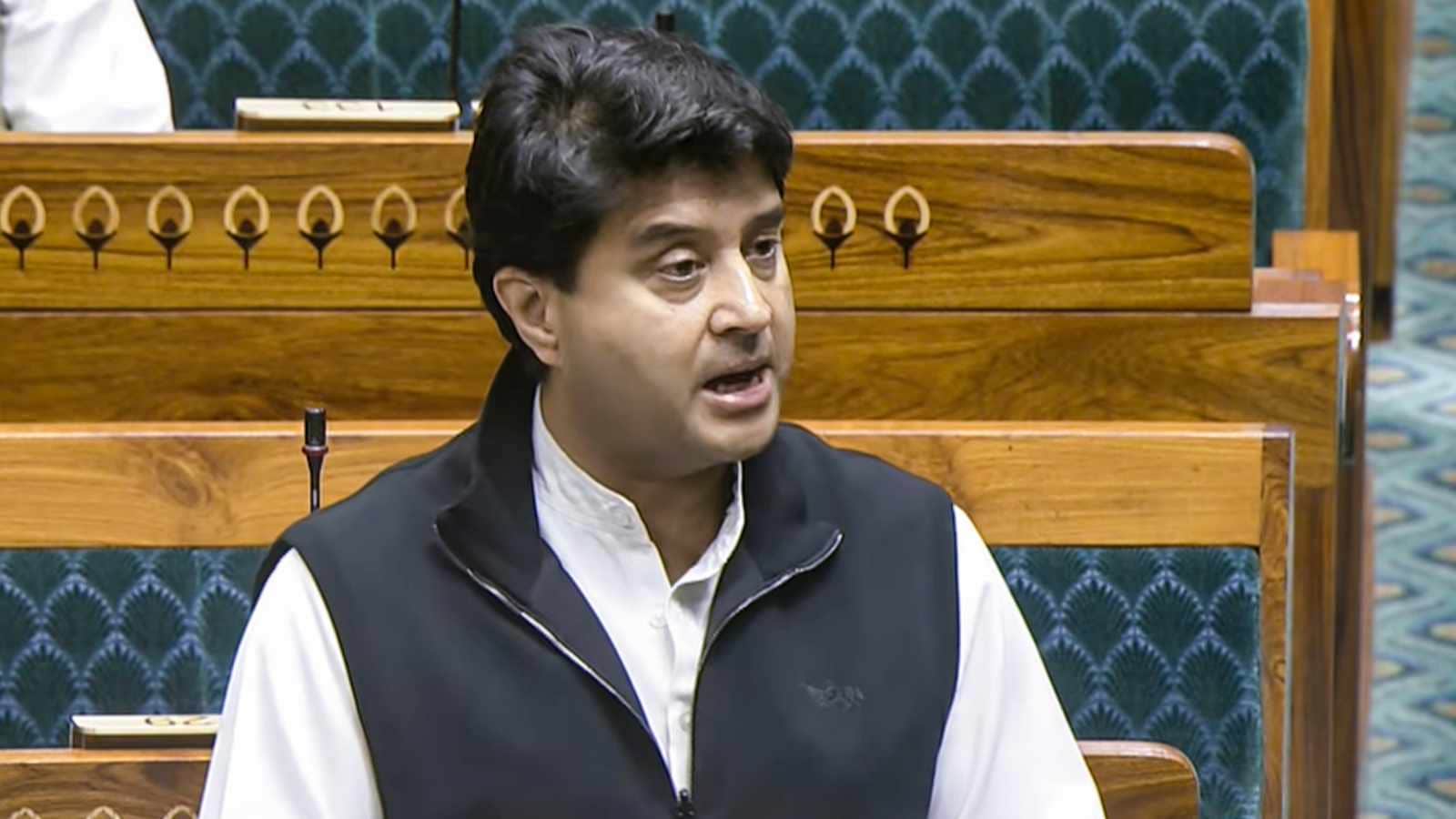
On November 26, a tribal woman died after waiting in a queue for two consecutive days to obtain fertiliser from a distribution centre in Guna in Madhya Pradesh. The BJP’s Guna MP and Union Communications Minister, Jyotiraditya Scindia, immediately swung into action. He publicly reprimanded local officials, inspected such distribution centres himself, and initiated measures to improve the fertiliser supply system while ensuring more transparency in it.
It was not Scindia’s first intervention in the administration matters in Gwalior-Chambal in the BJP-ruled state. The region has immense political significance for both the BJP and Scindia, who is the scion of the erstwhile Gwalior ruling family.
Recently, Scindia set local authorities in motion after receiving complaints of illegal gravel mining in Malhargarh, Bilheru, and Bhedka Ghat in the Mungaoli Assembly constituency in the belt. Following his intervention, the District Collector and the Superintendent of Police quickly constituted a team that seized seven dumpers, three excavator machines, two tractor-trolleys, and other equipment, effectively halting the illicit mining operations.
Scindia had not been highly visible in the region since his victory in his Guna bastion in the 2024 Lok Sabha elections. But in September this year, his unannounced appearance at a review meeting of development works at the neighbouring Gwalior Collectorate startled both his allies and rivals. His presence underscored a renewed political assertiveness, while the conspicuous absence of the BJP’s Gwalior MP Bharat Singh Kushwah fuelled Congress allegations that the old tussle between veteran BJP leaders and Scindia loyalists remained unresolved.
According to leaders close to the minister, with Chief Minister Mohan Yadav aligned with him, Scindia has now been looking to consolidate his influence in a region where rival BJP factions—including those affiliated to Assembly Speaker Narendra Singh Tomar—also compete for dominance.
Scindia’s political trajectory in the region has been marked by dramatic swings. In 2019, then a Congress heavyweight, he lost the Guna seat to BJP candidate K P Yadav. Months later, in 2020, he defected to the BJP with his 22 loyalist Congress MLAs, toppling the then Kamal Nath-led party government and paving the way for the BJP’s return to power in the state. In 2024, however, he returned to register a huge win in Guna, a constituency long associated with his family.
“At one time, Scindia ji was criticised for being aloof from the public and having a ‘Maharaja mentality’. Under the BJP, he has worked to change that image. He now makes it a point to maintain constant contact with people, supervise development work, and publicly reprimand officials when necessary to send a message that he stands with the people,” a leader affiliated to him said. He added that the Scindia had been present in the belt during the floods that devastated crops and also amidst the fertiliser shortages, and that after the tribal woman’s death, Scindia suspended the official who failed to issue her death certificate, personally handing the document to the grieving family.
At the same time, Scindia has been making announcements for a slew of new projects in his constituency. In total, he is pushing nearly Rs 200 crore worth of development initiatives—one of the most concentrated infrastructure drives the region has seen in years. These projects include railway overbridges, sports complexes, city forests, public buildings, and heritage structures.
At the heart of this infrastructure push is an effort to resolve transportation bottlenecks that have plagued the region for decades. Two major railway overbridges (RoBs) in Singhavasa are the most expensive components: the Panchmukhi Hanuman Temple RoB, costing Rs 20.64 crore, and the Mavan RoB worth Rs 30.42 crore. Together, these aim to eliminate chronic waterlogging, dangerous underpasses, and heavy-vehicle congestion that have long disrupted the economic corridor connecting the region to Uttar Pradesh, Rajasthan, and other parts of Madhya Pradesh.
Scindia also facilitated the construction of the Khokar bridge on the Niwari river—an 8m by 15m slab culvert with a 120-metre approach road—benefitting more than 16,000 residents of 26 villages who previously faced severe mobility challenges during the monsoon. In Hathikundan, where 450 residents were forced to take a 6 km detour every rainy season due to muddy roads, Scindia’s recent inauguration of the Sirsi–Hathikundan road finally resolved a perennial problem.
The power supply issues, among chronic grievances of locals, have also been key to Scindia’s agenda. His development package includes four new 33/11 KVA substations designed to provide stable, uninterrupted electricity—critical for irrigation, cold storage, and small-scale agro-processing in this predominantly agricultural region.
In Gwalior, too, Scindia has deployed a dedicated monitoring team to revive long-stalled development works. Projects such as the Ambedkar Memorial—pending for nearly 18 months—the station redevelopment plan, elevated road works, and repairs of extensively damaged roads are now being actively reviewed. “The roads were graded into three categories based on their condition to enable immediate response. There are regular reviews on land acquisition and bottlenecks, and Scindia personally sets targets,” a BJP leader said.
Other ongoing projects include the Guna Sports Complex, a Rs 16.93 crore facility spread over 6.57 hectares; the city’s first forest under the Green India Mission; multiple new school buildings; and a dedicated bhavan for journalists.